Art Deco and Retro Vintage Rings Styled for Today's Modern Wearer
Art Deco rings read as boldly modern a century later; knowing what separates a platinum Asscher-cut original from a Retro gold piece changes how you shop and wear both.

Pick up an authentic Art Deco ring and you're holding a small archive. The platinum is cool and dense beneath your fingers, the stone cut with a precision that predates computer-aided design, the milgrain edges so fine they look engraved by a watchmaker rather than a jeweler. These pieces, which rose to prominence during the 1920s and 1930s, are, as Greenwich St. Jewelers puts it, "true collectibles, often dating back nearly a century." That century of distance, rather than diminishing their appeal, has made them more relevant: the architectural severity that once signaled modernity now reads as the kind of restraint that contemporary dressers actively seek.
Understanding what you're looking at, and what to look for, is the first step toward wearing these rings with intention rather than accident.
Reading the Ring: Key Visual Identifiers for Art Deco
Art Deco jewelry was a deliberate break from what came before it. Where Art Nouveau leaned into organic curves, botanical forms, and sinuous femininity, Art Deco leaned hard the other way: sharp lines, streamlined silhouettes, and architectural motifs drawn from the same visual vocabulary as the Chrysler Building and the Paris Exposition. Greenwich St. Jewelers describes the era as "a design era defined by innovation, contrast, and cosmopolitan energy," one that "blends bold geometry, symmetry, and rich materials, reflecting the modernity of the time."
In a ring, that philosophy translates into a set of specific, identifiable features.
Metals
Platinum was the non-negotiable material of the Art Deco period. Its strength allowed craftsmen to create settings of extraordinary delicacy, with fine openwork and filigree that would have been structurally impossible in gold. Greenwich St. Jewelers notes that platinum was "valued for its strength and clean finish," and that clean finish, bright white and unoxidized even after decades, is itself a dating cue. If a ring is presented as genuine Art Deco and the setting is yellow gold, look more carefully; gold became dominant in fine jewelry only in the 1940s, partly because platinum was redirected to military use during World War II.
Stone Cuts
The geometry of Art Deco extends directly into its diamonds. Geometric diamond cuts were central to the aesthetic, and the period produced, or made fashionable, several cuts that remain among the most sought-after today: the emerald cut, with its long rectangular facets and stepped pavilion; the Asscher cut, its square variant with a distinctive windmill-pattern reflection; and the baguette, a narrow rectangular stone used extensively as a side stone to frame central gems. Alongside these, the earlier old-mine cut and European cut diamonds, with their high crowns, small tables, and soft, candlelit sparkle, appear frequently in genuine antique pieces, reflecting the transition between Victorian diamond-cutting practices and the more geometric Deco sensibility.
If you are trying to date a ring by its stone alone, a European or old-mine cut suggests late Victorian to early Art Deco; a crisp Asscher or emerald cut, often set in a long, stepped mount, places you more firmly in the 1920s and 1930s.
Surface Motifs and Design Grammar
Beyond metals and stones, the surface of an Art Deco ring tells its own story. Filigree, the delicate lacework of twisted wire fused into openwork patterns, appears on both the gallery and the shoulders of platinum mounts. Stepped edges, chevrons, fan shapes, and repeating geometric patterns echo the decorative vocabulary of Art Deco architecture and textile design. These aren't ornamental afterthoughts; they are structurally integrated elements, often executed with a precision that makes them difficult to replicate convincingly in contemporary mass production.
For accent stones, the era favored high-contrast chromatic combinations: black onyx against white diamonds, the deep green of jade inlaid into platinum, and velvety blue sapphires calibré-cut to fit precisely into geometric channels.
Art Deco Versus Retro: The Critical Distinction
Knowing that a ring is "vintage" is only the beginning. The Art Deco period, roughly 1920 to 1935, is immediately followed by what collectors call the Retro period, spanning the late 1930s through the 1940s, and the differences between them are significant for both aesthetics and value. Where Art Deco is characterized by platinum, geometric precision, and the chromatic austerity of diamonds against dark accent stones, Retro jewelry pivots decisively toward yellow and rose gold, larger and more sculptural forms, and a warmer, more theatrical sensibility. Wartime platinum restrictions drove jewelry makers toward gold, and the resulting pieces, often featuring bold scrollwork, ribbon bows, and large synthetic stones, carry an entirely different visual weight.
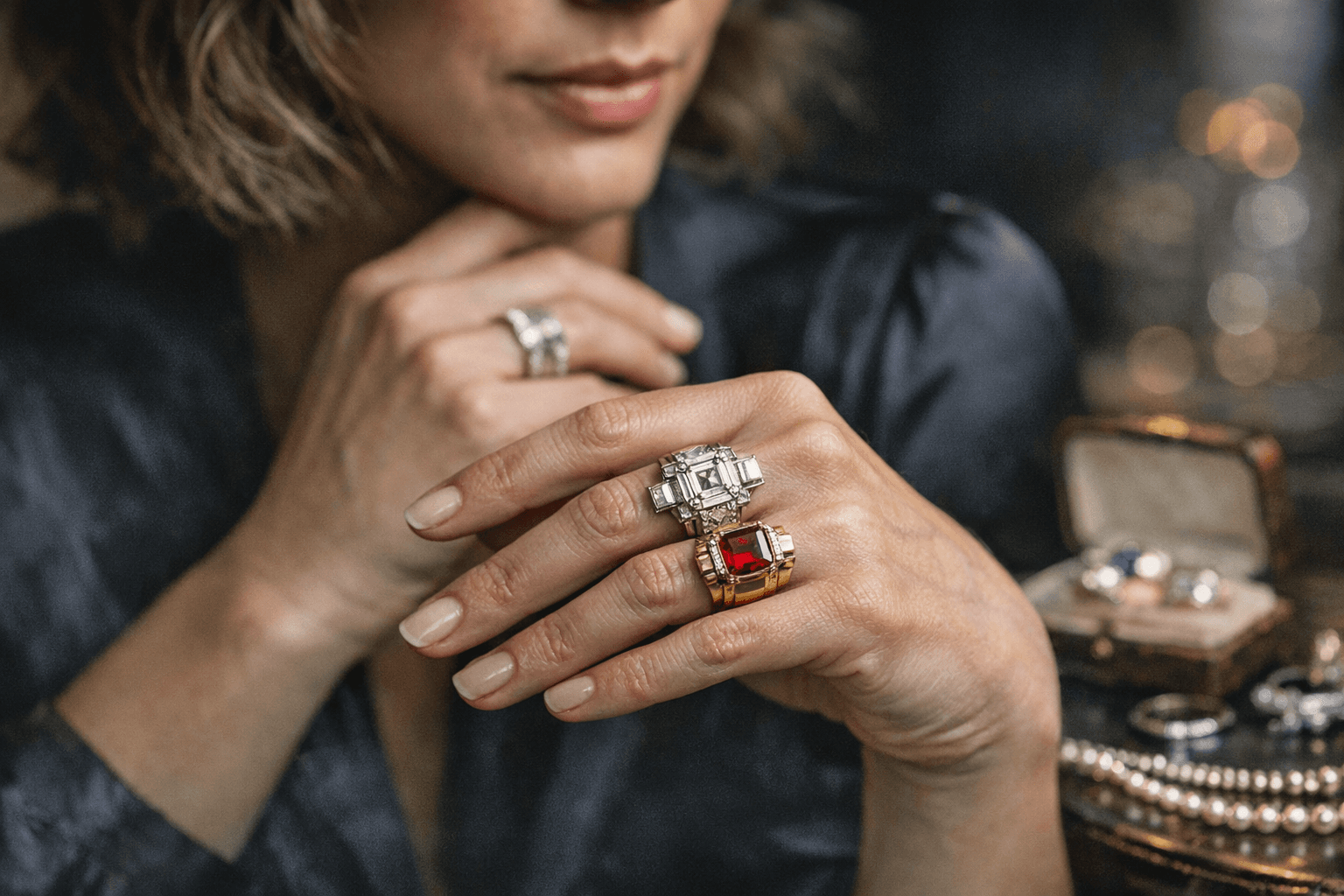
A ring offered as Art Deco but set in yellow gold with flowing, dimensional forms is almost certainly Retro, not Deco, and misidentifying the two is among the most common errors buyers make. Both periods produce genuinely beautiful jewelry; the distinction matters most when you are paying a premium for a specific era.
Authenticity, Rarity, and Where to Shop
Original Art Deco rings require collector-level engagement to find well. Reputable estate dealers, specialist auction houses, and antique jewelry shows are the primary sourcing channels; pieces come with varying degrees of provenance documentation, and the definition of "verified antique Art Deco" varies by seller. True vintage pieces can be rare or require collector-level sourcing, as Greenwich St. Jewelers notes, and buyers should approach any piece with a provenance question in mind: Is there documentation? Has a gemologist examined the metal and the cuts? Does the wear pattern on the platinum correspond to a century of use?
Greenwich St. Jewelers is transparent about their own position in this market: "It's worth noting that Greenwich St. Jewelers does not currently carry verified antique Art Deco jewelry. Instead, we curate a selection of thoughtfully designed Art Deco-inspired styles that channel the spirit of the era in modern, wearable forms." Their Grand Engagement Ring Setting, which "features sharp lines and a bold, structured silhouette that nods to Deco geometry," is an example of the contemporary Deco-inspired category that has grown significantly as demand for the original pieces outpaces supply.
This is an honest and increasingly common retail position. For buyers who want the Deco design language without the research burden of authenticating a century-old platinum piece, well-executed modern interpretations offer the same visual principles with the assurance of contemporary craftsmanship standards.
Styling Art Deco and Retro Rings for Today
The reason Art Deco rings translate so naturally to contemporary dress is that minimalism and architectural form never really left fashion. A stepped emerald-cut solitaire in platinum reads as cleanly now as it did in 1928, and it pairs as naturally with a tailored wool coat as it does with dressed-down denim. The ring does the work; it requires very little from the rest of the outfit.
A few principles for wearing these rings with confidence today:
- Let a single strong piece anchor the hand. Art Deco rings, with their geometric precision and high-contrast stones, compete with almost nothing else; stacking them aggressively dilutes the architectural effect that makes them worth wearing in the first place.
- Consider finger placement. An Asscher-cut ring with long baguette shoulders reads as longer on the finger; an old-mine cut in a more rounded mount sits differently. The geometry of the cut and mount should work with your hand's proportions, not against them.
- Mix-cut gemstone earrings or a structured pendant, the kinds of pieces Greenwich St. Jewelers specifically highlights as Deco-principle pieces, can extend the aesthetic from the hand to the whole look without requiring head-to-toe period dressing.
- For Retro pieces in rose or yellow gold, lean into the warmth: they sit beautifully against warm skin tones and pair naturally with earth-toned or cognac leather accessories.
The vocabulary of Art Deco, geometric lines, platinum precision, and stones cut to emphasize form over brilliance, turns out to be one of jewelry's most durable design languages. A ring that survived the twentieth century intact carries that durability in its very structure. Wearing it well is simply a matter of understanding what it is saying.
This article was produced by Prism’s automated news system from verified source data, official records, and press releases, then run through automated quality and moderation checks before publishing. The system is built and supervised by the people who set the standards it runs under. Read our full AI policy.
Did this article answer your question?