Art Jewelry Forum Spotlights Contemporary Works Repurposing Vintage Materials and Techniques
The Art Jewelry Forum's April 2026 "On Offer" roundup proves that the most compelling new work is being built on old bones, tracing today's material choices directly to pre-Columbian alloys and Arts & Crafts silver.
Where the Old Metal Lives
The Art Jewelry Forum's bi-monthly "On Offer" series has always functioned as something more than a gallery bulletin. Since the nonprofit's founding in 1997, its international network of member galleries has used the column to position contemporary art jewelry within a broader conversation, and the April 2026 installment is no exception. Three works in particular, each brokered through a different gallery on a different continent, reveal how the most rigorous makers working today are not simply referencing vintage traditions but physically inhabiting them: casting ancient alloys, reclaiming antique ornaments, and reaching for the specific material vocabulary of the Arts & Crafts movement. For the vintage-minded collector or dealer, this roundup functions as a field guide. Each piece offers a living specimen of techniques and materials that have thriving antecedents in the secondary market.
Peter Bauhuis and the Memory of Tumbaga
Few contemporary jewelers have made a more serious philosophical commitment to the archaeology of metal than Munich-based Peter Bauhuis. His work at Thereza Pedrosa Gallery in Asolo, northeastern Italy, exemplifies the practice he has built across decades: casting alloys that carry the history of human metallurgy in their composition. Tumbaga, the gold-copper alloy mastered by pre-Columbian cultures across Mesoamerica and South America, is not a material most Western goldsmiths reach for casually. Its warm, reddish cast and its resistance to rigid perfection make it an inherently talismanic substance, one that lends objects a feeling of excavation rather than manufacture.
Bauhuis trained at the Academy of Fine Arts in Munich under master goldsmith Otto Künzli, and the rigorous questioning of that lineage has never left his practice. He regularly creates his own alloys, producing surfaces that shift from matte white to pale green-yellow to deep orange depending on the metal's composition and oxidation, never removing the fine lines or visible traces left by the casting process. The result is jewelry that appears to have been unearthed rather than made. His ongoing Replika project takes this archaeology even further, proposing wearable rings that ask, openly and provocatively, whether an artist can pirate their own earlier work. That conceptual restlessness is what connects Bauhuis so directly to the pre-Columbian makers who worked tumbaga: in both cases, the alloy itself carries the argument.
For the vintage hunter, the lineage here is unmistakable. Pre-Columbian tumbaga objects, ranging from Muisca votive figures to Mixtec pendants, appear regularly at specialist auction houses and are increasingly documented in institutional collections. Search terms to refine your hunt: "tumbaga pendant," "pre-Columbian gold copper alloy," and "Mesoamerican cast gold." Provenance documentation and thermoluminescence testing certificates matter enormously in this category. Expect prices from a few hundred dollars for smaller decorative pieces to well into five figures for museum-attributed works, with the market rewarding documented archaeological context above surface beauty.
Carina Shoshtary and the Reclaimed Ornament
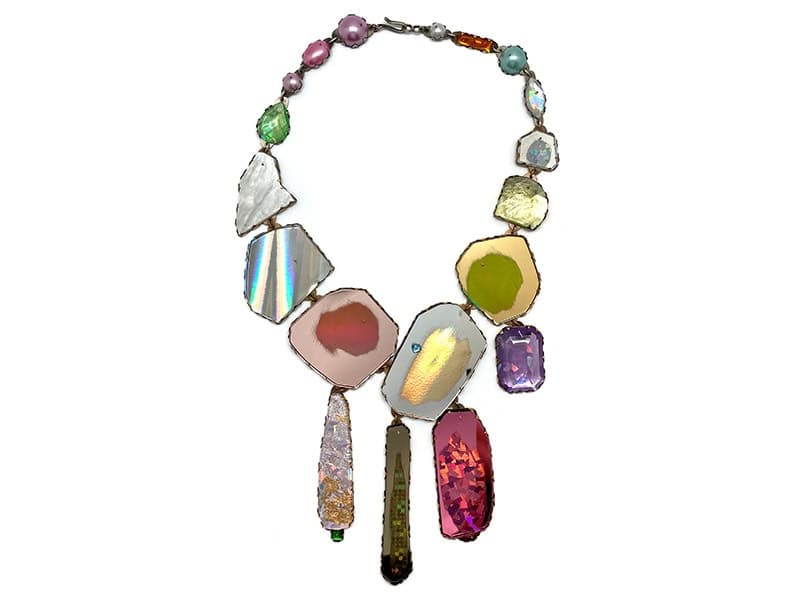
Where Bauhuis interrogates alloys, Carina Shoshtary interrogates the objects themselves. The Munich-born jeweler, who describes herself as "a kind of modern hunter-gatherer," constructs her mixed-media pieces from materials collected in her immediate surroundings, and the vintage elements woven through her earrings at Heidi Lowe Gallery are not decorative additions but structural arguments. Her practice insists that found and vintage components carry meaning that newly sourced materials cannot replicate: a patina, a prior use, a cultural context that inheres in the object itself.
Shoshtary's broader body of work demonstrates the sophistication of her material thinking. She navigates, as one account of her work puts it, "the space between the organic and the urban," incorporating glass, natural seeds, lacquer, paper, and coal alongside silver and vintage ornamental forms. The result is jewelry that reads simultaneously as contemporary sculpture and as an assemblage of memory. The vintage elements she incorporates are not restored or disguised; they remain legible, their age functioning as content.
The vintage lineage here belongs to the 1960s and 1970s studio jewelry movement, when a generation of makers on both sides of the Atlantic deliberately turned away from precious-stone conventions and toward found objects, organic materials, and anti-hierarchical craft. Artists like Arline Fisch in the United States and Susanna Heron in Britain brought assemblage logic into wearable form. For collectors hunting that generation's work, search "1970s studio jewelry found object," "craft revival brooch," and "art jewelry assemblage." Look for artist signatures and gallery provenance; much of the best work from this period was documented in small-run exhibition catalogs rather than through hallmarks. Secondary market prices for signed studio jewelry from this era range from roughly $200 for smaller earring-scale pieces to $2,000 and above for named artists with institutional exhibition histories.
Melanie Isverding and the Language of Silver, Enamel, and Stone
The brooch that Galeria Reverso in Lisbon presents by Melanie Isverding works in a material vocabulary that any serious student of the Arts & Crafts movement will recognize immediately: silver, enamel, hematite, and pearls. This is not a coincidence of taste. These four materials, combined in a single wearable object, constitute a direct inheritance from the reform jewelry of the 1880s through 1910s, when makers associated with the Guild of Handicraft, Liberty & Co.'s Cymric line, and the broader Arts & Crafts ethos rejected diamond-and-gold orthodoxy in favor of silverwork set with natural, opaque, and semi-precious stones.
Isverding's practice brings a distinctly contemporary conceptual charge to this material inheritance. She has spoken about the brooch as her preferred form precisely because of its dual nature: "I very much like to make brooches because they are more like objects or stand-alone pieces. I enjoy seeing them on the body, but I also appreciate when the object is strong enough that it is able to stand on its own." That tension between the worn and the displayed, between personal adornment and autonomous sculpture, was also central to Arts & Crafts jewelry, which aspired to elevate the applied arts to the status of fine art. Galeria Reverso, directed by Paula Crespo from a gallery housed in a Lisbon building covered with painted tiles, has long positioned itself as a platform for exactly this kind of work, contemporary pieces that carry theoretical weight without abandoning wearability.
Hematite is the detail most worth noting for vintage hunters. The iron-oxide mineral was widely used in Victorian and Arts & Crafts jewelry for its cool, almost metallic graphite luster, which reads as both understated and distinctly anti-commercial alongside the warm glow of enamel. Combined with pearls, whose cultivation Mikimoto perfected in the early twentieth century and whose use in Arts & Crafts pieces signaled natural luxury over gemological spectacle, the material combination places Isverding's work in direct dialogue with pieces being made in Birmingham and London more than a century ago.
Buying Guidance: Using Today's Work to Refine Yesterday's Search
The strategic advantage of following AJF's "On Offer" column as a collector is that it functions as a live index to vintage categories. When a contemporary maker commits seriously to a material, a technique, or a form, the vintage antecedents of that work become more legible, and often more findable, on the secondary market.
For hunting Arts & Crafts silver and enamel brooches in Isverding's tradition:
- Learn to read Birmingham assay marks: the anchor symbol denotes Birmingham, paired with date letters running in 20-year cycles. Pieces from 1890-1910 are the sweet spot for Arts & Crafts production.
- Search "Arts and Crafts brooch enamel silver," "Guild of Handicraft," "Liberty Cymric," and "Newlyn copper enamel" for the British tradition; "Wiener Werkstätte brooch" for the Viennese parallel.
- Hematite and pearl combination pieces in silver settings appear at regional auction houses regularly, often undervalued because they lack diamond-and-gold glamour. Expect $300-$1,500 for unsigned pieces, with attribution to known makers or guilds pushing prices to $5,000 and above.
For pre-Columbian tumbaga and cast alloy work in Bauhuis's tradition:
- Provenance is the primary valuation driver; pieces with documented collection history, including thermoluminescence reports and prior institutional ownership, command multiples over undocumented examples.
- Specialist houses including Sotheby's, Christie's, and Bonhams all hold regular pre-Columbian sales. Regional houses and estate sales occasionally surface pieces at lower entry points.
For 1970s studio jewelry in Shoshtary's found-object tradition:
- Exhibition catalogs from craft museums and galleries of that period, including those of the American Craft Museum and the Crafts Council in the UK, are the best research tools for attribution.
- Signed and documented pieces by artists who went on to academic careers or museum collection inclusion represent the strongest value proposition for long-term collectors.
The contemporary pieces AJF spotlights in April 2026 are priced as art: Bauhuis's work through Thereza Pedrosa Gallery runs to nearly €2,000 for a single ring, and Isverding and Shoshtary occupy comparable territory. But the vintage works they echo, equally rigorous in material thinking and often more rare, still trade at prices that reward the collector willing to do the archival homework. The contemporary market is pointing the direction; the secondary market still has the inventory.
Know something we missed? Have a correction or additional information?
Submit a Tip