Brooklyn Museum Deaccession Sale Brings Rare Institutional Provenance to Collectors
Brooklyn Museum's third deaccession in two years sent nearly 225 cataloged lots to Brunk Auctions, where institutional provenance met the open market on April 9.

Institutional documentation rarely follows a piece out of a museum's door intact. At Brunk Auctions in Asheville, North Carolina on April 9, it did: nearly 225 lots from the Brooklyn Museum's permanent collection entered the open market with accession records, exhibition histories, and curatorial notes attached, representing the museum's third major deaccession in two years.
Deaccession is the formal process by which museums release works from their permanent collections. It does not erase the record; it publishes it. Every acquisition note, provenance citation, and curator's notation travels with the object into private hands, creating a documentation chain that dealer attributions rarely match. The Brooklyn Museum has been deliberate about this. Following deaccessions of period artifacts in 2024 and tapestries in 2025, the April 9 sale concentrated on early American and Continental decorative arts, with material tracing additional provenance to the Garbisch, Garvan, and Amory Haskell private holdings. Director Anne Pasternak described the intent plainly: "Deaccessioning allows curators to refine and focus the collection, ensuring that we continue to display work that resonates and tells meaningful stories for our visitors." Proceeds support the museum's ongoing effort to convert spaces used for storage into active galleries, including expanded displays of Indigenous Arts and Arts of the Americas.
For collectors whose interests extend to metalwork, decorative accessories, and design-period objects, several categories in the sale reward close attention. Continental clocks appeared in the decorative arts section alongside a room screen by Gaston Priou and Aesthetic Movement furniture. Clocks cataloged with institutional accession records carry specific value: enameled surfaces, bronze cases, and movement details are difficult to verify without an acquisition trail that private collections seldom maintain. Museums track these routinely.
The Jacques Gruber Art Nouveau bookcase occupied similarly important territory. Gruber, the Nancy-based designer whose botanical vocabulary placed him squarely in the same aesthetic world as René Lalique and the Maison Vever, worked in the sinuous naturalistic language that defined the French Art Nouveau interior and its jeweled accessories equally. His bookcase came with a museum catalog entry that Brunk's specialists extended with their own condition analysis, a combination of documentation that Art Nouveau decorative arts almost never receive on the secondary market.
Fifty embroidered samplers, including work connected to the Otis family of Boston and the Lee family of Philadelphia, were cataloged with 17th- to 19th-century dates. The level of textile documentation attached to these pieces applies directly to understanding how needlework accessories and embroidered personal objects were preserved and attributed in an institutional setting, knowledge useful well beyond this particular sale.
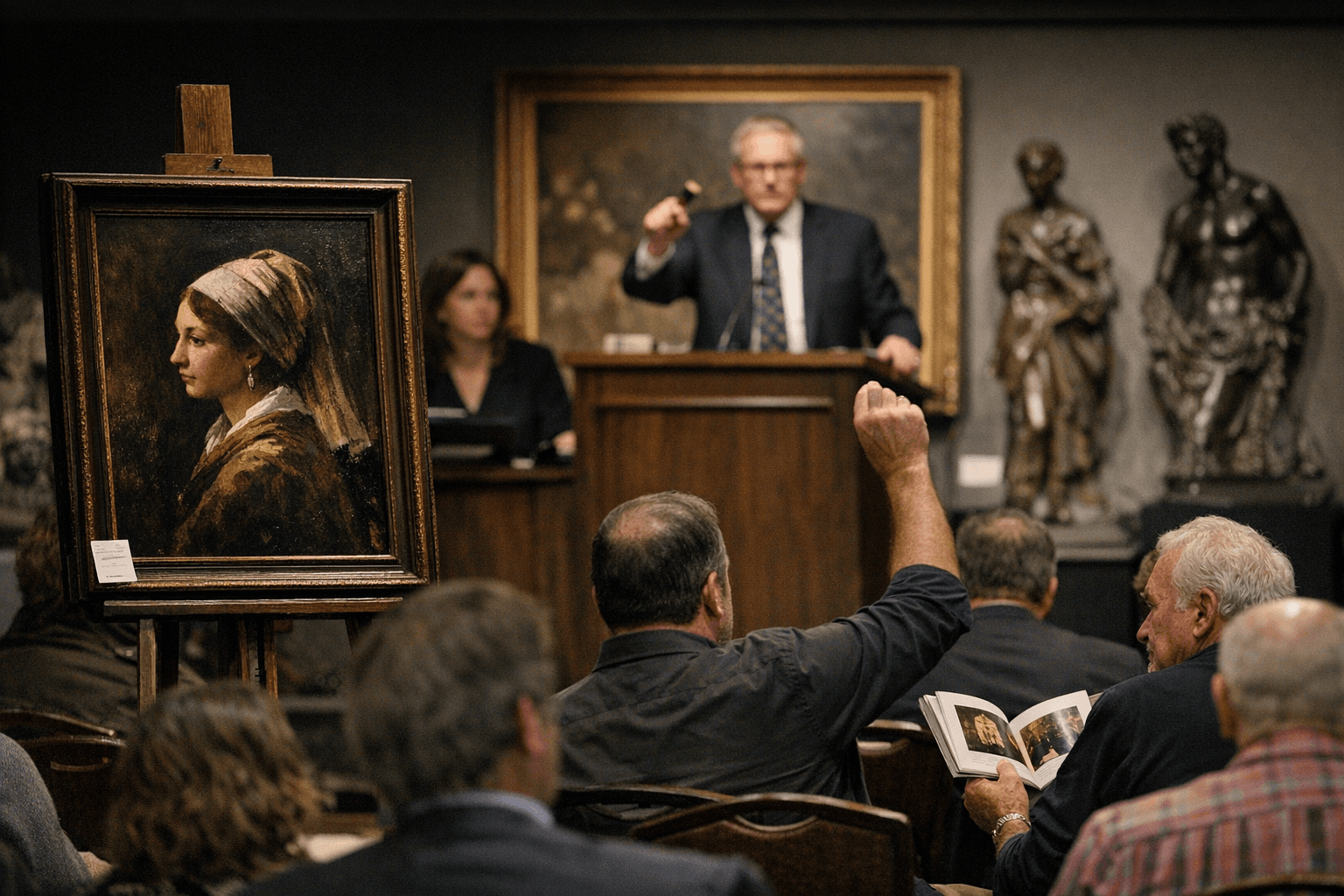
Pre-sale estimates ranged from $7,000 to $10,000 for a 19th-century painted blanket chest up to $60,000 to $90,000 for a late 17th-century cupboard of carved oak. A Thomas Sully artist's cabinet and an early New York walnut sawn-leg dressing table anchored the top tier alongside fine art by Blakelock, Abraham Walkowitz, and Whistler.
Condition is the variable museum storage introduces most unpredictably. Pieces held in climate-controlled institutional settings often emerge in better structural shape than works that remained in active use, but gilding, applied decoration, and surface treatments are susceptible to archival packaging protocols and the micro-environments of large storage facilities. At deaccession sales, the auction house's condition notes represent the first independent assessment a piece has received since acquisition. Read them against the photographs carefully, then request the accession file, not just the catalog entry, after winning a lot.
The Brooklyn Museum has signaled that this deaccession program is ongoing. For collectors who understand how to read catalog entries, that makes the next round worth watching from the moment Brunk begins accepting consignments.
Know something we missed? Have a correction or additional information?
Submit a Tip