Historic Astor Artifacts From Titanic Go to Auction
An 18k Patek Philippe pocket watch and 14k gold pencil case, recovered from the body of the Titanic's wealthiest victim, come to auction at Freeman's this month for the first time in 114 years.
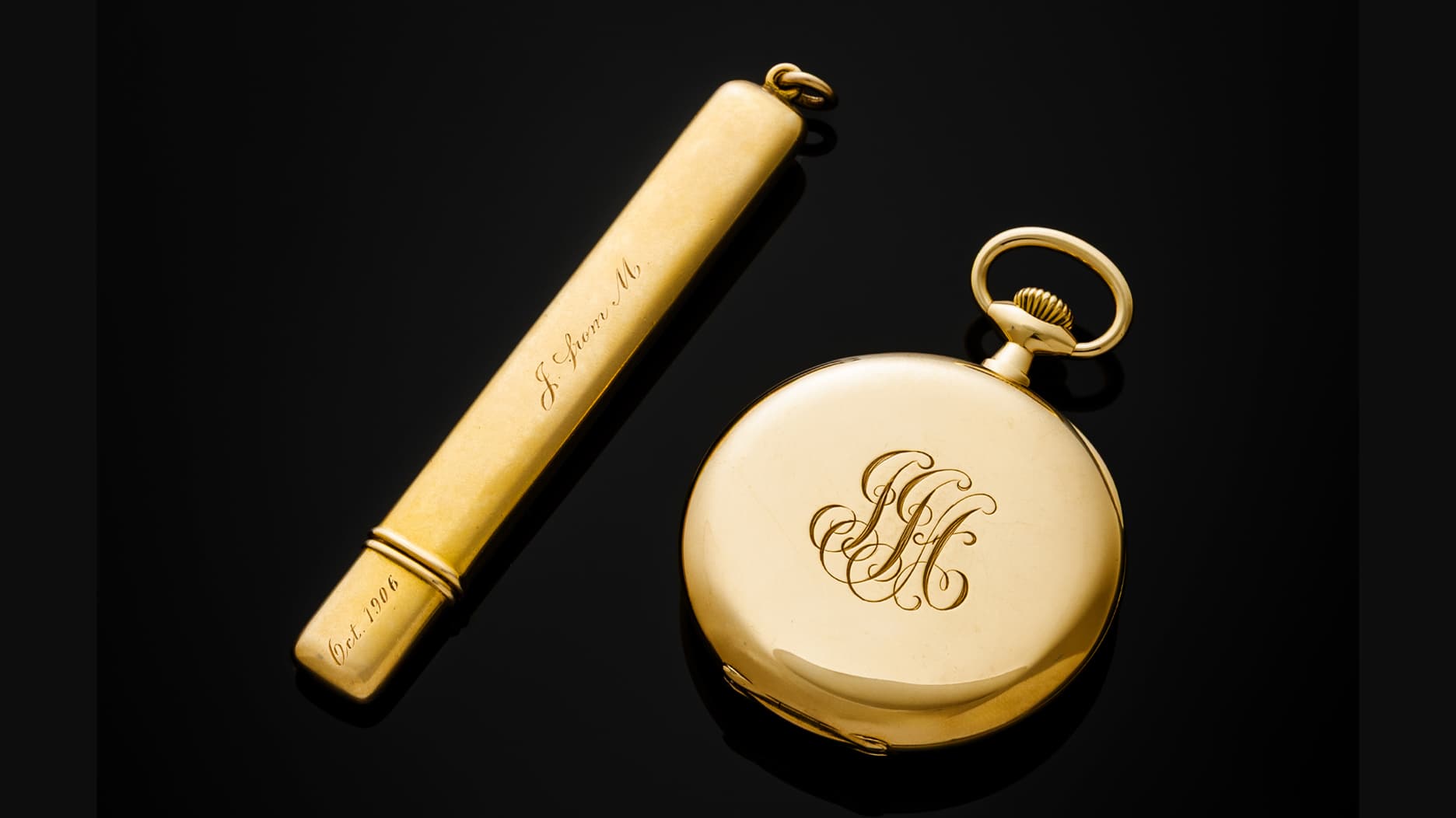
The two objects are not large. A gold pocket watch. A gold pencil case. But in the catalog of what John Jacob Astor IV carried aboard the RMS Titanic in April 1912, they speak volumes about the man's taste and the era that shaped it.
This month at Freeman's in Philadelphia, both pieces will come to public sale for the first time since Astor's death, 114 years of family stewardship ending with a gavel. The 18k gold Patek Philippe pocket watch, originally retailed through Tiffany & Co. and engraved with Astor's monogram, and the 14k gold Battin & Co. pencil case were recovered from Astor's body by the cable ship Mackay-Bennett on April 22, 1912. Astor, catalogued as body No. 124, was identified at sea in part by his distinctive diamond finger ring and the initials sewn on the label of his jacket, a reminder that for the Gilded Age's wealthiest men, personal adornment was never incidental.
At the time of the sinking, Astor commanded a fortune estimated at roughly $87 million, equivalent to approximately $2.9 billion today, making him the richest passenger aboard the Titanic. His object choices reflect that status with precision. The Patek Philippe pocket watch was no casual acquisition: it came through Tiffany & Co., which had served as Patek Philippe's American retail partner since 1851, when Antoine Norbert de Patek and Charles Lewis Tiffany formalized their relationship with a handshake in New York. Tiffany remains the only retailer in America whose name appears on a Patek Philippe dial, a distinction that was already a marker of extreme discernment in Astor's Edwardian world. That Patek Philippe's Geneva archives have confirmed both the watch's manufacture date and its sale date through Tiffany & Co. is not a small detail. It is precisely the kind of maker-mark documentation that separates a collectible from an heirloom with a story.
The pencil case, rendered in 14k gold by Battin & Co., is the quieter piece: a writing instrument's housing, the sort of object a man of Astor's means would have carried as reflexively as a watch. The difference in gold purity between the two objects, 18k for the watch and 14k for the case, is a period detail worth noting. Edwardian gentlemen routinely reserved 18k gold for watchcases and precious jewelry while accepting 14k for utilitarian luxury goods. Both alloys have remained stable through more than a century of family custody, in marked contrast to artifacts recovered from the ocean floor.
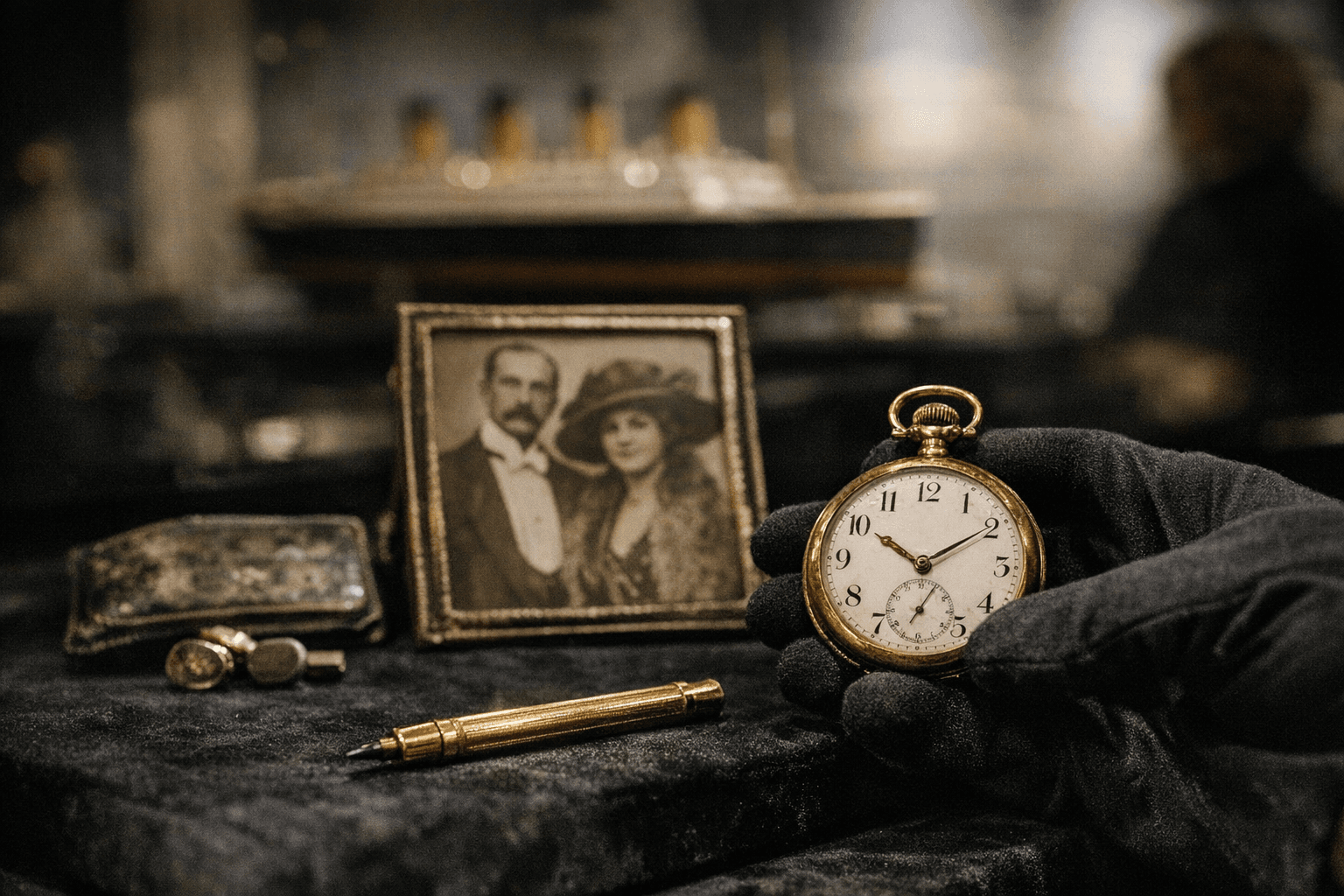
That distinction matters enormously for collectors considering a bid. These pieces did not spend 114 years on the Atlantic seabed. They passed through four generations of the Astor family, and Reginald Brack, Freeman's senior vice president and head of watches, noted that they "emerge with documented provenance across four generations." Patek Philippe's Geneva archives provide independent corroboration that does not depend solely on family tradition, a significant advantage in a category where Titanic mythology has sometimes outpaced Titanic evidence.
The emotional weight of objects linked to the Titanic is undeniable and, for some collectors, that weight carries its own ethical dimension. These are not relics salvaged from an anonymous wreck; they were carried on a man's body, recovered from the North Atlantic, and preserved with evident intention. The romance of the Titanic narrative is real. The responsibility of documentation is equally so, and in this case, both are unusually well served.
Know something we missed? Have a correction or additional information?
Submit a Tip