Best Antique Fairs and Estate Sales for Vintage Jewelry Hunters This April
Five April fairs across four U.S. regions where Art Deco rings, signed costume pieces, and mid-century gold regularly surface — with a cheat-sheet and five moves to negotiate on the spot.
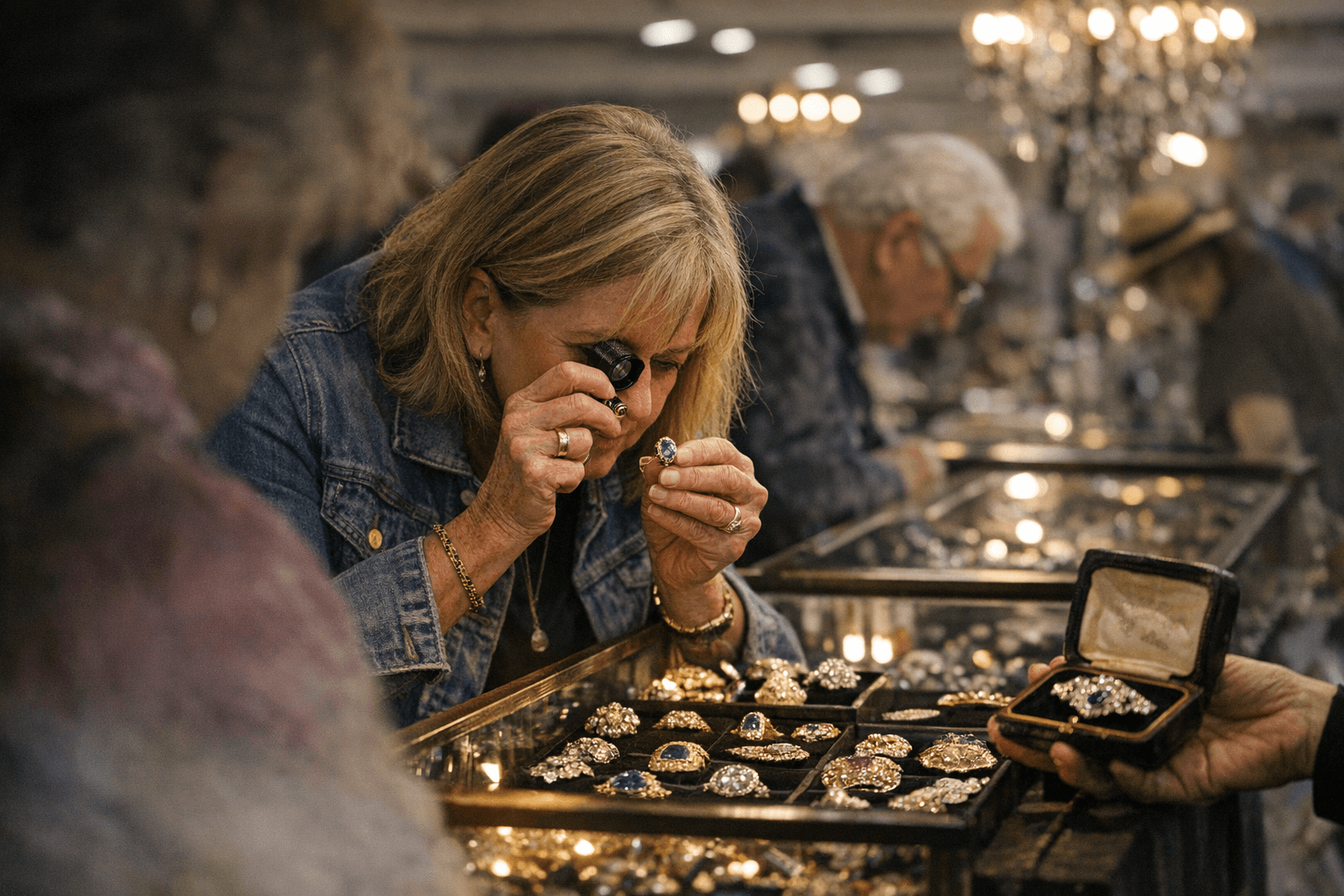
Pick up a brooch pulled from an estate table, and you're holding a small archive. The maker's mark stamped into the base tells you who designed it; the clasp mechanism tells you when; the condition of the prongs tells you how it was kept and by whom. April is when the archive opens back up for business. Outdoor markets restart their seasonal runs, multi-dealer shows draw national exhibitors, and estate-sale pipelines that slowed over winter begin flowing again. If you know where to go and what to look for, this month alone offers five events worth putting on the calendar.
Here is a regional breakdown, ranked by scale and depth of jewelry representation, with practical details for each.
1. Alameda Point Antiques Faire
| April 5, 2026 | 2900 Navy Way, Alameda, California | Early admission available; online tickets sold in advance (exchanged for paper tickets at entry, allow 15 minutes) | Best for: mid-century modernist jewelry, signed California estate pieces, costume jewelry |
|---|
Northern California's largest antiques show runs on the first Sunday of every month, and April's edition is the first of the spring outdoor season proper. More than 800 dealer booths spread across a former naval airstrip with the San Francisco skyline visible across the bay, and every single item on every table must be at least 20 years old. That vetting rule, enforced by the organizers, is rarer than it sounds. It means you are not sifting through new reproductions packaged to look vintage; everything here is the real article. For jewelry hunters, the sheer scale is the advantage: with more than 800 exhibitors, the probability of finding a signed Schreiner brooch, a 14k yellow gold retro cuff, or an early Haskell parure buried under a silk scarf is measurably higher than at any smaller show. Michaans Auctions operates adjacent to the faire, providing a reference point for current market values as you shop. Typical jewelry price range runs from around $35 for single unsigned costume pieces up to $3,000-plus for well-documented estate rings. Online ticket access is available; at-door tickets are equally fast for later admission.
2. Minnesota Antique Spectacular
| April 18-19, 2026 | Minnesota (Prime Promotions Events) | Discount coupons available via email newsletter | Best for: estate jewelry from national dealers, mid-century gold, signed pieces |
|---|
Prime Promotions has been operating antique shows and flea markets across Minnesota for nearly 30 years, and their Spectacular draws dealers from around the country, not just the region. That national footprint matters for jewelry hunters specifically: regional dealers tend to carry local estate material, but national exhibitors bring inventory sourced from estate liquidations across multiple states, which widens the variety of periods and price points significantly. This is the show where you are most likely to encounter a dealer who genuinely knows what they have, can tell you the piece's provenance, and has priced accordingly. It is also where negotiation on well-documented pieces is most productive, precisely because both buyer and seller are working from shared information. The show covers jewelry alongside furniture, pottery, rugs, clocks, glassware, and advertising, so the footprint is large. Prioritize jewelry tables in the first two hours of Saturday. Typical jewelry price range: $50-$5,000-plus.
3. Grayslake Antique Flea Market
| April 11-12, 2026 | Lake County Fairgrounds, 1060 E Peterson Road, Grayslake, Illinois | Saturday 9am-4pm, Sunday 9am-3pm | $9 at the door, children under 12 free, free parking | Best for: Art Deco estate jewelry, Midwest estate rings, signed costume pieces |
|---|
The indoor Expo Hall setting at the Lake County Fairgrounds gives Grayslake a distinct advantage that outdoor shows cannot offer: consistent lighting, protection from wind and rain, and the ability to examine delicate pieces without worrying about a gust scattering loose stones. For jewelry work specifically, this matters. Art Deco platinum filigree, which is inherently fragile, or a signed enamel compact that needs examining under a loupe, benefits from controlled conditions. The show draws vendors selling vintage clothes, jewelry, antique decor, and collectibles, and the Midwest pricing tends to be more accessible than comparable West Coast shows. A cocktail ring that might be tagged at $450 in a San Francisco market will often surface here at $180-$280. Arrive Saturday at opening; Sunday inventory thins. Typical jewelry price range: $15-$800.
4. Bull Yoke Flea Market
| April 16-19, 2026 | 2034 9 Mile Road, Union City, Michigan | 9am-5pm daily | Free entry | Best for: underpriced estate finds, raw hunting |
|---|
The four-day window is Bull Yoke's primary asset. Most fairs are one or two days, which creates pressure to move quickly and make decisions in compressed time. Four days allows you to return after doing homework: if you see a piece on day one that you cannot identify, you have time to research hallmarks, consult references, and come back with a confident offer on day four. The free entry also removes the psychological cost of a wasted trip. This is a traditional flea market with a mix of antique goods, tools, vintage clothing, and general merchandise, which means the jewelry is not curated. That is exactly the point. Uncurated markets are where underpriced pieces surface. A dealer who specializes in furniture and has a jewelry lot they inherited from a liquidation estate is the person you want to find. Bring your loupe, bring patience, and do not overlook the bottom drawers of display cases. Typical jewelry price range: $5-$300.
5. Contra Costa Vintage Market
| April 12, 2026 (every second Sunday of the month) | 3581-A Mount Diablo Boulevard, Lafayette, California | Organized by Vintage Vida | Best for: signed costume jewelry, curated vintage designer pieces |
|---|
Contra Costa is a recurring monthly market rather than a one-off annual event, which has shaped the character of its vendor base. Dealers who commit to showing up every second Sunday tend to be specialists rather than generalists, which means the jewelry on offer is typically better sorted and more knowingly priced than you will find at a sprawling flea market. For signed costume jewelry in particular, including pieces by American mid-century makers, a curated monthly market like this is an efficient hunting ground. The price premium over a raw flea market is real, but so is the confidence that the piece has already been looked at by someone who knows what they are selling.
Five rapid moves to make before you pay
1. Read the hallmarks before you hear the pitch. Flip the piece over first. Markings stamped into gold (750 for 18k, 585 for 14k, 417 for 10k), silver (925, 800, or lion passant for British sterling), or a maker's cartouche take 30 seconds to read and tell you more than any verbal description. At estate sales especially, unmarked pieces are common, and absence of marks changes the pricing conversation entirely.
2. Step into daylight for any colored stone. Fluorescent booth lighting masks treatments, doublets, and inclusions in colored gemstones. Before committing to anything with a sapphire, ruby, emerald, or tourmaline, walk the piece to the nearest natural light. Uneven color distribution, visible layering at the girdle, or dramatic color shift are all worth noting. You are not disqualifying the piece; you are pricing it correctly.
3. Photograph the back of every potential purchase. The macro camera on a current smartphone captures detail well beyond what the naked eye can read in a crowded booth. Get a sharp image of the base of every piece you are considering, even if you walk away. The image gives you a reference for later research, a record if you return, and leverage if a dealer claims a marking that is not actually there.
4. Bundle to negotiate. Dealers at multi-day fairs are more willing to discount a small lot than a single desirable piece. If you want three items from the same table, offer a combined price for all three that is 15-20% below the total. Moving volume early in a four-day show like Bull Yoke, or during the first morning at Minnesota Spectacular, is often worth more to a dealer than protecting the margin on any individual piece.
5. Ask the provenance question directly. At estate sales and larger fairs where dealers have sourced from estate liquidations, ask whether any documentation traveled with the piece: original boxes, appraisal letters, receipts, or photographs showing the piece being worn. Documentation is not a guarantee of authenticity, but it narrows the dating, adds measurable resale value, and signals that the dealer has done their own due diligence. At a show with national dealers, like Minnesota Spectacular, this question is almost always worth asking.
The best pieces rarely announce themselves. They sit upside-down in a tray, or folded in a velvet pouch at the back of a case, waiting for someone who knows what to turn over.
This article was produced by Prism’s automated news system from verified source data, official records, and press releases, then run through automated quality and moderation checks before publishing. The system is built and supervised by the people who set the standards it runs under. Read our full AI policy.
Did this article answer your question?