Marks4Antiques Combines Mark Identification, Pricing Data for Serious Jewelry Collectors
That little stamp on an inherited brooch could identify a Victorian silversmith or expose a $400 fake. Marks4Antiques makes the detective work possible.
Pick up an inherited ring or a brooch pulled from an estate sale, and you're holding a small archive. That faint stamped symbol inside the shank, pressed into the metal more than a century ago, is the piece's birth certificate: who made it, where, from what, and roughly when. The problem is that birth certificates can be forged, misread, or mistaken for something they're not — and nowhere is this more consequential than in the online vintage jewelry market, where a misattributed maker's mark can inflate a listing price by hundreds of dollars or, worse, lead a careful buyer to dismiss a genuinely rare piece as unremarkable.
This is where the research process has to be systematic. A single visual match is never enough. The collector's real advantage comes from cross-referencing a mark's visual identity against historical production periods, material standards, and realized auction prices. That four-step triage, photograph, visual match, era and material cross-check, auction comps, is exactly the workflow that separates confident acquisitions from expensive guesses.
Step 1: Photograph the Mark Before You Do Anything Else
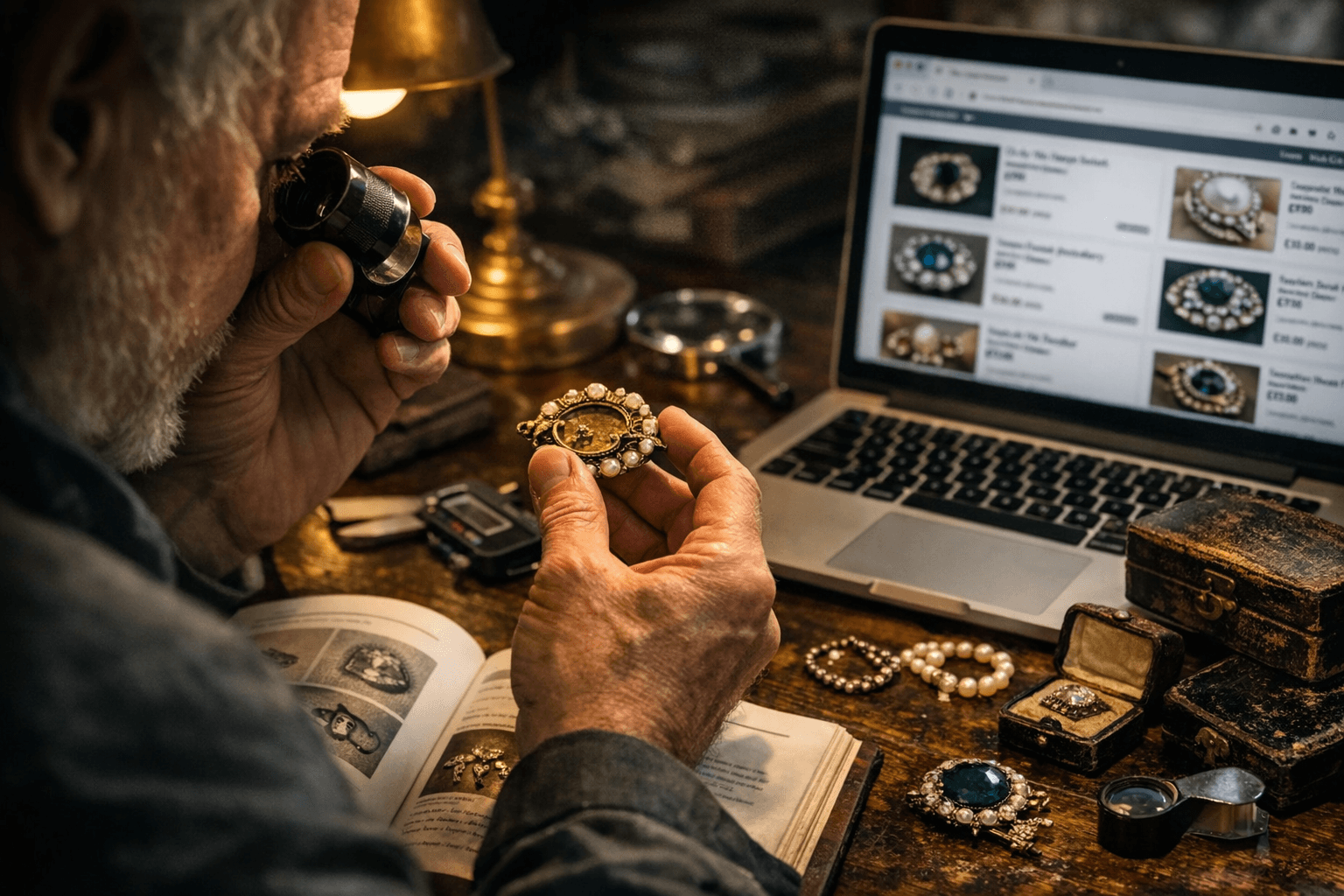
Before opening any database, capture the mark clearly. Rake-lighting (holding a flashlight at a low angle across the metal surface) is the single most effective technique for revealing stamps that appear invisible under flat light. Use macro mode on your phone, stabilize the piece against a contrasting background, and take multiple shots. A blurry photograph of a cartouche will send you down entirely the wrong research path, because many marks differ by a single letter, a minor border shape, or the angle of a crown. Save both your photograph and any description — oval cartouche, three initials, no date letter — before you begin matching.
Step 2: Visual Match with Marks4Antiques
Marks4Antiques organizes its database of tens of thousands of jewelry and silverware manufacturers by shape category, which maps naturally to how a collector first encounters a mark: as a visual object, not a name. If you can make out a shape but only two of three initials, the site's proprietary Initials Search accepts a "?" wildcard in place of any unreadable letter, returning every possible combination for you to compare against your photograph. The Name Search works in the opposite direction: if you already have a suspect attribution, it pulls every known mark used by that maker onto a single page so you can rule in or rule out variants at a glance.
The database includes actual images of marks from all countries and all periods, and it covers far more territory than sterling silver alone. Costume jewelry, fashion accessories, and Native American and Southwest studio pieces are all represented, an important breadth given how frequently mid-century signed costume jewelry is misidentified as fine silver on secondary-market listings.
Step 3: Cross-Check Era and Material Standards
A visual match is a hypothesis, not a conclusion. The next move is to test it against what you know about the period. Marks almost always carry implicit material and date information, and inconsistencies between what the mark claims and what the metal shows are the clearest signal that something is wrong. This cross-check is where a solid secondary reference becomes essential alongside Marks4Antiques.
For British pieces, the hallmarking system is particularly information-dense, and particularly easy to misread. A fully hallmarked British silver piece will carry at minimum a fineness mark, an assay office mark, and a maker's mark. The four current UK assay offices are London, Birmingham, Edinburgh, and Sheffield, and each carries a distinct symbol: London's lion passant for sterling (indicating 92.5% silver) is perhaps the most recognized, but the Birmingham anchor and Edinburgh castle are frequently confused with decorative elements by buyers unfamiliar with the system. British date letters add a further layer: they run in alphabetical cycles, but the letters I, J, and L are sometimes omitted to prevent ambiguity in certain typefaces, meaning each cycle runs 25 letters rather than 26. Punch shape and typeface together distinguish one alphabetical cycle from another, which is why a mark photographed with even slight distortion can appear to date from an entirely different decade.
Britannia silver, marked 958 and represented by a seated figure carrying a shield, is particularly prone to misidentification. Online listings frequently describe pieces bearing this mark as "unusual hallmark, possibly foreign," when in fact Britannia standard was compulsory in Britain between 1697 and 1720 and remains in use today on higher-purity silver. A piece stamped with the Britannia mark and an early date letter cycle is not mysterious: it is a documented, regulated standard with a 300-year paper trail.
Step 4: The Marks That Fool Even Experienced Buyers
The most consequential lookalikes in the online vintage market fall into a handful of recurring categories. Understanding them is the fastest way to avoid being one of the collectors who pays a premium for misattributed provenance.
- Tiffany vs. pseudo-Tiffany: Authentic Tiffany pieces are always stamped with both a maker's mark and a fineness mark. For sterling silver, the fineness reads either "925" or "Sterling," the latter being more common on older pieces. For 18-karat gold, the stamp is "750"; for platinum, "950." A listing that shows only a "Tiffany & Co." script without an accompanying fineness mark should trigger immediate skepticism, though it is worth noting that heavy wear can erode stamps on genuine vintage pieces. On earrings specifically, the mark is typically found on the earring stem.
- "925" as a quality signal vs. "925" as a maker's attribution: A "925" stamp confirms silver purity. It says nothing about who made the piece. Listings that describe "925 Tiffany" or "925 Cartier" are conflating the fineness mark with the maker's mark, two separate stamps that must both be present and legible for any attribution to stand.
- British lion passant vs. Italian export marks: Italian silver exported to the UK during the mid-20th century was required to carry its own import marks, which can sit adjacent to British-style marks in ways that appear, at first glance, like a complete British hallmark suite. The shapes and placement differ, but the casual eye reads "old English silver" and stops there.
- Date letter cycles across assay offices: The same letter "C" in a similar gothic script can represent a London piece from one decade and a Birmingham piece from another — the assay office mark is the key to decoding which cycle applies, and it is the mark most frequently cropped or obscured in online listing photographs.
Step 5: Auction Comps Through Values4Antiques
Once you have a working identification that survives the era and material cross-check, the final step is pricing context. Marks4Antiques integrates an auction records tool that draws on millions of realized prices from sale rooms across the United States, United Kingdom, and Europe. The operative word is "realized": as the site makes clear, formal appraisals rely exclusively on prices that have actually been paid, not estimates, reserve prices, or unsold lots carrying wishful valuations. A piece that sat unsold at a dealer's asking price for two years is not a valid comparable. A piece that cleared at Christie's after competitive bidding is.
The practical workflow is straightforward: search the description of your piece, review the sale images for items with matching marks, metal standards, and condition, and note the price range across the most recent comparable lots. That range becomes your negotiating baseline, whether you are buying, consigning, or seeking insurance coverage.
The Collector's Mark Triage Checklist
Print this and keep it with your loupe.
1. Photograph the mark under rake-lighting; save the image before beginning research.
2. Identify the cartouche shape and note every legible element: letters, symbols, borders.
3. Search Marks4Antiques by shape category; use the "?" wildcard for unclear characters.
4. Pull all known marks for your suspected maker using Name Search and compare each variant.
5. Cross-check the mark against the correct national hallmarking system for the suspected country and period.
6. Verify that fineness and maker's marks are both present and consistent with period standards.
7. Check for era inconsistencies: a mark that postdates a claimed period is disqualifying.
8. Run auction comps on realized prices; use at least three comparable lots from the past 24 months.
9. Flag any discrepancy between visual match and material/date evidence before purchasing.
10. If the mark still reads ambiguously after this process, pursue professional appraisal before committing to a significant price.
The collectors who avoid costly misattributions are not necessarily the most experienced; they are the most methodical. A rigorous four-step triage with the right tools closes the gap between instinct and certainty, which is ultimately what separates a collection built on knowledge from one built on hope.
This article was produced by Prism’s automated news system from verified source data, official records, and press releases, then run through automated quality and moderation checks before publishing. The system is built and supervised by the people who set the standards it runs under. Read our full AI policy.
Did this article answer your question?