Carolina Herrera spotlights Spanish porcelain and glass jewelry in Madrid
Madrid’s Plaza Mayor became a crash course in collectible Spanish motifs, where porcelain carnations and handblown glass read like clues for spotting artisan-made jewelry.
What the Madrid show revealed for vintage jewelry eyes
Carolina Herrera’s Spring 2026 show in Madrid was not just a runway presentation, it was a lesson in how Spanish heritage materials travel from archive to ornament. The collection, staged in Plaza Mayor, framed itself as a celebration of Spanish craftsmanship and a tribute to Madrid’s rhythm, contrasts, and visual language, with jewelry that translated those ideas into brooches, pendants, and earrings.
For anyone who shops vintage-inspired jewelry, that matters because the strongest pieces rarely imitate history loosely. They borrow from a recognizable source: a flower, a craft tradition, a city, a material, or a technique with a paper trail. Here, the references were specific enough to decode, from the carnation to handblown glass to the older language of Azabache and Spain’s Golden Age.
The motifs to know: carnation, glass, and the Madrid archive
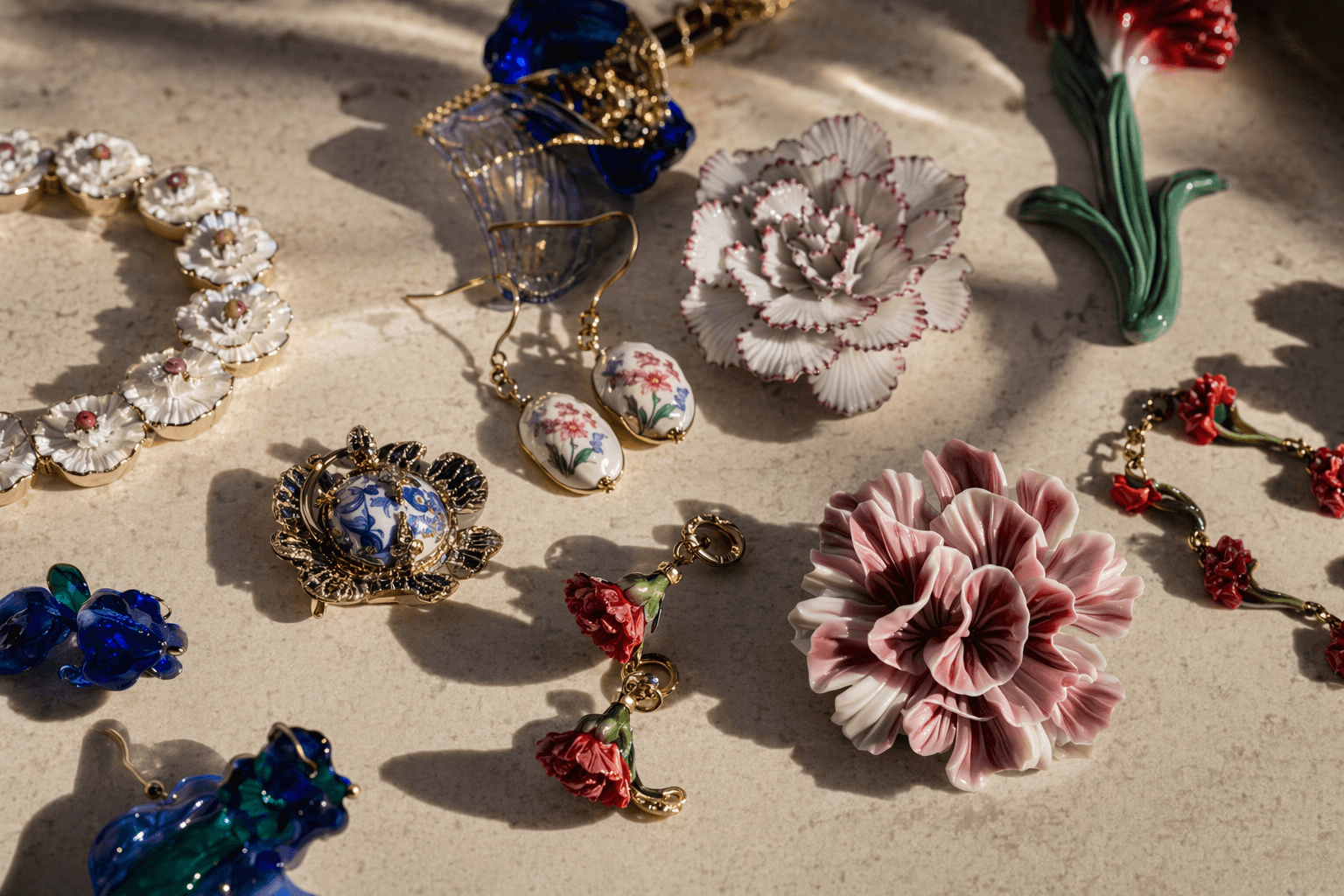
The clearest jewelry cue in the collection came from the carnation, Spain’s emblematic flower. Madrid artisans Andrés Gallardo and Marina Casal created delicate porcelain pieces inspired by that form, while Mar del Hoyo, founder of Levens Jewels in Barcelona, introduced handblown glass jewelry that leaned into organic petals, droplets, and sculptural lines. That mix of floral symbolism and material specificity is exactly what collectors look for when separating decorative costume jewelry from pieces with stronger identity.
On the secondary market, this type of work tends to fall into a few collectible categories: porcelain floral jewelry, art-jewelry pieces that treat a motif as sculpture, and glass ornaments that depend on handwork rather than mass production. A porcelain carnation brooch, for example, reads very differently from a generic enamel flower pin because the material itself is part of the story. Glass pieces that capture light through irregular forms tend to carry that same artisanal signal, especially when they avoid perfect symmetry.
Why the venue matters as much as the jewels
Plaza Mayor was not a neutral backdrop. Carolina Herrera made the location part of the narrative by presenting its first main collection outside New York in Madrid, turning the city itself into a credential of place and culture. The runway, staged on a 450-meter strip in the house’s signature pink and attended by about 800 guests, gave the homage a public scale that matched the ambition of the jewelry.
The collection also drew on Madrid’s 17th-century Golden Age and the La Movida movement, two very different historical registers that tell you how to read the accessories. One points to ornament, ceremony, and craft lineage. The other points to rebellion, color, and modernity. When a collection bridges those poles, the jewelry often becomes the easiest place to see the tension between old-world references and contemporary styling.
How to spot the difference between artisan-made and fashion jewelry
A buyer looking at a porcelain flower brooch or a glass pendant should inspect the same things a collector would. The most telling clues are usually the back, the edge, and the fastening. True artisan-made pieces often show hand finishing, subtle irregularities in petals or droplets, and a clasp or setting that feels integrated rather than merely attached.
Look for these cues:
- A maker’s name, signature, or workshop mark on the reverse
- A clean but not machine-perfect finish on porcelain petals or glass surfaces
- Slight variation from piece to piece, especially in floral forms
- Metal findings that feel sturdy and purposeful, not thinly decorative
- Weight that matches the material, with porcelain feeling denser and glass more visibly translucent or layered
The Carolina Herrera collaborations are useful because they show how a heritage motif can be handled at two levels: as fashion ornament and as collectible craft. Andrés Gallardo and Marina Casal’s porcelain carnation jewels suggest a handmade, small-workshop sensibility, while Levens Jewels’ handblown glass pieces point to a sculptural approach that depends on the maker’s hand. Contemporary fashion jewelry often copies the silhouette but flattens the execution, using molded resin or uniform casting instead of visible craft decisions.
Where history surfaces in the details
Carolina Herrera’s own product language also widened the frame beyond jewelry. One Spring 2026 crystal-embroidered midi dress was described as drawing on Azabache, an ornate technique linked to Spain’s Golden Age. That matters because it connects the accessories to a broader decorative tradition in which black, shine, and ornament carry cultural memory.
For a vintage jewelry reader, Azabache is a reminder to watch for black stones, jet-like finishes, and glossy dark elements that appear in Spanish-inspired pieces. The best examples are rarely just “black accents.” They are tied to a regional vocabulary, often paired with florals, devotional references, or theatrical silhouettes. When the reference is real, it tends to show up consistently across the whole look, not as a random decorative flourish.
The archive piece that sharpens the story
Casa Seseña added another layer of authenticity. Founded in 1901, the house contributed archival capes, and Carolina Herrera noted that the brand once counted Carolina and Reinaldo Herrera among its wearers. In jewelry terms, that kind of archival reference is useful because it signals a real lineage rather than a vague nod to “heritage.”
Collectors should take the same approach when evaluating vintage-inspired jewelry. Ask whether the design borrows a recognizable craft language, or whether it simply borrows romance. A true period or artisan-made piece usually has a clearer relationship to place, maker, and material. A contemporary imitation often has the mood, but not the grammar.
Why this collection belongs on a collector’s radar
Wes Gordon’s 77-look Spring 2026 lineup made the case that heritage can still feel immediate when it is filtered through the right materials. The jewelry was not an accessory afterthought; it was one of the collection’s sharpest tools for translating Madrid into something wearable. Porcelain carnations, handblown glass petals, archival capes, and Golden Age references all pointed to the same lesson: the most collectable vintage-inspired jewelry usually has a visible source.
That is the practical takeaway for anyone scanning estate cases, resale platforms, or family drawers. If a piece claims Spanish inspiration, look for the evidence in the material and the making. Porcelain should look hand-formed, glass should catch light with nuance, and the motif should feel rooted in a real tradition. When those details line up, the jewelry is doing more than borrowing an aesthetic. It is carrying a history you can actually read.
This article was produced by Prism’s automated news system from verified source data, official records, and press releases, then run through automated quality and moderation checks before publishing. The system is built and supervised by the people who set the standards it runs under. Read our full AI policy.
Did this article answer your question?