Charlotte Gere, Victorian Jewellery Scholar Who Reshaped the Field, Dies at 88
Charlotte Gere, whose 1972 book Victorian Jewellery Design pioneered the field, died at 88. Her 20-plus books remain the authoritative standard for dating and reading 19th-century pieces.
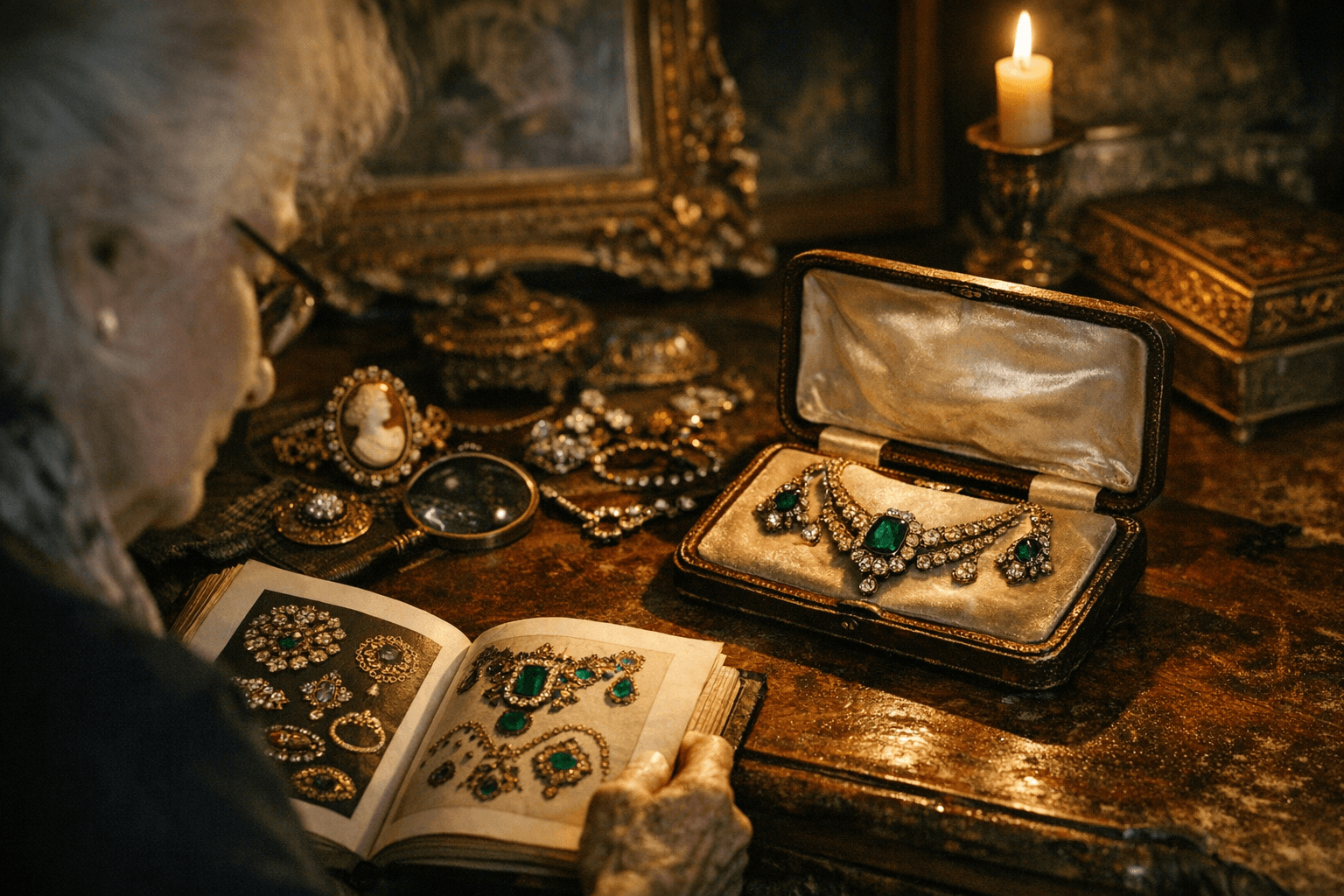
Pick up a gold mourning brooch from an estate sale, the kind wound with jet-black hair sealed under bevelled crystal, and you are holding a small archive. The piece has a decade, a grammar, a precise set of visual codes that tell you who made it, for whom, and under what aesthetic conventions. For most of the 20th century, the tools to read that grammar were thin on the ground. Charlotte Gere, who died in March 2026 at the age of 88, did more than almost anyone to supply them.
Born in 1937, Gere published her first major work, Victorian Jewellery Design, in 1972, at a moment when Victorian objects were still widely dismissed by serious collectors as sentimental clutter. The book, issued by William Kimber in London, was immediately recognized as pioneering because it established a scholarly framework for a field that had none. Over the five decades that followed, she built on that foundation with more than twenty books and numerous articles, ranging from Pre-Raphaelite metalwork to the Aesthetic interior, and her influence touched exhibitions, museum cataloguing practice, and the way dealers and auction specialists describe 19th-century work.
Her most comprehensive achievement arrived late in her career. Jewellery in the Age of Queen Victoria: A Mirror to the World, co-authored with British Museum curator Judy Rudoe and published by the British Museum in 2010, won the 2011 William Berger Prize for British Art History. At 552 pages with 500 illustrations, the volume treated Victorian jewellery not as a style category but as a social document: who wore what, why, and what the symbols meant to viewers who could decode them on sight.
That decoding capacity is the most practical gift Gere left collectors and appraisers. Her scholarship mapped taste in decade-by-decade terms that are still usable at any dealer table. The 1840s and 1850s were austere decades, producing restrained, darker pieces. Hair ornaments dominated the 1830s and early 1840s, giving way to diadems in the 1850s and then to lavishly faceted diamond sets from the 1860s onward. Those later pieces were frequently modular and convertible, designed to be dismantled and reconfigured for different social occasions, and their adjustable construction is itself a dating marker. The parure, a matching suite of brooch, bracelet, and earrings, Gere identified as the signature grammar of middle-class aspiration across the mid-Victorian decades, representing what she and Rudoe called a democratization of fashionable consumerism.
On revival styles, her work was equally specific. Through two volumes cataloguing the Hull Grundy Gift at the British Museum, beginning with The Jeweller's Art in 1978 and culminating in the definitive two-volume The Art of the Jeweller in 1984, both co-authored with Hugh Tait, Gere gave dealers and museum professionals their first systematic guide to archaeological revival jewellery. These are the pieces that Castellani and Carlo Giuliano produced in deliberate emulation of ancient Greek, Etruscan, and Roman finds newly excavated in the mid-19th century. The physical markers are granulation on gold surfaces, close-set twisted wirework, and an absence of prong or claw settings: techniques chosen to signal antiquity, clustering these works firmly in the 1860s through 1880s. Pieces by these makers appear regularly in the secondary market without attribution; the Hull Grundy catalogues remain the reference most dealers reach for first.
A third body of work addresses the artist-jeweller tradition that ran parallel to commercial production. Artists' Jewellery: Pre-Raphaelite to Arts and Crafts, co-written with Geoffrey Munn and published in 1989 by the Antique Collectors' Club, separated the hand-produced work of figures such as C.R. Ashbee and Henry Wilson from the mass trade. The distinction is practically significant: Arts and Crafts pieces made through workshops like Ashbee's Guild of Handicraft tend toward hammered or matte silver surfaces, cabochon rather than faceted stones, and deliberately irregular, handworked forms. These attributes resist industrial replication and carry a premium in the current market. Gere's book, which traced individual jewel designs back to the original drawings of artists including Dante Gabriel Rossetti and William Holman Hunt, remains the only work to do this with sufficient breadth to be genuinely useful for attribution.
Her scholarship also recovered something harder to quantify: the social and literary context that made small pieces carry enormous symbolic weight. Through letters, novels, newspaper accounts, and exhibition records, Gere and Rudoe showed how the language of botanical jewellery, each flower signalling a specific sentiment to a recipient who knew the code, made a modest brooch function as a text. Knowing that a pansy, from the French pensée, communicated loving thought, or that forget-me-nots had their own precise freight of meaning, transforms the reading of a piece from aesthetic assessment to something closer to translation.
From 1981 to 1987, Gere served as editor of the National Art Collections Fund magazine and annual reports. In 1997 she co-curated Victorian Fairy Painting at the Royal Academy. Her 2000 book The House Beautiful: Oscar Wilde and the Aesthetic Interior, written with Lesley Hopkins, extended her analysis from jewellery to interior design and positioned both within the wider Aesthetic Movement.
For anyone who handles 19th-century pieces professionally, her books form a working library rather than a historical archive. Victorian Jewellery Design, Artists' Jewellery: Pre-Raphaelite to Arts and Crafts, and Jewellery in the Age of Queen Victoria, taken together, cover commercial production, artist-made work, and the social history that contextualizes both. The Hull Grundy collection at the British Museum, which Gere helped catalogue across two volumes, gives physical form to the typologies her prose describes and remains one of the most navigable reference collections in the field.
She was 88. The academic discipline she effectively founded now encompasses dedicated auction departments, specialist dealers, and curatorial programs on multiple continents, and the distance between where the field was in 1972 and where it stands today is, in large part, the measure of one scholar's determination to take Victorian jewellery seriously.
This article was produced by Prism’s automated news system from verified source data, official records, and press releases, then run through automated quality and moderation checks before publishing. The system is built and supervised by the people who set the standards it runs under. Read our full AI policy.
Did this article answer your question?