Cut-Steel Jewelry Shines, England’s 18th-Century Metallic Sparkle Triumphs
A cut-steel piece can hide in plain sight until its faceted studs flash like tiny diamonds. Learn to read the construction, period clues, and condition that separate Georgian treasure from later imitation.
The clue is in the glitter
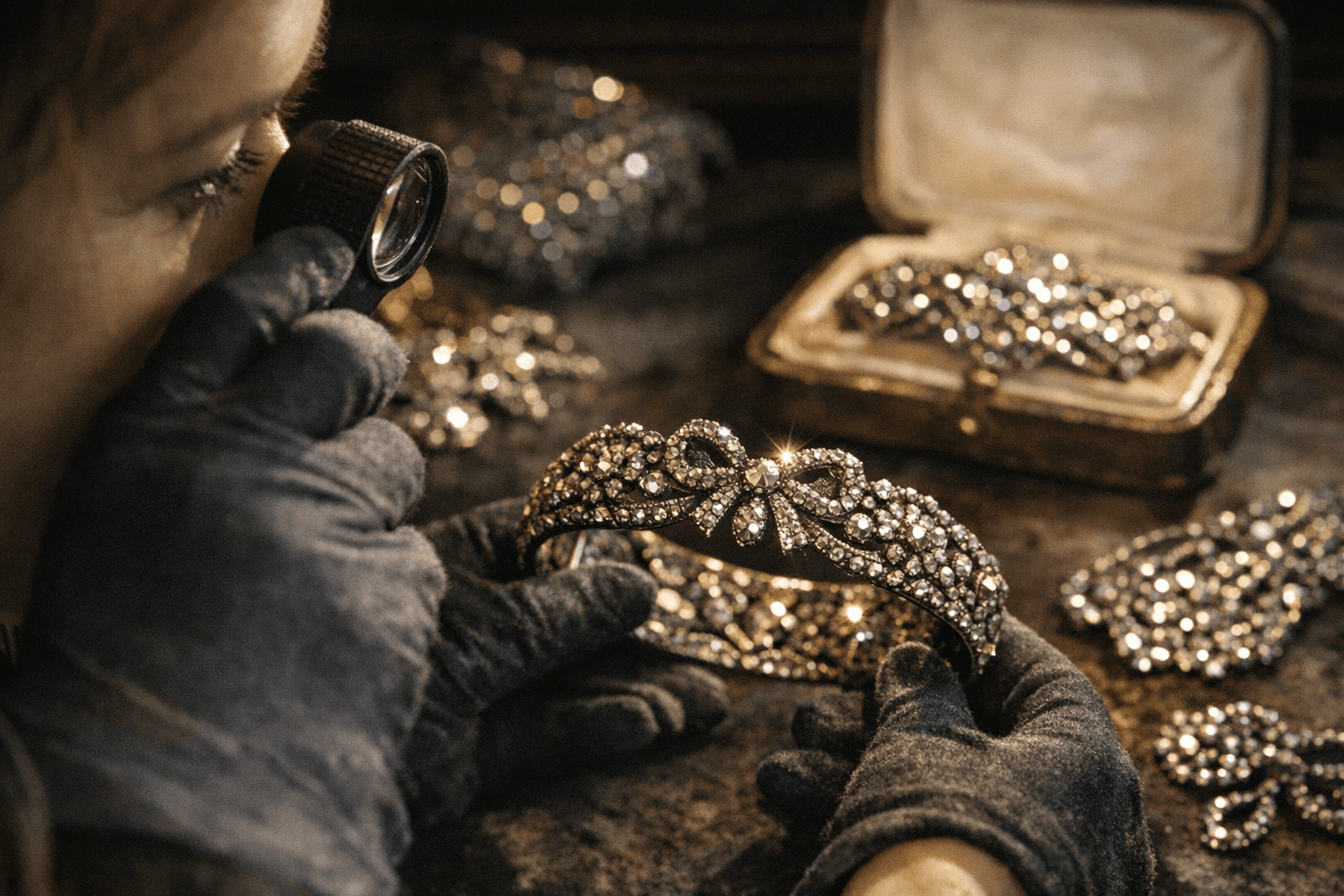
A piece of cut-steel jewelry can look almost black at first glance, then throw off a cold, sharp sparkle when it turns in the light. That is the tell: brightly polished steel rivets or studs, each cut with faceted ends to imitate diamonds, assembled into ornament with real period ambition. By the late 18th century, cut steel had become a distinctly English specialty, and from about 1775 to 1810 it was immensely popular across jewelry and accessories.
The material’s story begins much earlier than many people expect. Production appears to have started in Woodstock near Oxford in the early 1600s, then spread by the 1760s to London and Birmingham. Later pieces were also made in Wolverhampton, and the style traveled from England to France and the Continent. What survived was not simply an inexpensive imitation of precious metal, but a legitimate luxury form in its own right, one that could command serious money and status.
How to read a true cut-steel piece
The first thing to inspect is construction. True cut steel is built from many small, separate steel elements, usually rivets, studs, beads, or links, each polished and faceted so the surface catches light in a disciplined, geometric way. It does not have the soft, stone-set glitter of later gemstone jewelry, and it does not rely on a single broad reflective plane. Instead, the whole object reads like a tight mosaic of metal points.
Use your eyes and fingertips together. On a bracelet, chatelaine, buckle, or watch chain, the pattern should feel deliberate and repetitive, with each element doing its own work. The effect is grey rather than mirror-bright, but powerful, and the best surviving examples still have a crisp, almost architectural sparkle. If the piece looks dull, rounded off, or heavily softened at the edges, much of that original brilliance may be gone.
Cut steel was used far beyond earrings and brooches. It appeared in buttons, buckles, chatelaines, watch chains, sword hilts, tiaras, bracelets, and even smallswords. That breadth matters because it shows how deeply the material was woven into fashionable dress and masculine accessories alike. A cut-steel object should feel like part of that larger world of early industrial luxury, not like a one-note novelty.
- Look for many individually set steel studs or beads rather than a cast surface.
- Expect a faceted, diamond-like flash, not a soft silver glow.
- Check whether the construction is dense, precise, and repetitive.
- On bracelets, note whether the links would have sat on ribbon or another backing.
Some cut-steel bracelets were originally mounted on silk ribbon to keep the sharp links from scratching the wrist. That detail can be a useful collecting clue. A surviving ribbon, or evidence that one once existed, suggests a piece designed for close wear rather than display alone. At the same time, a later replacement ribbon should be read cautiously, because it can hide wear or alter the original look.
The Georgian name to know: Matthew Boulton
If one maker defines the prestige of cut steel at the end of the 18th century, it is Matthew Boulton of Birmingham. He specialized in cut-steel articles and worked out of the Soho Manufactory, where James Watt’s rotative steam engine was installed in 1788 and helped drive the grinding and polishing wheels used on steel wares. That industrial edge is part of the material’s appeal: cut steel joined labor, machine power, and fashion in a way that feels startlingly modern.
Boulton also collaborated with Josiah Wedgwood, pairing jasperware cameos with steel settings for buttons, watch fobs, chatelaines, and related luxury objects. A Metropolitan Museum of Art object dated about 1790 describes these steel-and-jasper combinations as among the most popular English jewelry forms of the period. The pairing makes perfect sense visually: Wedgwood’s blue-and-white jasperware brought classical softness, while cut steel supplied a hard, glittering frame that made the whole object read as refined and cutting-edge at once.
Museums preserve this story in metal. The Metropolitan Museum of Art notes cut-steel sword hilts and jewelry as a distinctly English specialty, and the Victoria and Albert Museum identifies the material as fashionable in the decades around 1800. Those collections also make clear that the best pieces were not merely functional accessories. They were polished statements, made in London, Woodstock, Oxfordshire, Birmingham, and Wolverhampton for a market that prized brilliance and ingenuity.
Why cut steel gets mistaken for marcasite or Art Deco
Cut steel is often confused with marcasite jewelry, and the confusion is easy to understand. Both can read as dark, faceted, and glittering from a distance. The difference is in the substance and the age of the fashion: marcasite is pyrite, and pyrite was commonly called marcasite until the 19th century, when the two were distinguished. Later Victorian marcasite, and the Art Deco revivals of the 1920s, also borrowed that glittering dark-metal look.
That means a shiny, geometric, grey-toned piece is not automatically Georgian, and not every sparkling blackened ornament is cut steel. The decisive question is whether you are looking at faceted steel rivets or at stone-set decoration from a later period. Georgian and early 19th-century cut steel should feel mechanically precise and historically early, with a construction style rooted in button-making, buckles, sword fittings, and the luxury hardware of the 18th century. Art Deco pieces, by contrast, often come with a cleaner, more stylized modernity that belongs to a different visual language entirely.
Condition is where value separates from survival
For collectors, condition matters most in the parts that once made cut steel brilliant. The faceting should still be visible, the rivets or studs should remain complete, and the surface should retain enough polish to flash when it moves. When those details survive, the object still reads the way it was intended, as a controlled burst of metallic light.
The biggest warning signs are loss and deformation. Missing studs, flattened faceting, bent links, heavy surface corrosion, and crude later repairs all weaken the piece visually and historically. A damaged bracelet can still be interesting, but the difference between a collectible Georgian or Victorian example and a common survivor is often the difference between crisp geometry and tired, broken sparkle.
Pay close attention to replacements, especially on bracelets and chatelaines. New links, modern clasps, and later re-mounted ribbons can alter both appearance and wearability. A period piece can tolerate age, but not every intervention. The most desirable examples keep their original logic intact, even if they show gentle wear.
A style that stayed alive well into the 19th century
Cut steel did not vanish with the Georgian period. It remained popular well into the 19th century, and it continued to appear in later historical revivals and museum collections. Napoleon is associated with a cut-steel parure presented to his second wife, Archduchess Marie Louise of Austria, and Louis XVIII acquired a similar set at the Paris Exposition des Produits de l’Industrie in 1823. Those examples prove that the material retained cachet far beyond its English birthplace.
That long life is part of what makes cut steel so compelling now. It begins as an early 1600s workshop specialty in Woodstock, becomes a polished English obsession by the late 18th century, and travels onward into imperial and revival taste. Hold one in your hand and you are not just looking at dark metal with sparkle. You are holding one of the earliest pieces of industrial luxury, built to catch the light and keep its story.
This article was produced by Prism’s automated news system from verified source data, official records, and press releases, then run through automated quality and moderation checks before publishing. The system is built and supervised by the people who set the standards it runs under. Read our full AI policy.
Did this article answer your question?