Sea-life motifs resurface, vintage shells, coral, and mermaids draw collector interest
Sea-life jewels are surfacing again, but the most compelling examples are the ones with history, rare materials, and a story hidden in the clasp.
The tide rises, and the archives follow
The best sea-life jewels rarely announce themselves as gimmicks. They feel like small archives, with a shell’s curve, a coral branch’s texture, or a mermaid’s silhouette carrying the evidence of another era in plain sight. When you turn one over and find a maker’s stamp tucked into the clasp or a worn hinge at the back of a brooch, you are not just looking at ornament. You are reading a piece that has survived changing tastes, changing wardrobes, and changing ideas about what jewelry can mean.
That is why shells, coral, fish, and mermaids are back in the conversation now. Contemporary fashion has revived ocean imagery with enough force to make it look current, but the strongest examples have older roots than any runway moment. The result is a rare overlap: jewelry that feels newly desirable because it is already historically anchored.
Why ocean motifs feel relevant again
In spring 2025, Zuhair Murad leaned into mermaidcore, sending seashell-encrusted dresses into the conversation and proving that the sea can still read as glamour rather than costume. By March 2025, WWD was noting that heritage design, nature, and art inspiration were shaping key fall 2025 jewelry collections shown at Paris Fashion Week. That matters because it places shell and coral jewelry inside a broader mood, one that favors material memory over sterile minimalism.
WGSN has also been tracking the same current from a product-development angle. The global consumer trend forecaster released its Top Trends for 2024 and Beyond in January 2024, reinforcing how forecasting now shapes what brands make and how they sell it. In other words, the return of sea-life motifs is not a one-off flourish. It sits inside a longer cycle of nostalgia, nature, and collectible design, which is exactly why the market has room for both contemporary pieces and vintage finds.
Shells and coral: the materials that still carry weight
Shell and coral are not decorative inventions of the modern era. The Metropolitan Museum of Art’s essay on nineteenth-century American jewelry notes that exotic materials such as coral and helmet conch shell were often acquired only from afar, which explains their continuing allure. These materials were prized not just for color and form, but for the effort and distance embedded in them. That sense of rarity still separates a true collector piece from a later novelty item made to mimic the look.
In vintage shops and estate sales, shell jewelry deserves a careful eye. Look for natural irregularity, a hand-finished edge, and construction that respects the material rather than flattening it into a cartoon of the sea. Coral, especially when carved into branches, berries, or small floral forms, often reveals the craftsmanship in the transitions between polished surfaces and untouched texture. The more persuasive examples feel sculptural, not merely themed.
Fish and mermaids: when whimsy becomes scholarship
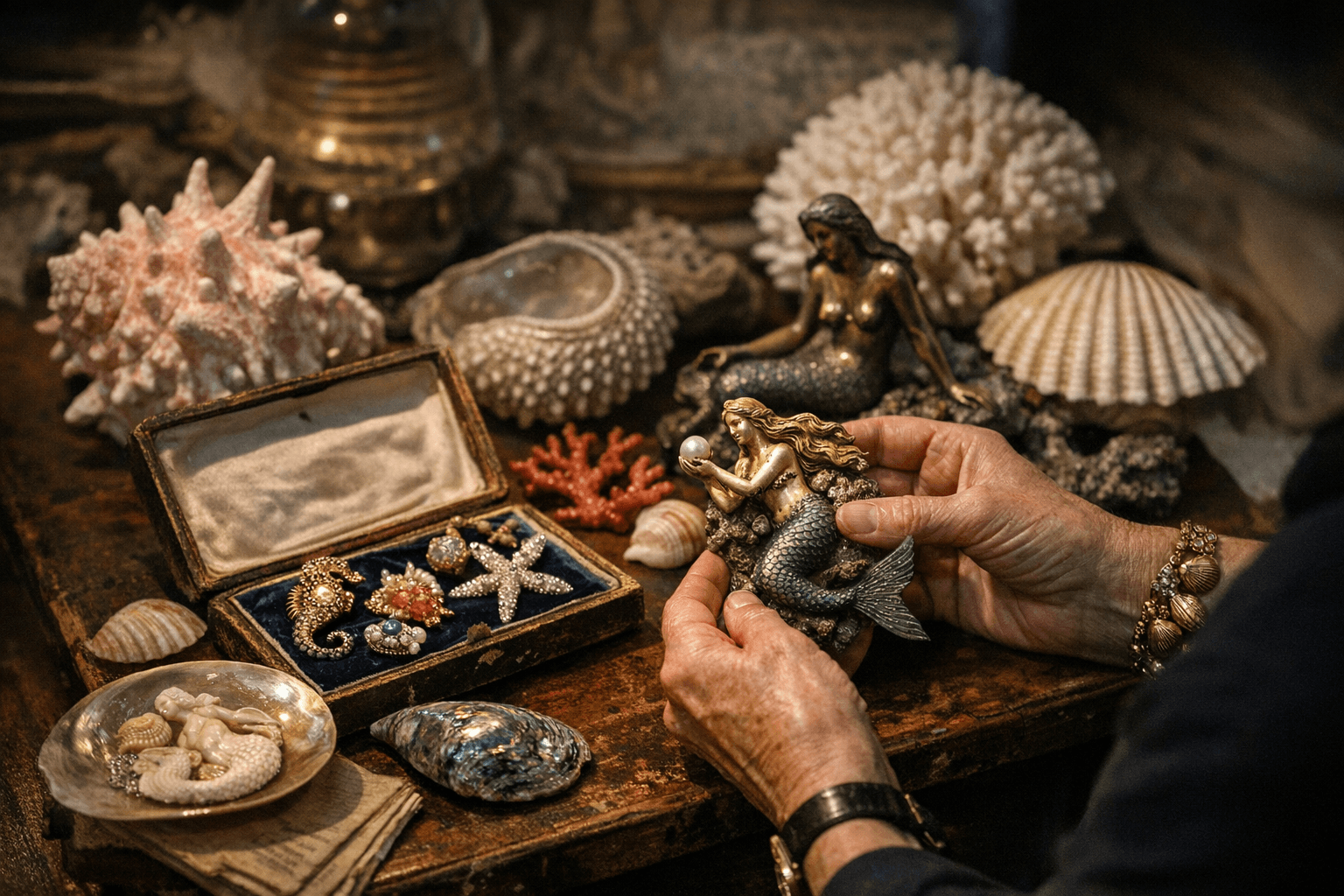
Fish and mermaid designs can be the hardest to read, which is exactly why they are so rewarding. The Metropolitan Museum of Art holds a pendant in the form of a mermaid dated 1870 to 1895, and the details of that jewel echo unpublished designs by Aachen goldsmith Reinhold Vasters now in the Victoria and Albert Museum. That connection is the kind of evidence collectors should love: a single jewel that links period taste, workshop imagination, and the wider decorative arts story.
Mermaid jewelry with true collector interest tends to balance fantasy with structure. The best examples are not merely cute or theatrical; they show deliberate line, convincing anatomy, and metalwork that gives the figure presence even at a small scale. Fish motifs work similarly. Whether rendered as a brooch, pendant, or charm, the pieces worth keeping tend to have sharper engraving, better proportion, and a finish that suggests they were made to be worn long after a seasonal trend faded.
How to read a piece in hand
The quickest way to distinguish a historically rooted sea-life jewel from a modern novelty is to slow down and inspect the object like a conservator would.
- Turn it over and study the reverse. Older brooches and pendants often reveal more in the back than the front, from hand-soldered joints to wear patterns at the catch.
- Check the clasp, hinge, bale, and pin stem. These are the places where age, repair, and quality usually announce themselves first.
- Look at the surface finish. Carved shell, coral, and well-made figural metalwork should have depth and variation, not a flat, factory-stamped look.
- Judge the scale and restraint. Collectible pieces usually commit to the motif with confidence, while novelty jewelry often piles on detail without real compositional discipline.
- Read the silhouette. A mermaid pendant or fish brooch should feel designed, not merely illustrated.
That kind of close looking matters because sea-life jewelry lives or dies on craftsmanship. A piece can be charming on a tray and still be forgettable in the hand. The ones collectors keep returning to usually have a strong outline, a tactile surface, and evidence that someone with real skill understood both the motif and the medium.
Why the institutional context matters to collectors
The Metropolitan Museum of Art’s Costume Institute has more than 33,000 objects spanning seven centuries, a scale that puts ocean-themed adornment in a much larger lineage of fashion and decorative arts. That breadth is important because it reminds you that shell, coral, fish, and mermaid motifs are not fringe curiosities. They are recurring forms that have moved through centuries of dress, design, and display.
For a collector, that institutional backdrop changes the way a jewel is valued. A shell brooch is more interesting when it echoes 19th-century material culture. A mermaid pendant becomes more compelling when it can be read against period goldsmithing and unpublished design sources. Even a contemporary sea-inspired jewel gains more credibility when it participates in a lineage that spans museum holdings, runway references, and the practical pleasures of wear.
What is worth noticing now
The market is rewarding pieces that do more than nod at the ocean. Shells with honest carving, coral with visible natural character, fish rendered with real line, and mermaids with convincing period spirit are the motifs to watch. They bridge contemporary fashion jewelry and vintage costume jewelry, but the most desirable examples are never generic. They have evidence in the metal, a history in the material, and enough design intelligence to feel alive long after the tide of novelty has moved on.
This article was produced by Prism’s automated news system from verified source data, official records, and press releases, then run through automated quality and moderation checks before publishing. The system is built and supervised by the people who set the standards it runs under. Read our full AI policy.
Did this article answer your question?