Decoding Hallmarks and Purity Stamps on Gold, Silver, and Platinum Jewelry
Those tiny numbers stamped inside your ring band are a complete biography in metal — learn to read them and you'll never overpay for a piece again.
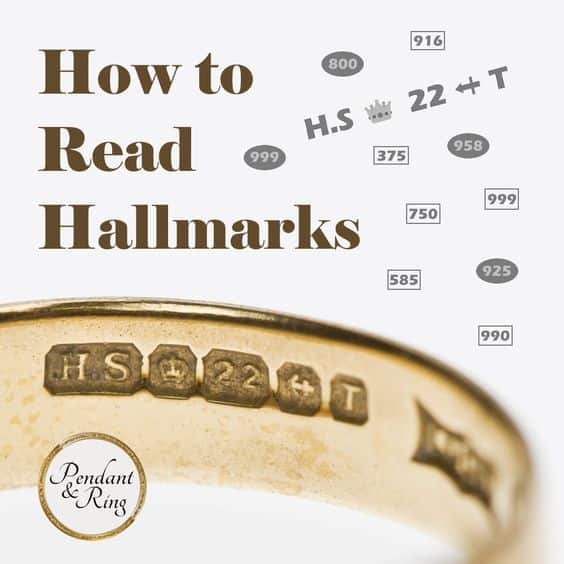
Pick up an inherited brooch or a ring pulled from an estate sale box, and you're holding a small archive. The scratches and patina are one kind of record; the marks pressed into the metal are another, more precise one. Hallmarks are small stamps or engravings that function like a piece's identity papers, capable of revealing metal purity, country of origin, the timeframe of manufacture, and the assay office that certified the piece. Learning to decode them transforms casual admiring into genuine collecting intelligence.
Hallmarks vs. Maker's Marks: Two Different Languages
Before squinting at any stamp, it helps to know which kind you're looking at. Jewelry stamps, also known as hallmarks, quality marks, and maker's marks, are small symbols, numbers, or letter engravings applied during manufacturing that identify a piece's features such as metal type, purity, maker, or origin. The distinction between the two main types matters enormously for authentication.
Hallmarks are typically used in countries with government-regulated systems to identify country of origin, metal content, and sometimes the date or assay office. Maker's marks, also known as manufacturer's marks, identify the jeweler, artist, or brand who created the piece, and can appear as initials, names, or logos. Both may sit side by side on the same ring shank, but they answer entirely different questions: the hallmark tells you what the metal is worth; the maker's mark tells you who made it.
Where to Look
Marks are normally located on the inside of a ring band, on the clasps of necklaces and bracelets, or on the backs or posts of earrings. On antique pieces, the grouping can be remarkably compact, several distinct symbols pressed within a few millimeters of each other. Use a magnifying loupe or jeweler's glass to better see small engravings, since some hallmarks may be faint, especially on older or well-worn pieces.
Reading Gold Purity Stamps
Gold hallmarks are expressed in either karatage, such as 18K or 14K, or millesimal fineness, such as 750 for 18K gold, depending on the country of origin or the manufacturer's preference. The millesimal system, dominant across Europe, expresses purity in parts per thousand rather than parts per 24. The equivalences are exact:
- 10K = 41.7% gold
- 14K = 58.5% gold
- 18K = 75% gold (millesimal stamp: 750)
- 22K = 91.6% gold (millesimal stamp: 916, commonly used in India, where gold jewelry is often marked "22K916" for traditional high-karat pieces)
- 24K = 99.9% gold, often stamped 999
Unlike the karat system, which tells you the gold metal content expressed in parts per 24, the millesimal fineness scale expresses purity in parts per 1,000, stamped as a three-digit number indicating the percentage of gold in the item. Victorian and older British pieces may use the abbreviation "CT" rather than "K": a ring stamped "18CT" and one stamped "18K" or "750" all describe the same alloy.
Brilliant Earth also notes that additional color alloy abbreviations often accompany the karat mark: "YG" for yellow gold, "WG" for white gold, and "RG" for rose gold. A piece incorporating two gold colors might carry a dual stamp such as "14K W&Y," shorthand for white and yellow gold combined.
One category of stamps deserves particular caution. Jewelry stamped with HGE (Heavy Gold Electroplate), GE (Gold Electroplate), or GF (Gold Filled) contains minimal gold content applied over base metals such as copper; these are not solid gold pieces, and their resale and intrinsic value reflect that.
Silver Purity Stamps
Silver uses a parallel numeric system. The most widely recognized stamp is 925, indicating 92.5% pure silver, the international standard for sterling. The "925" stamp indicates sterling silver, meaning the piece contains 92.5% pure silver and 7.5% other metals; this is the international standard for sterling silver. The word forms "Sterling," "STER," and "STG" all carry the same meaning and appear on American and some British pieces in place of the numeric stamp.
Two older European grades appear frequently on antique Continental pieces:
- 950 = 95% silver (Britannia silver, the sole legal British standard from 1697 to 1720)
- 800 = 80% silver (a standard common throughout Continental Europe, particularly Germany, Austria, and Italy, during the 19th and early 20th centuries)
Platinum Purity Stamps
Platinum is measured not in karats but in parts per thousand, making it part of the same millesimal family as European gold and silver marks. The most common hallmarks include 950 (95% pure platinum, the standard for fine jewelry), 900 (90% pure), 850 (85% pure), and 999 (99.9% pure, used for investment-grade bullion). Items may also carry the word abbreviations "PLAT" or "PT," sometimes paired with the fineness number as "PT950." Platinum hallmarking in the UK began in 1975 with the 950 standard; the 850, 900, and 999 standards were added in 1999, meaning earlier platinum items may bear only "PLAT" or "PT" stamps without an official numeric fineness.

Country and Assay-Office Marks
The British hallmarking system is among the oldest and most rigorous in the world. British pieces usually carry three or more marks: an assay office mark, a standard or purity mark, a maker's mark, and often a date letter. The city symbols are iconic: a leopard's head indicates London, while an anchor denotes Birmingham. The metal-type symbols are equally recognizable: a lion passant for sterling silver, a crown for gold, and an orb for platinum.
A Victorian ring illustrates the system beautifully: it might carry a crown symbol alongside "18" for gold purity, the leopard's head denoting assay in London, and a date letter cycling through the alphabet according to the year of hallmarking. Prior to 1998, a British hallmark consisted of four compulsory marks: the maker's mark, the metal purity, the assay office responsible for testing, and the date mark. The date letter is no longer compulsory, but on antique pieces it remains one of the most useful tools for precise dating.
France operates one of the most visually distinctive systems in the world, using pictorial marks rather than numbers. For 18-karat gold (750 fineness), the guarantee mark is an eagle's head facing right, a symbol in continuous use since 1838 and the most frequently encountered French gold mark. French sterling silver at 925 fineness carries a Minerva head, the goddess of wisdom wearing a helmet. Switzerland and Germany tend to use millesimal purity numbers alongside a unique maker's mark or assay office stamp, bridging the pictorial and numeric traditions.
Maker's Marks and the Great Houses
A maker's mark can be as simple as a pair of initials inside a shaped cartouche, or as recognizable as a full brand name. For collectors of Art Deco jewelry, the maker's mark is often the most valuable stamp of all: Cartier, Tiffany & Co., and Van Cleef & Arpels each stamped their rings with proprietary marks during the 1920s and 1930s, and their presence on a piece materially affects both authentication and market value. Whether you're considering a pre-owned diamond necklace from Cartier or a vintage platinum ring, hallmarks act as a roadmap to ensure you're investing in genuine, high-quality workmanship.
Maker's and sponsor's marks typically feature one, two, or three letters stamped inside various shapes or shields, and may represent an individual's initials or letters from a company's name; only an entity registered with an assay office can have such a mark stamped on a precious metal item.
Dating a Piece by Its Marks
The style and content of stamps shift meaningfully across jewelry eras:
- Georgian (1714–1837): Rarely stamped; pieces from this period that lack marks are not necessarily inauthentic.
- Victorian (1837–1901): British pieces may carry "9CT" or "18CT"; the full British hallmark set with date letter and assay office symbol is common on higher-quality pieces.
- Art Deco (1920s–1930s): Look for purity stamps in distinctive stylized fonts. Depending on country of origin, rings may also bear assay marks, date letters, or import marks.
- Retro (1940s–1950s): Sometimes marked with a patent number alongside or instead of a traditional hallmark.
Vintage pieces from approximately the 1920s through the 1980s tend toward cleaner, more standardized stamps, less symbolic imagery and more legible numerals. Modern pieces are the most uniform of all, often carrying only the purity mark and a maker's trademark.
Gemstone Stamps
Purity is not the only information pressed into metal. Certain pieces carry stamps that declare what is set in them. "DIA" denotes a diamond in the setting; "CZ" indicates cubic zirconia, a diamond simulant. On high-end pieces, natural gemstones may be identified by name, with "Sapphire" or "Ruby" stamped alongside the metal marks. Knowing the difference between "DIA" and "CZ" on a ring you're considering at an estate sale is exactly the kind of detail that separates an informed buyer from a disappointed one.
Practical Reading: A Step-by-Step Approach
1. Examine under magnification. Use a jeweler's loupe and look at the obvious locations first: inside the band, near clasps, on pendant backs and earring posts. Marks are usually clustered together.
2. Identify the purity stamp first. The purity number is usually the largest and most legible stamp; once you identify whether you're dealing with gold (common numbers: 375, 585, 750, 916, 999), silver (800, 925, 950), or platinum (850, 900, 950, 999), you have the foundational information.
3. Read any accompanying marks. Note the assay office symbol, maker's mark, and date letter separately. Each answers a distinct question about the piece's provenance.
4. Cross-reference worn marks. Antique hallmarks have a distinctive visual character: hand-stamped impressions that are deep but slightly irregular, with ornate crests, elaborate shields, and symbolic imagery. When a mark is partially worn, compare it against official hallmark charts rather than guessing.
5. Know what absence means. Some antique or artisan pieces may be valuable despite lacking stamps; the marks may have worn away with age or may not have been required at the time of production.
The hallmark system is, at its core, one of the oldest forms of consumer protection in existence, a centuries-long commitment to honesty in precious metals. For anyone buying vintage jewelry, those tiny stamps are not a formality: they are the difference between a story you can verify and one you simply have to take on faith.
This article was produced by Prism’s automated news system from verified source data, official records, and press releases, then run through automated quality and moderation checks before publishing. The system is built and supervised by the people who set the standards it runs under. Read our full AI policy.
Did this article answer your question?