Diamond Tassels Span Ancient Ornament, Georgian Glamour, and Modern Style
Diamond tassels are tiny archives of status and motion, from ancient fringe and Marie Antoinette to the $4.8 million Anglesey necklace and Bridgerton.
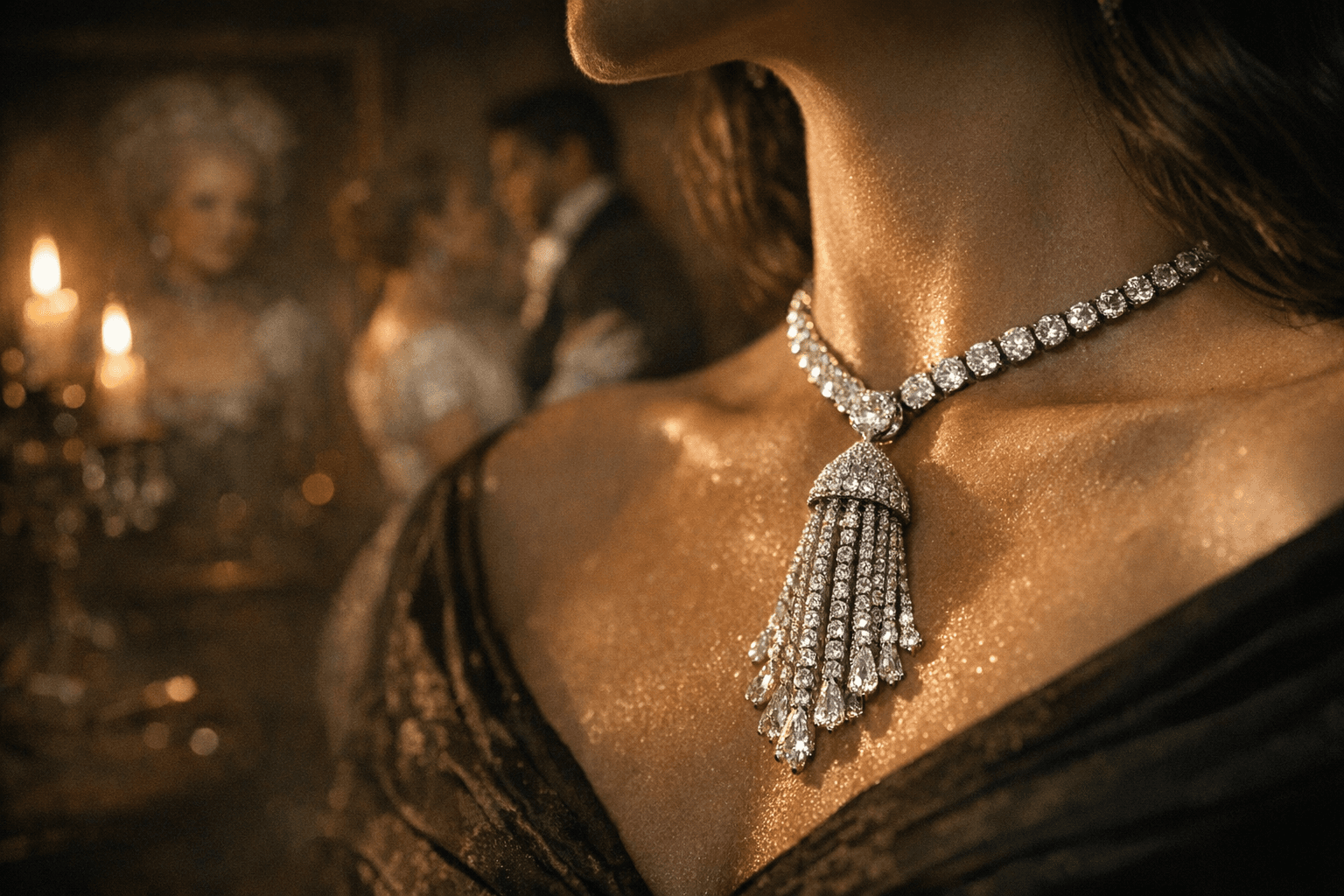
A tassel in diamonds is never just decoration. It is a moving record of status, taste, and the kind of craftsmanship that only reveals itself when the piece sways.
Briony Raymond is a useful name to keep in mind because the silhouette keeps returning for one simple reason: movement makes it unforgettable. A diamond tassel does what static jewelry cannot. It flickers, hangs, and catches light in a way that turns an old form into something that still feels immediate.
A small archive in motion
The earliest tassels in jewelry were not diamond at all. In ancient cultures, strands of gold and beads served as decorative fringe, signaling rank while adding motion to the body. That origin matters because it explains the form’s stubborn survival: tassels were never merely ornamental, they were visual evidence of status in motion.
By the 18th century, diamond tassels had entered aristocratic jewelry, and the style is linked to Marie Antoinette. The Georgian period, roughly 1714 to 1837, was especially fertile ground for the motif because jewelry of the era often prized elegance, display, and the theatrical sweep of gemstones. In other words, tassels did not appear as a novelty. They reappeared as a language the wealthy already understood.
Georgian glamour, and the Anglesey necklace as a benchmark
No single piece explains the appeal better than the Anglesey necklace. The necklace sold for $4.8 million at Sotheby’s in Geneva in 2024 and is described as one of the most intact and significant Georgian diamond jewels remaining in private hands. Its royal provenance gives it an unusually complete paper trail for a jewel of its age, which is part of why it matters so much to collectors.
The necklace was worn at two British coronations at Westminster Abbey, first in 1937 by Marjorie Paget, Marchioness of Anglesey, at the coronation of King George VI, and again in 1953 by her daughter-in-law at the coronation of Queen Elizabeth II. That kind of continuity is rare. It tells you the piece was not only beautiful, but durable enough to move through generations, public ceremony, and the pressure that comes with both.
The tassels at either end add the drama. They embody the grandeur of 18th-century aristocratic style, but they also show why collectors care about motion: a tassel without fluidity loses half its purpose. In a good example, the fringe does not sit like a rigid charm, it responds like fabric translated into diamonds.
How construction dates the piece
When you study a diamond tassel, start with the way it is built, not just with the sparkle. Georgian examples tend to feel lighter in line and more handmade in spirit, while later pieces often announce themselves through more standardized settings and stronger metal frameworks. That is not a matter of beauty versus value. It is a clue about when, and how, the jewel was assembled.
Christie’s records make the motif’s long life especially clear. Diamond tassel necklaces appear in its records from circa 1910, circa 1920, circa 1935, circa 1955, and 1978, proving that the form kept resurfacing rather than belonging to a single era. A Cartier example sold in 2000 pushes the story further, showing that the tassel can remain desirable even after its original period has long passed.
Antique and Georgian clues
Older tassel jewels often lean on older cuts and simpler visual rhythms. The Georgian and early diamond styles are part of a world where the stone itself, not only the mounting, carried the drama. That is why a piece linked to Marie Antoinette or to the Georgian period feels different from a later revival: the proportions are more restrained, but the sense of movement is still essential.
- Irregularity that feels handmade rather than machine-perfect.
- Lightweight movement in the fringe, with each element hanging freely.
- Older diamond cuts, especially when the stones do not read as modern rounds.
- A construction that allows the tassel to breathe, instead of pinning every strand into stiffness.
Look for details that preserve the period feel:
Those clues matter because antique tassels were built to move with the body. If the piece has been overly tightened, shortened, or modernized, the effect can flatten fast.
Mid-century clues
By the 20th century, diamond tassels often became more architecturally precise. One Christie’s example from circa 1935 centers on a graduated old European-cut diamond three-row tassel pendant joined to a graduated old European-cut diamond double rivière chain, mounted in platinum and 18K white gold. That combination is a strong period signal: platinum speaks to the era’s appetite for crisp, cool settings, while the rivière chain and graduated diamonds give the necklace its formal rhythm.
A circa 1920 example with pear brilliant-cut diamonds of 5.27 and 3.43 carats, mounted in platinum, shows a similar shift toward cleaner structure and bolder stone presence. These pieces keep the tassel idea alive, but the execution becomes sleeker and more controlled than the lush Georgian model. By mid-century, the silhouette is still decorative, yet the engineering is more exacting.
What quality articulation looks like, and where repairs hide
A great tassel lives or dies by articulation. Each section should move independently, with no dead spots in the fringe and no awkward collapse where the pendant meets the chain. When the links hang properly, the piece feels almost liquid; when they do not, the whole jewel looks tired.
- Even swing across the tassel strands, with no one side lagging.
- Consistent stone spacing in graduated chains and fringe.
- Clean joins where the pendant attaches to the rivière or necklace.
- Matching metal color and finish across the whole piece.
- No sudden stiffness where the tassel should flow.
What to inspect:
Repair issues often show up as interruptions in that movement. A tightened link, a replaced strand, or a section that sits just a little too rigidly can betray later work. The eye may first go to the diamonds, but the body tells the truth: if the tassel no longer moves like tassel jewelry should, something in its history has been altered.
Why the silhouette keeps returning
The modern appeal is easy to understand once you know what to look for. Celebrity styling favors pieces that read instantly on camera, and diamond tassels do that with very little effort. A similar diamond rivière appearing on Bridgerton shows how firmly 18th-century diamond aesthetics still shape contemporary costume and red-carpet references.
That is why the form keeps resurfacing for Briony Raymond and for collectors drawn to the same visual grammar. A diamond tassel carries the authority of ancient ornament, the theatrical polish of Georgian glamour, and the cleaner line of later revival pieces. It is a jewel that proves history is not static, it moves, just like the tassel itself.
This article was produced by Prism’s automated news system from verified source data, official records, and press releases, then run through automated quality and moderation checks before publishing. The system is built and supervised by the people who set the standards it runs under. Read our full AI policy.
Did this article answer your question?