Beginner’s guide — how to buy estate and vintage jewelry at auction (what to check and questions to ask)
Buyer's premiums alone can add 27% to your hammer price at major houses — here's the exact checklist that turns auction nerves into confident bids.
Pick up a Georgian mourning ring pulled from an estate sale and you're holding a small archive: a strand of hair pressed under crystal, a name engraved in a copperplate hand, a grief made permanent in 18-carat gold. That object passed through at least two centuries before landing in a lot. Whether you pay a fair price for it, or get burned, comes down almost entirely to preparation. Auction rooms reward the informed and punish the impulsive, but the knowledge gap between a first-timer and a seasoned collector is narrower than the houses would like you to believe. What follows is a chronological playbook, from the week before the sale to the moment the shipping crate arrives at your door.
Before You Go: Research Is the Real Bid
The single most useful thing you can do before attending any estate or antique jewelry auction is to study past sale catalogues and hammer results for comparable pieces. Most major houses publish these online. If you're chasing an Edwardian platinum and old-mine diamond brooch, pull the last twelve months of comparable lots at Christie's, Sotheby's, and Bonhams and map the price range. You're not looking for an average; you're looking for the floor, the ceiling, and the outliers, because outliers tell you when condition, provenance, or celebrity ownership skewed a result.
Know the metal-and-era combinations that command premiums. 18-carat gold (stamped 750 in European hallmark systems, or carrying a British assay office lion passant alongside a purity mark) typically trades at a meaningful premium over 9-carat or gold-filled pieces, even when the designs are superficially similar. Research what typical price ranges look like for the specific era, metal, and gem combination you want before you walk into the preview room.
During Preview: What to Look at Before You Bid
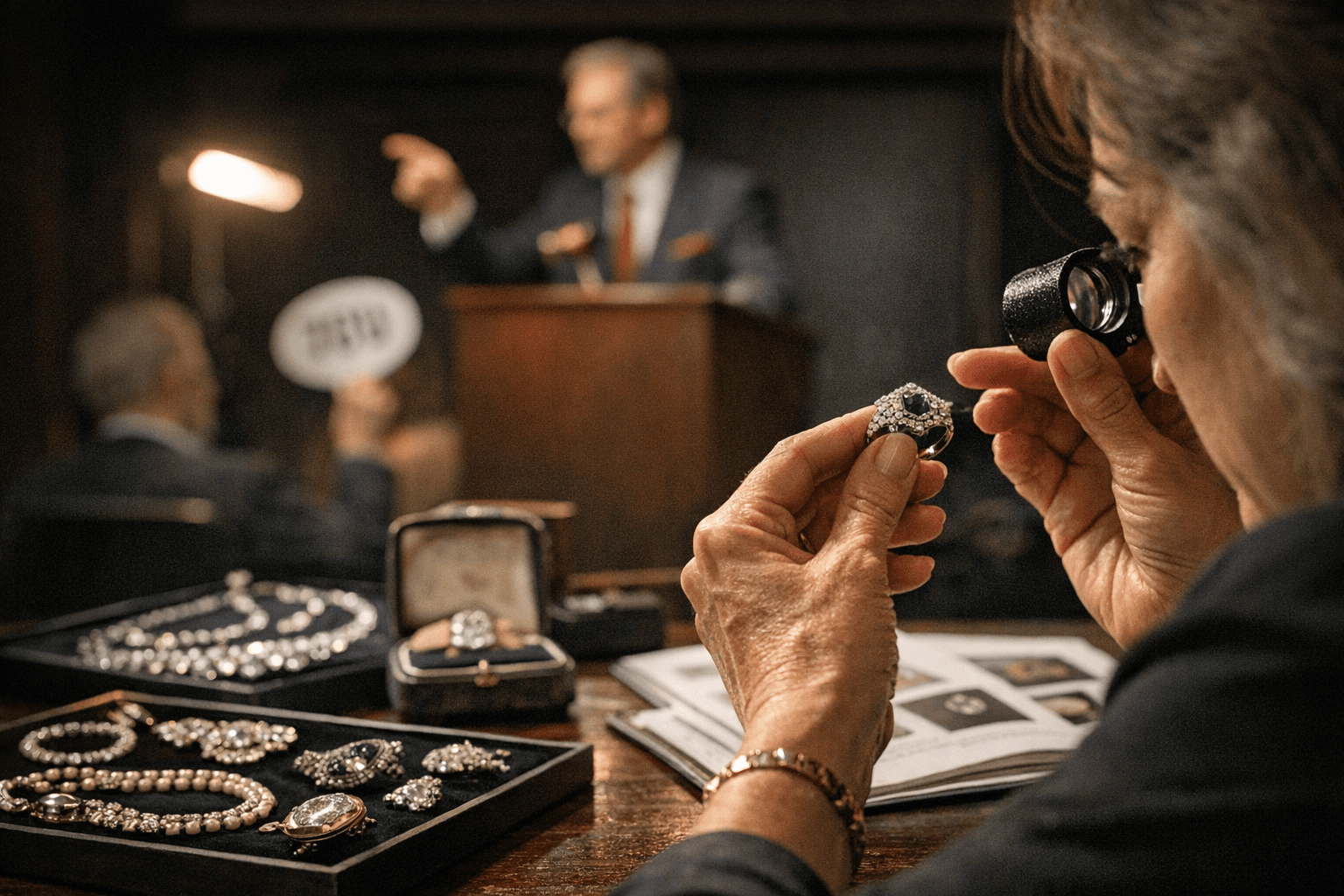
Always read the condition report before anything else. A reputable house will produce one with photographs; if there isn't one, ask why. Then, where possible, inspect the lot in person or request a live video preview. Your eyes (or a loupe, ideally 10x) are looking for four specific things:
- Signs of repair: solder seams at joints, colour shifts along a shank or prong, slightly mismatched patina between sections of a piece.
- Replaced stones: a stone that sits too perfectly, is slightly too large or too small for its collet, or whose girdle profile doesn't match the cutting style of the period is almost certainly a later replacement.
- Cracks in settings: bezel settings on Victorian pieces can develop hairline fractures that aren't visible in photographs but are immediately obvious under magnification.
- Wear consistent with age: genuine age-wear is even and logical (a ring worn on the right hand wears at the shank sides; a brooch's pin-stem wears at the catch). Artificially distressed pieces tend to wear in the wrong places.
- Has the item been tested for metal purity, and can I see those results?
- Are any of the stones replaced, and if so, when and by whom?
- Is there a condition report with photographs available in writing?
- What is the full provenance history, and is it documented?
The right questions to ask the specialist:
Authentication Primer: Hallmarks, Marks, and What They Mean
Hallmarks are the starting point, not the finish line. In Britain, a complete hallmark includes a maker's mark (initials in a cartouche), an assay office mark (the London leopard's head, the Birmingham anchor, the Edinburgh castle), a standard mark for purity, and, from 1975 onwards, an optional date letter. For gold, 18-carat is marked 750; for sterling silver, 925 alongside a lion passant. Some very early Victorian and Georgian pieces predate numerical purity marks and carry only assay office symbols and a maker's mark, which requires cross-referencing against specialist reference databases.
Beyond hallmarks, look for date stamps, designer signatures, patent numbers, and trademarks. These can provide more context and help verify a piece's age and authenticity. For pieces attributed to a named house, ask specifically for provenance documentation and any service or restoration history. A Cartier ring with its name removed from the cartouche is worth considerably less than one that retains it; a Cartier ring with a cleaning receipt from the Paris atelier dated 1962 is worth more than one without.
For gemstones above a meaningful size and value threshold, independent laboratory reports are non-negotiable. GIA (Gemological Institute of America), established in 1931 and widely regarded as the foremost authority on diamonds, should be your baseline for white stones. AGL (American Gemological Laboratories) carries a strong reputation as the premier colored-stone lab in the United States, and many auction specialists will flag an AGL report as essential for significant colored gemstones. If a lot description says "Burmese ruby" but there's no AGL or Gübelin origin report, that attribution is an opinion, not a fact.
Bidding: Set the Number Before the Gavel Rises
Set a firm maximum price before you enter the room or place an absentee bid, and build the buyer's premium into that ceiling, not onto it. At major international houses, premiums are tiered: Sotheby's New York, for example, has structured its rates at around 27% on the hammer price up to $1,000,000, stepping down from there at higher price points. Phillips introduced a revised fee structure in 2025 that rewards early written bids placed at least 48 hours before the auction. Smaller regional houses typically charge 20-25% flat. At any house, the premium is not negotiable once the hammer falls.
If you can't attend in person, absentee and online bidding are reliable alternatives, but read the incremental bidding policy carefully. Many houses will bid in increments on your behalf up to your maximum, meaning another bidder could win a lot for one increment above your second-highest bid with no way to respond. For high-value lots, consider attending or streaming live.
The True Cost Calculator: What the Hammer Price Doesn't Include
Before you set a maximum bid, run this calculation:
- Hammer price (your ceiling, before anything else)
- Buyer's premium: 20-27% at major houses on the first $1,000,000
- Sales tax or VAT: varies by jurisdiction; in some US states, antiques are taxable
- Insured shipping: a platinum Art Deco bracelet in a padded case going cross-country costs more than a standard parcel; budget accordingly
- Conservation: a loose stone, a broken clasp, or worn prongs need immediate attention from a qualified conservator, not a high-street jeweler
- Resizing: a ring that's two sizes too large requires shank work; on a piece with continuous pavé or a delicate hand-engraved design, that cost is significant
- Independent appraisal: for insurance purposes, budget $150-$400 for a certified appraisal from an independent gemologist, not a dealer with a financial interest in the valuation
A lot that hammers at $2,000 can realistically land on your doorstep at $2,900 before any repairs or resizing.
After You Win: The Post-Sale Checklist
Most auction sales are final. Unlike retail, there is no return window once the invoice is issued, which makes the pre-sale steps above genuinely consequential, not just precautionary.
1. Arrange insured shipping immediately; don't collect informally. Get a written receipt from the house before the piece leaves their custody.
2. Photograph everything as it arrives, still in the packaging, then again after unpacking.
3. Keep all documentation: the lot description, the invoice, any condition report, any lab certificates, and your own purchase correspondence.
4. Schedule an independent appraisal for insurance within 30 days. Your homeowner's policy almost certainly doesn't cover fine jewelry at auction value without a scheduled rider.
5. Confirm payment and collection deadlines with the house immediately after winning; most require settlement within five to seven business days.
When to Bring in Specialist Help
Two categories of lot consistently justify the cost of a buyer's agent or independent specialist: rare early periods and scientifically complex stones. Georgian jewelry (pre-1837) is minimally hallmarked, frequently repaired, and poorly documented in general auction catalogues. Early Victorian pieces share some of these challenges. A specialist who works specifically in this period will spot a marriage piece (a clasp from one item, a pendant from another, united by a later hand) that a generalist or an auction specialist handling 400 lots a sale simply won't flag.
On the gemological side, Type IIb diamonds (the category that includes the Hope Diamond, noted for their blue color and semiconductive properties), natural versus cultured pearls, and Burmese versus synthetic-origin rubies all require laboratory testing that goes beyond standard grading. The difference between a natural Basra pearl necklace and a cultured one can be $200,000 on a single lot; the difference between a GIA-confirmed no-heat Burmese ruby and an untested one is similarly dramatic. These are not cases for self-education at the preview table.
One-Screen Summary: Save or Share Before You Bid
Before you go: Study comparable hammer results. Know the metal/era/gem price range. Set a total budget including premium, tax, and shipping.
At preview: Ask for the condition report in writing. Use a loupe. Check for replaced stones, repairs, and wear. Verify hallmarks against reference.
- Has metal purity been tested?
- Are any stones replaced?
- Is provenance documented?
- What is the exact buyer's premium structure and all additional fees?
- What are the payment and collection deadlines?
Questions to ask the specialist every time:
Red-flag answers: "We're not sure about the stones." / "The condition report isn't ready yet." / "It's Burmese — you can tell by the color." / Vague provenance ("from a private European collection" with no documentation).
After winning: Insure in transit. Photograph on arrival. Schedule independent appraisal. Keep every document.
Get a specialist if: the piece is Georgian or early Victorian, the gemstones are potentially high-origin colored stones, or the lot is attributed to a named house without paperwork to match.
The auction room is one of the last places where you can still buy a piece of genuinely rare jewelry at a price that reflects knowledge rather than retail markup. That advantage belongs entirely to the buyer who showed up prepared.
This article was produced by Prism’s automated news system from verified source data, official records, and press releases, then run through automated quality and moderation checks before publishing. The system is built and supervised by the people who set the standards it runs under. Read our full AI policy.
Did this article answer your question?