Gold Hallmark Numbers Explained: What 375, 585, 750, 916 & 999 Mean
Those three digits stamped inside your grandmother's ring are a precise chemical fingerprint — decode them and you hold the full story of where, when, and for whom that gold was made.
Every piece of gold jewelry is, in a sense, a small archive. The ring pulled from an estate box, the chain untangled from a velvet pouch, the bangle bought at a street market in another country: each one carries a tiny stamped number that encodes its chemistry, its likely origin, and its era. Learning to read those numbers is one of the most practical skills a jewelry buyer or collector can develop, because it transforms guesswork into certainty before money ever changes hands.
The Conversion Chart: Save This
The system behind most gold stamps is called millesimal fineness. Rather than describing gold content as a fraction of 24 (the karat system), it describes it as parts per thousand. A number stamped on a piece of gold simply tells you how many of every 1,000 parts are pure gold. The five marks you will encounter most often, and their karat equivalents, break down like this:
- 375 = 9 karat = 37.5% pure gold
- 585 = 14 karat = 58.5% pure gold
- 750 = 18 karat = 75% pure gold
- 916 = 22 karat = 91.6% pure gold
- 999 = 24 karat = 99.9% pure gold
Converting between the two systems takes one step: to go from karats to a millesimal number, divide the karat by 24, then multiply by 1,000. Eighteen karats gives you (18 ÷ 24) × 1,000 = 750. To reverse the process, divide the millesimal number by 1,000, then multiply by 24: (585 ÷ 1,000) × 24 = 14.04, which rounds to 14 karats. The slight rounding explains why 14-karat gold technically comes out to 58.333% pure gold but is conventionally stamped 585.
What Each Number Actually Signals
The number alone tells you purity, but the context around it tells you much more.
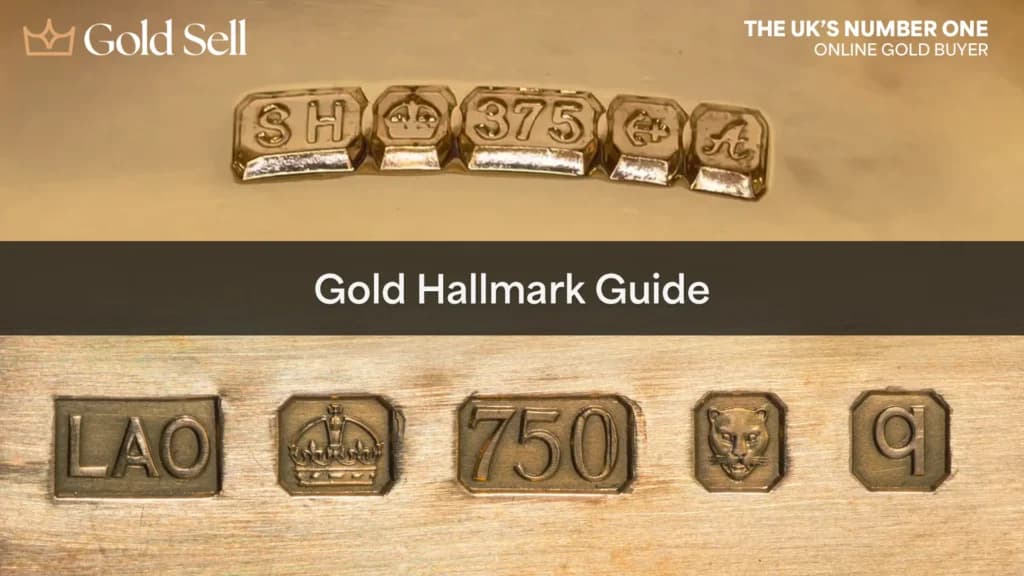
375 is 9-karat gold and is the legal minimum standard for jewelry sold as gold in the United Kingdom. It is the workhorse of British jewelry, preferred for its hardness, its lower price point, and its long tradition in the everyday fine jewelry market. If you find 375 on a vintage piece with additional British assay marks, such as the leopard's head for London, the anchor for Birmingham, or the castle turret for Edinburgh, you are holding a piece made for the domestic British market. The numerical format for UK hallmarks became compulsory in 1999, so older British pieces may instead show the number 9 alongside a crown symbol, the format used between 1854 and 1999.
585 is 14-karat gold, the standard that dominates the American and much of the continental European market. It is a rational compromise: enough gold to carry the rich color and the corrosion resistance the metal is prized for, enough alloy to keep it durable and affordable. In the United States, the Federal Trade Commission requires that any piece stamped with a karat mark also carry a manufacturer's registered trademark, a rule designed to ensure accountability if the stamp turns out to be misleading. Under FTC guidelines, a karat stamp may deviate by as much as half a karat from the stated purity, meaning a piece marked 14K could legally be as low as 13.5 karats, though a stamp reading 14KP (the P standing for "plumb") signals that the purity is exact.
750 is 18-karat gold, the dominant standard in high-end European jewelry and the benchmark for fine watchcases, luxury brooches, and the kind of Italian goldsmithing that commands serious secondary-market prices. Seventy-five percent gold content gives 18-karat pieces a distinctly warm, saturated yellow that lower-karat alloys simply cannot match. A vintage European ring marked 750, with a French eagle's head or an Italian provincial mark alongside it, is almost certainly a mid-century or earlier piece made for a clientele that expected quality to be visible.
916 is 22-karat gold, carrying just enough alloy for workability while remaining visually indistinguishable from pure gold to most eyes. It is the standard of Indian fine jewelry, where the Bureau of Indian Standards (BIS) hallmarking system has codified 916 as the preferred mark for bridal and ceremonial pieces. A piece stamped 916 with South Asian maker's marks is almost certainly intended for a market where gold functions as both adornment and store of value, and where the precise fineness matters enormously to the buyer.
999 is fine gold: 99.9% pure, the standard for bullion coins and bars, and for East Asian ceremonial jewelry where visual richness takes precedence over wearability. Pure gold is too soft for daily use, so 999-stamped pieces are typically investment items, commemorative pieces, or objects meant to be worn rarely.

Color, Durability, and What Your Eyes Can Tell You
Fineness has physical consequences you can observe without any tools. Gold content directly governs color: the higher the millesimal number, the deeper and more saturated the yellow. A 9-karat piece (375) looks noticeably paler than an 18-karat piece (750) because a large fraction of its volume is copper, silver, or zinc. If a piece sold to you as 18 karat looks wan and slightly brassy under good light, that discrepancy is worth investigating.
The relationship between purity and hardness runs in the opposite direction. Pure gold is remarkably soft, which is why 24-karat pieces dent and scratch easily. At 9 karats, the high alloy content makes the metal harder and more resistant to daily wear, which is one reason British everyday rings have historically favored it. The tradeoff is that the alloys introduced to harden the gold are also the source of skin sensitivities: nickel, a common component in white gold alloys and some lower-karat yellow gold alloys, is the leading cause of contact dermatitis from jewelry. If you or someone in your family reacts to certain pieces, fineness is where the investigation begins.
For resale, the logic is straightforward. Higher millesimal numbers mean more gold by weight, which means higher melt value. An 18-karat chain carries roughly twice the gold content of a 9-karat chain of identical weight, and its secondary-market floor price reflects that accordingly.
Red Flags: Stamps That Should Make You Pause
Not every number stamped on a piece of metal means what it appears to mean.
- "18K GP" or "750 GP": The letters GP stand for gold plated. The karat number describes the purity of the plating layer only, not the piece itself. A base-metal item electroplated with 18-karat gold is not a gold piece; it is a plated piece.
- "GF" or "RGP": Gold filled (GF) and rolled gold plate (RGP) indicate a mechanical bonding of a gold layer to a base metal. These are more substantial than electroplating but are still not solid gold. A stamp reading "1/20 10K GF" means that 1/20th of the total metal weight is 10-karat gold.
- "HGE": Heavy gold electroplate, sometimes marketed to sound more impressive than standard plating. It remains a plated item.
- Nonstandard numbers: Legitimate millesimal fineness marks are standardized. If you encounter a three-digit number that does not correspond to any recognized standard (375, 417, 585, 625, 750, 916, 990, 999), treat it as a red flag and seek verification.
- Mismatched stamps: A ring shank marked 750 whose setting has a different (or no) fineness stamp may indicate a repair using a different alloy, or, in worse cases, a fraudulent assembly.
- Suspiciously sharp or raised stamps on older pieces: Authentic vintage stamps show the same wear as the surrounding metal. Fresh-looking marks on an aged surface warrant scrutiny.
A Simple Verification Flow Before You Pay for an Appraisal
If you have an unstamped piece or a stamp that raises doubts, work through these steps before committing to a formal assay:
1. Check with a loupe first. Hallmarks on rings are inside the band; on necklaces and bracelets, they are typically on the clasp or a small attached tag. On very fine chains they can be nearly microscopic. A 10x jeweler's loupe reveals marks invisible to the naked eye.
2. Test with a magnet. Gold is not magnetic. If a piece is strongly attracted to a magnet, it contains ferrous metal and is almost certainly not solid gold. This test eliminates the most obvious fakes quickly, though it cannot confirm gold content on its own.
3. The vinegar test. Submerge the piece in white vinegar for approximately 15 minutes. Genuine gold holds its color and luster; base metals and low-quality plating will show discoloration or tarnishing.
4. An acid test kit. Available at jewelers' supply shops, these kits use nitric acid at calibrated strengths matched to different karat levels. Scratch the piece on a testing stone, apply the acid, and read the reaction: real gold at the stated purity shows no dramatic color change; base metals and lower karats will fizz or turn green.
5. Electronic gold testers. Handheld devices measuring electrical conductivity can give a karat reading directly. They range from roughly $100 to $500 and deliver laboratory-level accuracy without damaging the piece.
6. XRF analysis and professional assay. X-ray fluorescence (XRF) scanning is the tool professional dealers and auction houses use: it reads the precise alloy composition non-destructively. A formal assay from a certified office is the definitive standard if significant money is at stake.
The stamp inside that inherited ring is not a formality. It is a condensed chemical biography, a record of the refiner's work, the assayer's verification, and the market the piece was made to serve. Reading it accurately means you are not just buying jewelry; you are reading the object on its own terms.
This article was produced by Prism’s automated news system from verified source data, official records, and press releases, then run through automated quality and moderation checks before publishing. The system is built and supervised by the people who set the standards it runs under. Read our full AI policy.
Did this article answer your question?