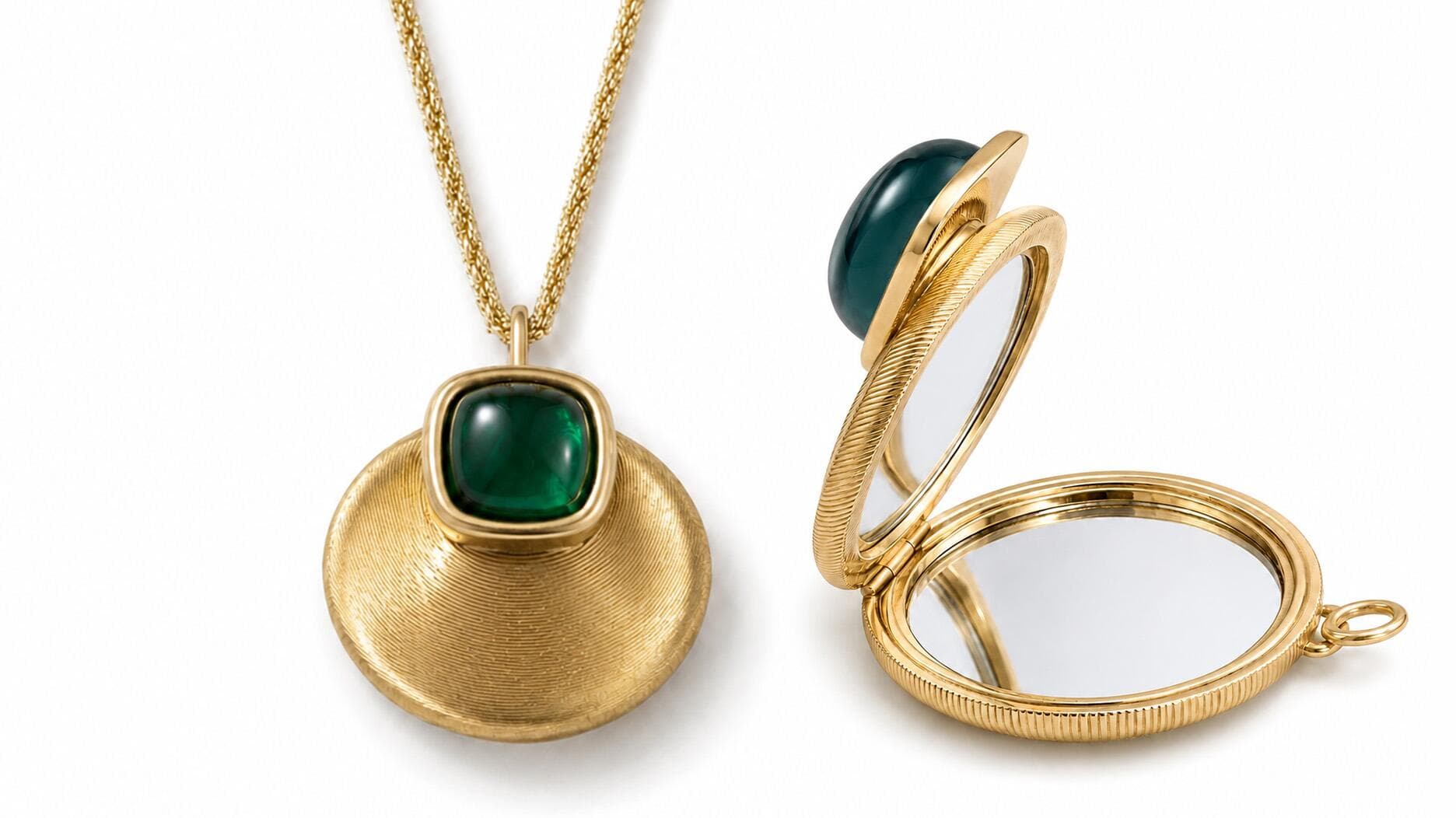
Heritage Auctions Launches Searchable Index for Jewelry Maker's Marks Identification
Heritage Auctions' searchable A-Z maker's marks index turns a mystery stamp into a probable designer, but marks alone can mislead without cross-checking re-strikes and import hallmarks.
Every piece of inherited jewelry is, at its core, an archive waiting to be read. The rectangular punch stamped inside a ring shank, the cartouche pressed into a brooch's reverse, the initials crowded into a necklace clasp: these are the metadata of material culture, encoding maker, origin, and sometimes decade into a mark no wider than a thumbnail. The challenge, for most collectors, has always been translation.
Heritage Auctions built its maker's marks reference to address exactly that work. The database runs A through Z, pairing images of actual designer and maker stamps with background notes that connect each mark to its originating designer or studio and a typical date range of use. Intended as a practical lookup for collectors who encounter initials, logos, or obscure studio stamps on rings, brooches, and signed pieces, the index covers high-value houses including Buccellati, Boucheron, Bulgari, and Tiffany. Its alphabetical image directory makes it navigable not just by designer name but by the visual logic of the mark itself, letting you enter at whatever letter or logo element you can make out and work outward from there.
Before reaching for the database, though, one foundational distinction deserves attention, one the index itself addresses: maker's marks and assay hallmarks are not the same thing, and conflating them is among the most routine mistakes in self-guided identification. A maker's mark is proprietary. It identifies the workshop, designer, or manufacturer who created or retailed the piece. An assay hallmark is a legal certification, applied by an independent testing authority, verifying the purity of the metal and encoding where and when that testing occurred. A ring might carry both marks clustered together in the same hallmarked interior, or it might carry only one. Learning to distinguish them before you search is what keeps a productive inquiry from going sideways at the first step.
The identification workflow that Heritage's index enables begins the moment you can see the stamp at all. Map what you have under a loupe before opening any database. Is the mark enclosed in a shaped cartouche, rectangular, oval, lozenge, or shield? Or does it stand free? Does it contain letterforms, a pictogram, a device, or a combination? What metal is the piece, and does any purity indication appear alongside the mark? These four observations narrow your search more than any keyword. Heritage's image directory lets you enter at the probable initial or visual element and filter by date-range cues in the background notes. A credible probable match is the goal of this first pass, not a final determination.
That distinction matters because marks alone can mislead in ways that even experienced collectors underestimate. Re-strikes are the most misunderstood hazard: a punch used by one studio in one period can be replicated later, either by the same house under different ownership or by a separate maker trading on an established name. The physical stamp might be visually identical to the original while belonging to a completely different production context. Lookalike logos compound the problem. Several mid-century manufacturers used similar script initials or geometric devices, and without the date-range context that Heritage's background notes provide, a match on letter form alone can send an identification in the wrong direction. Import marks introduce a third layer of complexity. When jewelry crossed national borders, receiving countries often applied their own verification stamps alongside the original maker's mark, creating a cluster of punches that can read as multiple maker attributions when only one is original. Understanding this cluster is often where the real identification work begins.
This is why the authentication discipline requires corroboration from at least two independent sources after an initial Heritage match, and why era and style analysis must run alongside the mark research rather than after it. For visual cross-referencing, Global Gemology's Trademark Database is a free resource covering both antique and modern trademarks, notable for providing high-resolution photographs of actual stamps rather than digitized illustrations. The difference between a photograph and a reproduction matters when you are comparing a punch's fine internal lines. For assay marks specifically, the Hallmark Research Institute offers rigorous analysis of international certification systems, including the French Eagle's head and the British Lion Passant, two of the marks most commonly encountered on Continental and British estate pieces and most commonly misread by collectors unfamiliar with European assay conventions.
The era and style check works independently of marks entirely, and it functions as physical evidence that either corroborates or challenges whatever the database returns. The construction of a piece, its setting architecture, its stone cuts and prong gauges, its metal composition and finishing technique, these tell a chronological story that should align with the maker and date range the stamp suggests. A brooch marked with a name associated with 1940s American manufacturing but set with hand-cut Old Mine stones in a silver collet warrants immediate scrutiny. Material evidence that contradicts a mark's implied date range is not a reason to dismiss the identification outright, but it is a reason to proceed to professional appraisal before making any purchase or valuation decision based on attribution.
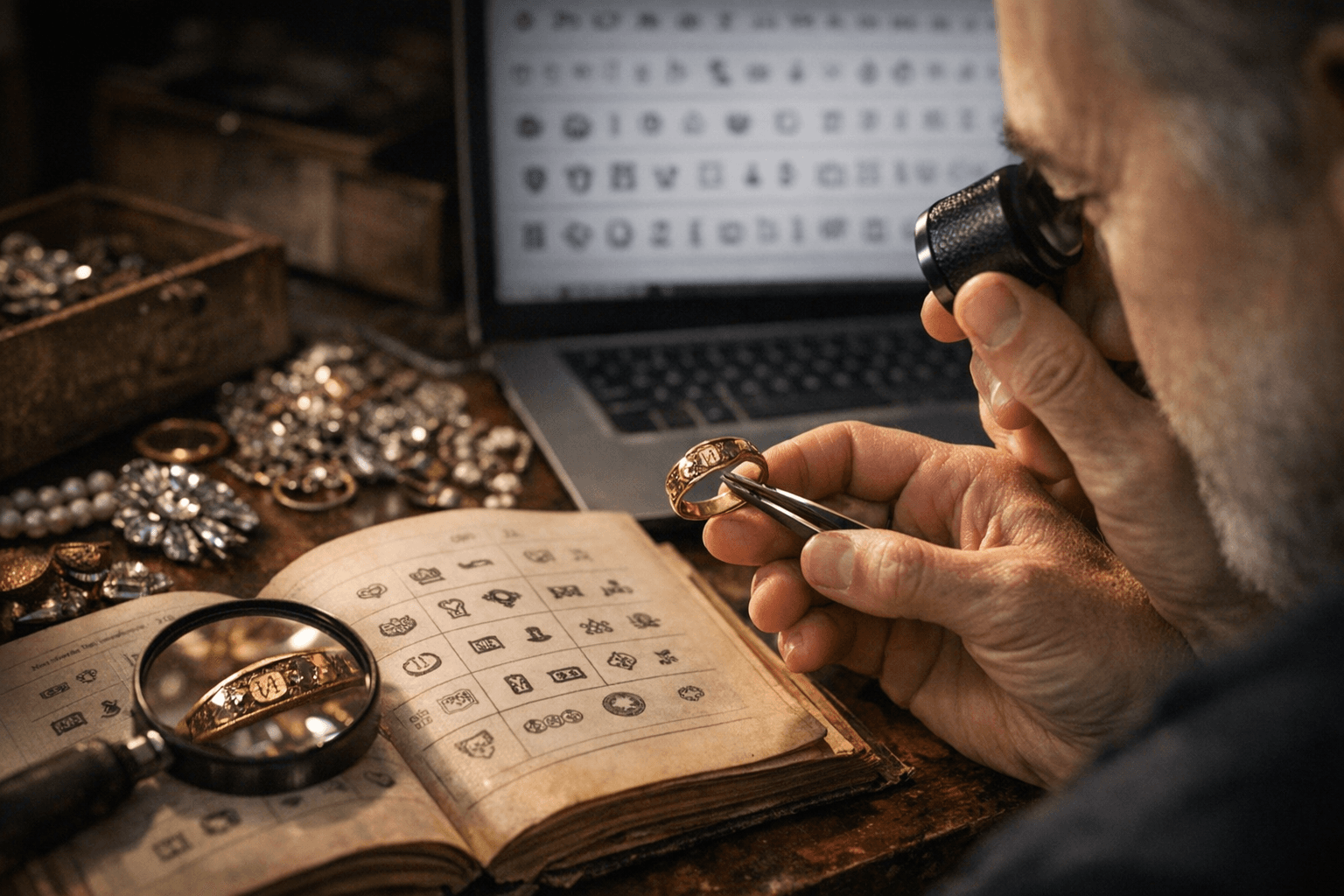
For pieces headed to an appraiser, Heritage's index also functions as preparation. Confirming a signature, narrowing a manufacturing window by matching a distinctive punch, and generating specific questions for a professional appraisal are three practical outcomes Heritage explicitly identifies for the resource. Arriving at an appraisal already knowing that a brooch's cartouche matches Boucheron's mid-century stamp format, and that the assay mark inside corresponds to French gold standards of a particular decade, transforms a general inquiry into a targeted one and makes the appraiser's time more productive.
For high-end luxury pieces where attribution carries the most financial weight, Heritage maintains a separate Designer Gallery focused on authenticated marks for Cartier, Van Cleef and Arpels, and Tiffany. The Gallery is calibrated to help collectors distinguish a genuine signature from an "inspired-by" copy, a meaningful gap when the difference in valuation can run to multiples of what an unverified mark suggests.
When sharing a mark for crowd identification, image quality determines whether the exercise produces a useful response or an inconclusive one. Position the piece on a matte, neutral surface with no reflective background. Use a macro lens or your phone's macro setting and work in diffused natural light or soft artificial light without direct flash, since flash creates hot spots that obscure the fine lines of engraved or struck marks. Shoot a minimum of three frames: one straight-on, one at a slight angle to reveal any depth in the punch, and one showing the mark in the context of the piece's interior surface so that viewers can assess its position relative to the metal seam. Include a scale reference in at least one frame. If multiple marks appear clustered together, photograph the full cluster before isolating individual marks, because the relationship between stamps is itself evidence.
In the field, when neither a loupe nor a laptop is immediately accessible, Google Lens has become a genuinely useful first-pass tool. A clear macro photograph of a distinctive logo or symbol can return a plausible identification in seconds. That identification is a working hypothesis only, requiring verification against Heritage's index and at least one additional database before it carries any evidentiary weight. The tool is most reliable for immediately recognizable house marks and least reliable for the obscure studio stamps where the real identification challenges tend to live.
The broader ecosystem of mark research reflects how specialized these challenges become. Antique Jewelry University, maintained by Lang Antiques, organizes its Maker's Mark Index by letter, symbol, and country of origin, a structure particularly valuable when a mark's national origin is itself in question. For silver, 925-1000.com functions as the field's canonical sterling reference, an exhaustive encyclopedia of silver hallmarks, world trademarks, and initials that the Texas Jewelers Association has described as the "go-to" resource for identification of marked silver pieces. Costume jewelry and mid-century American designers have their own specialist resource in Morning Glory Antiques and Jewelry, whose pictorial guides and "Jewel Chat" articles cover Trifari, Coro, and Miriam Haskell with a granularity that fine-jewelry databases rarely match.
A mark is where the inquiry begins, not where it ends. The stamp on a ring shank is a handshake across decades between maker and collector, but handshakes can be imitated, restruck, and misapplied. What converts a promising database match into a verified provenance is the combination of Heritage's alphabetical image index, independent visual cross-referencing, physical style analysis, and when the stakes warrant it, professional appraisal. That is how an inherited piece stops being a mystery and starts being a record.
This article was produced by Prism’s automated news system from verified source data, official records, and press releases, then run through automated quality and moderation checks before publishing. The system is built and supervised by the people who set the standards it runs under. Read our full AI policy.
Did this article answer your question?