Hong Kong Art Week 2026 Highlights Vintage Jewelry Across Ten Must-See Venues
Hong Kong Art Week 2026 draws collectors across ten unmissable venues, where adornment, craft, and decorative art surface alongside painting and sculpture.
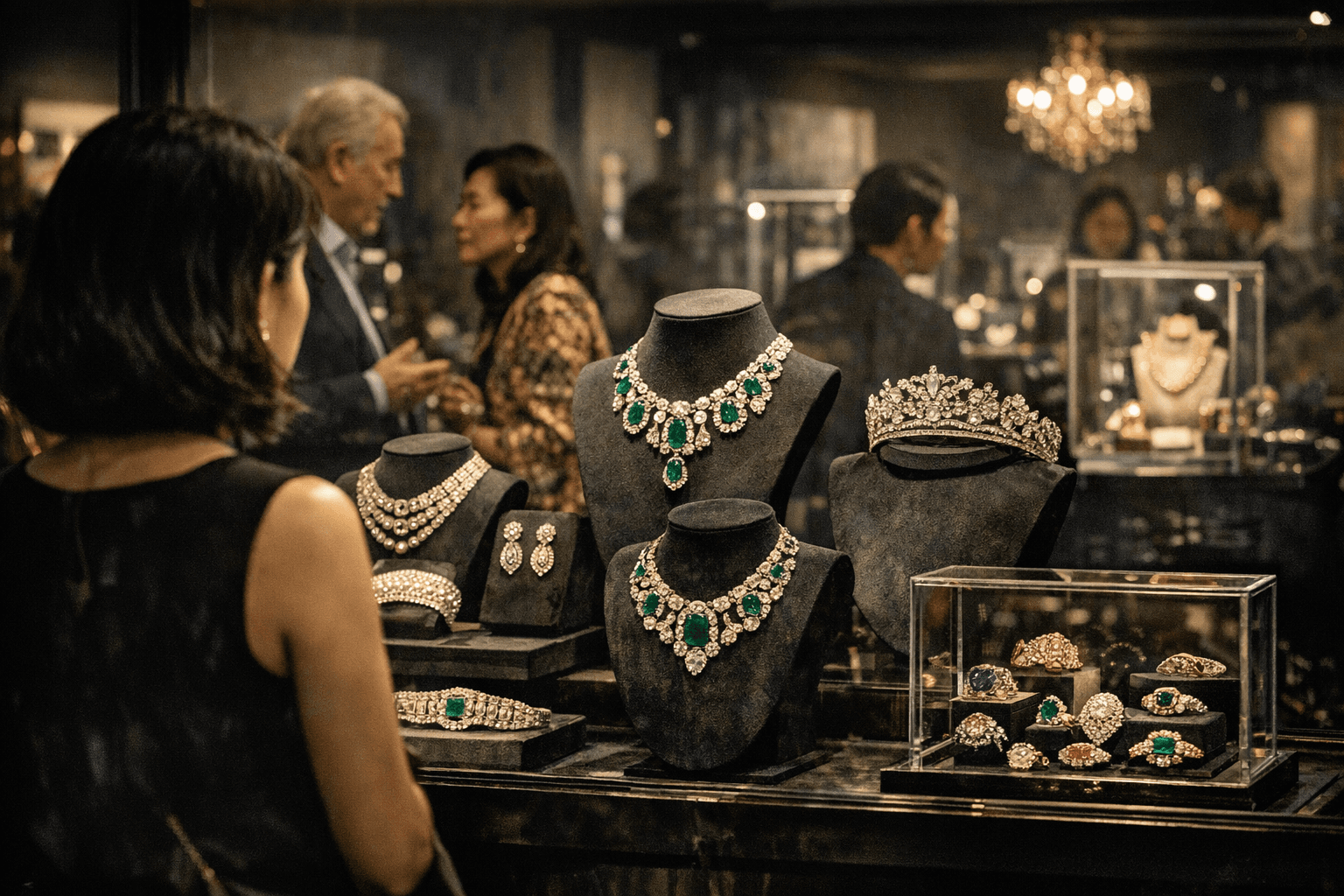
Pick up a piece of Hong Kong's art week in your hand and you're already holding something layered: the city's identity as a free port, a trading hub, a crossroads of craft traditions stretching from Song dynasty jade to contemporary goldsmithing. This March, ten venues across the city offered collectors, dealers, and anyone who cares about how objects are made and where they come from a remarkable range of encounters with art in wearable, decorative, and sculptural form. For those of us who track provenance as closely as aesthetics, Hong Kong Art Week 2026 was an object lesson in how a city's collecting culture shapes what it displays.
Art Basel Hong Kong: The Hong Kong Convention and Exhibition Centre, Wan Chai
The 13th edition of Art Basel Hong Kong held its VIP preview on March 25 and 26, with public days running March 27 to 29 at the Hong Kong Convention and Exhibition Centre in Wan Chai. The fair brought together 240 galleries from 41 countries and regions, including 32 first-time exhibitors, with over half operating spaces in the Asia-Pacific region and 29 based in Hong Kong. For jewelry-conscious collectors, the material intelligence on display ran deep: El Anatsui made his Hong Kong debut at White Cube with a new series of shimmering aluminum and copper wire installations made from thousands of flattened liquor-bottle caps, the material carrying the historical weight of colonial trade routes. The interrogation of ornament, surface, and accumulation that defines Anatsui's practice speaks directly to anyone who thinks about how precious materials accrue meaning. On the fair's first day, Pablo Picasso's *Le peintre et son modèle* (1964) reportedly sold for "approximately" €3.5 million at BASTIAN's booth, a reminder that Art Basel remains where the market's most significant transactions happen.
Art Central: Central Harbourfront
Art Central opened its VIP preview on March 24 at the Central Harbourfront Event Space, with general admission running March 25 to 29; set in a purpose-built structure overlooking Victoria Harbour, a ten-minute walk from Art Basel, it presented over 100 galleries and 500 artists from Hong Kong, Asia, and beyond. Now in its 11th edition, the fair has sharpened its identity as a more emerging-focused counterpart to Art Basel, with this year's edition launching a new Creative Programme curated by Zoie Yung, centered on digital culture and embodiment. Among the standout commissioned works, Kaitlyn Hau's *Recursive Feedback Ritual 0.01* (2026) was described as "some of the most cutting-edge experimentation in the field," while Chaklam Ng's *Shadow Work* (2026) investigated "the evolving relationship between performer and instrument beyond musical output." Art Central typically offers stronger entry-level and mid-market buying opportunities than Art Basel, with works ranging from HK$10,000 up to the high six figures for established names, making it the more accessible entry point for collectors beginning to build.
Tai Kwun: The Former Central Police Station
Locals consistently recommend Tai Kwun, the former Central Police Station that was transformed into a cultural destination in 2018. Claudia Albertini of MASSIMODECARLO Hong Kong called it "not only a space to experience history, art, and culture, but also a pulsing heart at the center of Hong Kong," and during Art Week, Tai Kwun Contemporary hosted live programming alongside "Stay Connected: Supplying the Globe," which brought together works by 40 artists reflecting on globalization and personal histories. The week-long programme ran from March 23 to 29 in collaboration with Art Basel Hong Kong, with "Stay Connected" featuring over 70 works examining globalisation through personal and regional narratives, extending into live performances exploring themes of identity, the body, and social interaction. The compound's layered stone architecture, its former holding cells and parade grounds now repurposed as gallery spaces, gives every object displayed here a charged sense of containment and release.
M+ Museum: West Kowloon Cultural District
Across the harbour, the eight-minute ferry from Central makes M+ one of Art Week's most rewarding detours; the headline show was "Lee Bul: From 1998 to Now," on view through August 9, described by M+ director Suhanya Raffel as "simply a must" and representing the most comprehensive survey of the South Korean artist in Asia to date. Lee Bul's practice is inseparable from the language of adornment: her cyborg sculptures and sequined installations have long interrogated how the body is decorated, armored, and transformed. M+ also presented "Shanshui: Echoes and Signals," described by Pascal de Sarthe as "a profound exploration of the relationship between landscape and humanity in our post-industrial, digital age," as well as a Robert Rauschenberg show focused on the artist's time in Asia. On the M+ facade, a co-commissioned animated work, *3 to 12 Nautical Miles* by Pakistani-American artist Shahzia Sikander, traces the historic links between the British East India Company, Mughal India, and China during the Qing dynasty, screening nightly until June 21.
Hong Kong Palace Museum: West Kowloon
A short walk from M+, the Hong Kong Palace Museum was presenting "Heavenly Horses" to celebrate the Year of the Horse in 2026, with 100 artworks spanning the 13th century to the present, tracing the history of horse painting. The museum's broader collection and programming represent a vital counterpoint to the commercial fair circuit: the institution showcases heritage artifacts including priceless ceramics and antique silks from local collectors, materials that inform how Hong Kong's most sophisticated buyers think about provenance, rarity, and age. Collectors whose eye moves between contemporary art fairs and antique jewelry will find the Palace Museum's treatment of historical craft particularly grounding.
Central Gallery District: H Queen's and Surrounding Streets
Many of the week's most significant gallery shows were within walking distance of each other in Hong Kong's Central neighbourhood, with the vertical tower H Queen's housing Hauser & Wirth, and White Cube and MASSIMODECARLO nearby, alongside long-standing spaces such as Pearl Lam and 10 Chancery Lane, fixtures of the city's contemporary art scene since the early 2000s. Standout shows in the area included Nicole Eisenman at Hauser & Wirth, El Anatsui at White Cube, Walter Price at David Zwirner, and Dinh Q. Lê at 10 Chancery Lane. Gagosian presented Mary Weatherford's first solo show in Asia, and Pearl Lam Galleries showcased works by Qiu Anxiong, whose paintings the gallery described as depicting "a dystopian natural world inhabited by displaced animals and human figures." The density of these spaces in a single walkable block rewards the kind of sustained, comparative looking that serious collecting demands.
Pavilion and WEEKENDERS: Satellite Fairs in Central
Two new satellite fairs proved worth tracking alongside the week's larger events: Pavilion, a new alternative fair in H Queen's founded by Willem Molesworth and Ysabelle Cheung of PHD Group, was conceived as a viable platform for younger, more experimental galleries. A short walk away, WEEKENDERS Tiny Little Art Fair, organized by Sansiao Gallery HK at Wilson House on Wyndham Street, brought together seven galleries and dealers from Hong Kong and Japan. Satellite fairs like these are where the most speculative and materially adventurous work tends to surface first, and where collectors who care about wearable and decorative art often encounter makers before the broader market catches up.
Oil Street Art Space (Oi!): North Point
Zoie Yung recommended Oil Street Art Space, known as Oi!, in North Point as a stop slightly outside the main rush; the community-focused venue aims to make art relevant to local audiences. Curator Klaus Biesenbach singled it out at the 2025 Museum Summit as "one of Hong Kong's most compelling cultural spaces," citing its ability to bridge institutional programming and neighborhood engagement. For visitors fatigued by the fair circuit's commercial intensity, Oi! offers a decompression: work at a community scale, often site-responsive, where the relationship between maker and audience is genuinely local.
ArtHouse Tai Hang: Tai Hang Neighbourhood
Running March 21 to 25, ArtHouse Tai Hang, founded by curator Jacky Ho and supported by the Hong Kong Tourism Board, turned the Tai Hang neighbourhood into a city-wide art event, with ten exhibition houses across the district's quiet lanes and heritage buildings showcasing over 50 local and international artists. Standout names included contemporary ink artist Hung Fai, whose works are held in M+ and the Hong Kong Museum of Art, alongside neighbourhood-based Jason Ho, Japanese artist Tomohiro Takahashi, and Brooklyn-based Antone Konst. A HK$250 ticket included a HK$50 dining voucher, making this one of the week's most accessible and unhurried experiences before the main fairs opened. The domestic scale of exhibition houses, objects encountered in rooms rather than booths, changes how you read a piece entirely.
Para Site: Quarry Bay (30th Anniversary Programme)
Also in Quarry Bay, the nonprofit Para Site offered a quieter counterpoint with "Site-seeing," presented as part of its 30th anniversary programme, bringing together artists born between the 1970s and 1990s from across the Asia Pacific and beyond through newly commissioned and recent works exploring urban transformation, memory, and belonging. The Artsy guide that assembled these ten recommendations specifically called out the nonprofit sector as giving Hong Kong's art scene its distinctive character, and Para Site is the clearest proof of that claim. An institution that has spent three decades building a rigorous, research-led programme outside the commercial fair ecosystem represents exactly the kind of sustained infrastructure that makes a city's art culture worth trusting.
Taken together, these ten venues trace a city that thinks hard about how objects move between cultures, accumulate value, and carry history. Art Basel Hong Kong director Angelle Siyang-Le put it plainly: "We are fostering cross-collecting. There are individuals from antiques or ink who are starting to engage with our platforms." That crossover is not incidental. It reflects a city where the boundaries between fine art, decorative object, and wearable form have always been more porous than elsewhere, and where the most attentive collectors have always moved between all three.
This article was produced by Prism’s automated news system from verified source data, official records, and press releases, then run through automated quality and moderation checks before publishing. The system is built and supervised by the people who set the standards it runs under. Read our full AI policy.
Did this article answer your question?