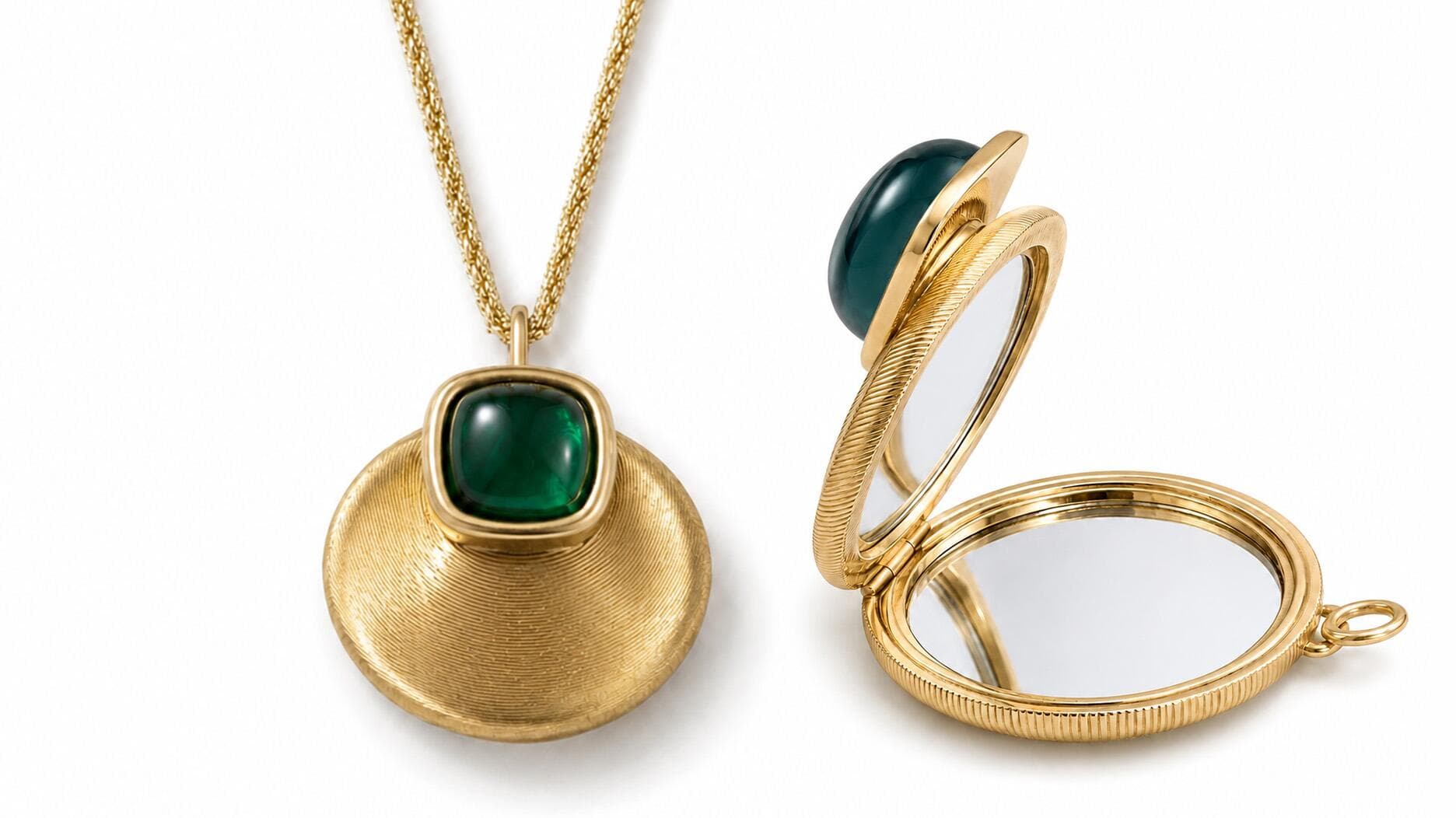
How Designers Find Authentic Antique Jewelry Deals on Etsy
Designers call Etsy a secret weapon for estate jewelry, but only if you know how to search, spot fakes, and vet sellers before spending a dollar.

Pick up a French 18K gold garnet snake ring pulled from an Etsy listing, and you're holding a small archive: the serpent motif popular in Victorian mourning jewelry, the deep burgundy garnets set in rose-cut cabochons, the weight of a century in your palm. Or you might be holding a very convincing reproduction listed with a vague "vintage-inspired" description and a seller who hasn't responded to a message in two weeks. The difference between those two outcomes isn't luck. It's method.
Designers who source consistently from Etsy have developed a rigorous, repeatable process for telling the genuine from the dressed-up, and their approach applies with particular urgency to jewelry. Unlike a mid-century lamp or a Hepplewhite Revival chair, a ring or brooch is small enough to photograph deceptively, easy to misdate, and frequently stripped of the hallmarks that would otherwise confirm its provenance. This field guide walks through exactly how to search, how to vet, and how to walk away from listings that don't hold up.
Why Etsy Remains a Legitimate Source for Antique Jewelry
The platform's reputation for handmade and custom goods obscures something designers have long exploited: its depth as an antiques marketplace. Designers have agreed that Etsy is a secret weapon for finding one-of-a-kind and artisan-made accessories, art, and textiles, but people often underestimate how valuable a tool it can be for sourcing investment-worthy antiques and vintage pieces beyond custom items.
The scale is the challenge and the opportunity simultaneously. There are a lot of listings and vendors spanning the world to sort through to find that antique cabinet or vintage silverware you're hunting down. Some moments feel like a fun challenge, especially if you're just perusing, whereas others can feel like failures if you can't find the exact pieces you're dreaming of. The designers who succeed have learned to work with the platform's architecture rather than against it.
Step 1: Build Your Search Vocabulary Before You Type Anything
The single most consequential skill in Etsy jewelry hunting is precision language. A search for "gold ring" returns tens of thousands of results spanning every era, material, and quality level. A search for "Georgian closed-back foil garnet brooch" or "Arts and Crafts silver enamel pendant Cymric" returns something manageable, and the sellers who write those descriptions have almost certainly done their homework.
Designers recommend being as specific as possible, including exact styles, eras, origins, product names, and even colors. In practice, that means building a vocabulary of period terms before you open the search bar. For jewelry, useful era identifiers include Georgian (pre-1837), Victorian (broken into Early, Mid, and Late), Edwardian, Arts and Crafts, Art Nouveau, Art Deco, Retro (1930s-1950s), and Mid-Century Modern. Supplement era terms with construction vocabulary: cabochon, table-cut, rose-cut, old mine-cut, foil-backed, repoussé, filigree, cannetille, basse-taille. Add material terms: pinchbeck, rolled gold, Sheffield plate, sterling, 9ct, 15ct, 18ct, jet, vulcanite, Bakelite, celluloid. The more precise your vocabulary, the more useful your results, and the more quickly you can tell whether a seller's description reflects genuine expertise.
Alongside precision searching, apply Etsy's 'vintage' filter to ensure you're only looking at secondhand items classified as older and antique. This filter screens out contemporary makers listing "vintage-style" new pieces, which is among the most common sources of confusion for first-time buyers.
Step 2: Use Saved Searches and Favorites to Train the Algorithm
The search process is not a one-session task. Atlanta-based designer Laura Jenkins is direct about the time investment required: "The search takes a long time because there is more to sift through but as you start to 'favorite' items, the Etsy algorithm starts to understand what you are looking for better."
That favoriting behavior is not just bookmarking; it's active calibration. Each item you add to your favorites signals your aesthetic range to Etsy's recommendation engine, so your subsequent search results and homepage suggestions progressively narrow toward what you actually want. Jenkins buys a significant volume of both collectible and costume jewelry from the platform, including vintage Navajo pieces, and she credits patient, repeated searching as the methodology behind consistent finds.
Set up saved searches for your most specific terms. When a new listing matches your saved query, Etsy notifies you. For rarer categories, such as Victorian gold mourning lockets or signed Miriam Haskell parure sets, new listings may appear infrequently; a saved search means you don't have to remember to check manually.
Step 3: Vet the Seller Before You Examine the Listing
Even the most beautifully photographed listing is only as trustworthy as the seller behind it. The vetting sequence should begin with seller history, not product photos.
Look for Star Seller status, a designation Etsy applies to shops that maintain consistently high ratings, on-time shipping, and responsive messaging. Read through reviews with attention to specificity: a review that says "beautiful ring, exactly as described" is less informative than one that says "the hallmarks were clearly photographed and matched the description, the piece arrived well-packaged, and the seller answered my follow-up about the assay mark within hours." Reviewers who mention hallmarks, condition accuracy, and seller communication are the ones who were also vetting carefully.
Check how long the shop has been active and how many sales it has completed. A shop with 400 completed sales and a consistent aesthetic (specializing, say, in Scandinavian silver or American Arts and Crafts pieces) tells a different story than a shop with 12 sales, a wildly mixed inventory, and no clear area of expertise.
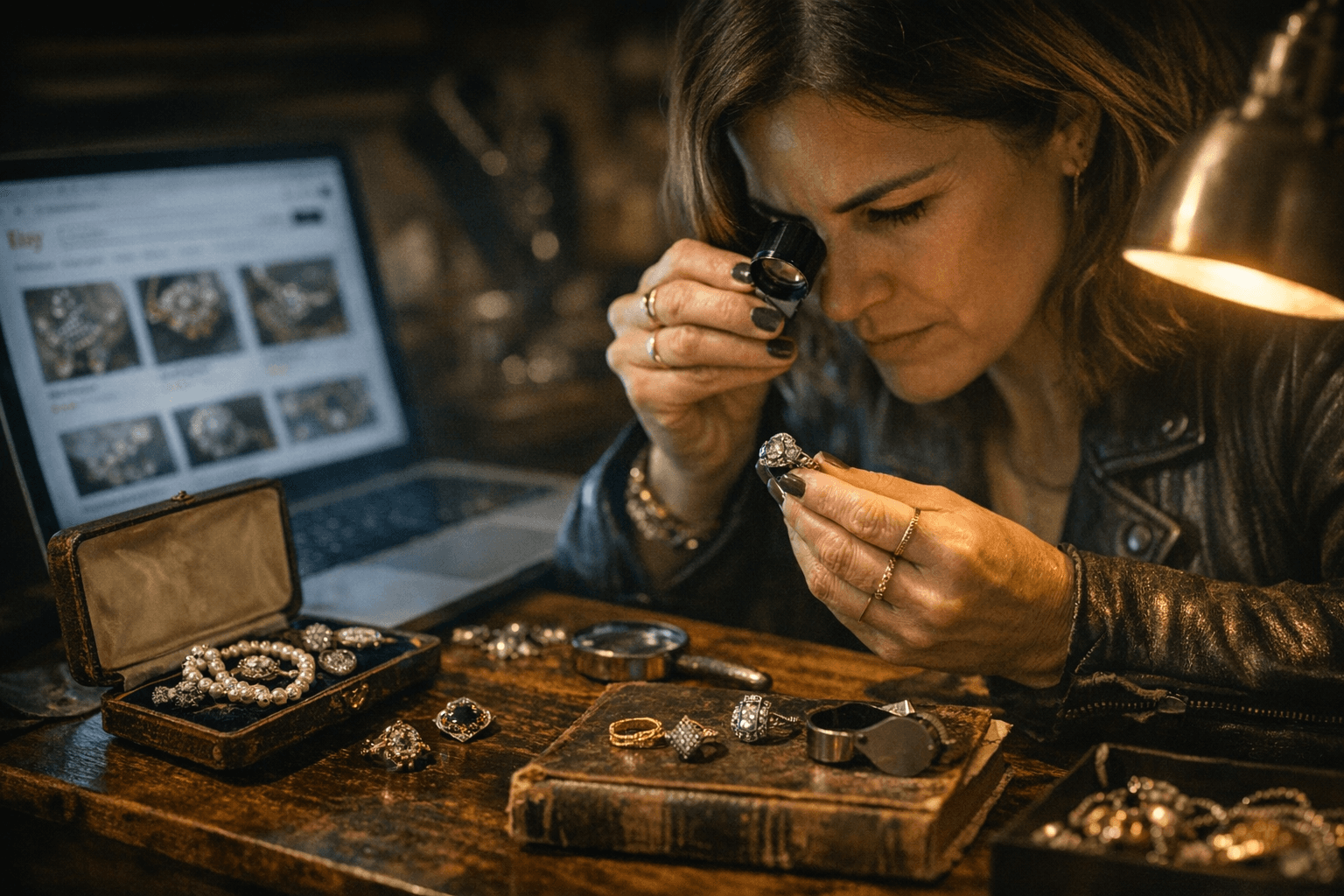
Step 4: Use Messaging as Your Primary Verification Tool
Richmond, Virginia-based designer Elly Poston describes messaging as the cornerstone of her vetting process: "We always ask sellers questions about their items before purchasing, so we rely on messaging to gauge trust. It helps if they respond quickly and provide clear answers to our questions."
The speed and quality of a seller's reply is itself diagnostic. A knowledgeable seller who lives with their inventory can answer specific questions about hallmarks, condition, measurements, and provenance within hours. A seller who can't answer or deflects to the listing description when you've asked for something not pictured there is a meaningful warning sign.
When messaging, request close-up photographs of hallmarks, clasps, and any areas showing wear or repair. Ask for measurements (length, width, weight if possible). For metal pieces, ask whether the seller has any testing information, such as acid test or XRF results, confirming metal content. Designers recommend requesting measurements and testing information explicitly, including metal tests, particularly for pieces described as gold or silver without a clearly legible assay mark in the provided photos.
Also confirm the seller's return policy in detail before purchasing. A seller who offers no returns on antique jewelry, combined with vague descriptions and slow messaging, should give you significant pause regardless of how appealing the piece looks.
The 10 Fastest Red Flags for Reproductions and Misdated Pieces
Experienced collectors develop an eye for the signals that a piece has been misrepresented, either deliberately or through a seller's own uncertainty. Watch for these:
- The description uses "vintage-style," "vintage-inspired," or "antique aesthetic" rather than asserting a specific era.
- Photographs show no evidence of wear: no patina on sterling, no slight scratching on clasps, no wear at contact points on rings or bracelets.
- The piece looks machine-perfect. Genuine pre-industrial jewelry carries slight asymmetries and tool marks that modern reproduction casting does not.
- Hallmarks are absent on pieces from countries and periods where hallmarking was legally required (British gold and silver items assayed after the 14th century, for example, carry regulated marks).
- The clasp or finding style is inconsistent with the claimed era. A lobster-claw clasp on a "Victorian" necklace is an immediate anachronism; box clasps, toggle clasps, and C-catch brooch fittings each correspond to specific periods.
- The gemstone cuts don't match the period. Old mine-cut and rose-cut diamonds appear in pre-1900 pieces; round brilliant cuts were not in wide use until the early 20th century; perfectly calibrated modern cuts on a claimed Georgian piece warrant skepticism.
- The listing description is copied almost verbatim across multiple sellers, suggesting drop-shipping or bulk reproduction inventory.
- The seller cannot identify where they acquired the piece, beyond "lot purchase" or "estate sale" with no further detail.
- Prong settings are machined and perfectly uniform on a piece claimed to predate industrial casting methods.
- The price is dramatically below comparable authenticated pieces, particularly for items described as 18K gold or set with natural stones.
3 Smart Questions That Expose Evasive Sellers
The difference between a forthcoming seller and a problematic one often emerges not in what they volunteer, but in how they respond to specific questions. These three cut through vague listings efficiently:
1. "Can you photograph the hallmarks or maker's marks at high magnification, and describe what you see stamped on the metal?" A knowledgeable seller will do this immediately.
A seller who responds that the piece has "no marks" on a claimed British silver item, or who sends an unusably blurry photo, has answered your question.
2. "How did you date this piece, and what reference sources did you use?" This question distinguishes a seller who studied their inventory from one who guessed.
A strong answer references specific resources, design elements, or construction details. A weak answer says "it looks old" or "the previous owner said so."
3. "What is your return policy if a professional appraisal disputes the described age or metal content?" This question is not adversarial; it is reasonable due diligence on any meaningful purchase.
A seller who becomes defensive or refuses returns under any circumstances when you've asked politely is signaling that their confidence in the piece's description does not extend to standing behind it financially.
Putting It Together
The designers who find pieces like signed Navajo silver cuffs and 18K gold snake rings on Etsy are not simply lucky browsers. They have built keyword vocabularies, trained algorithms over dozens of sessions, filtered aggressively, and treated the messaging tool as a negotiation rather than a courtesy. They check return policies the way a jeweler checks a loupe: methodically, before the transaction, not after.
The platform's blessing is its global breadth; vintage silverware, collectible costume jewelry, estate lighting, and genuine period rings from sellers in France, Japan, the American Southwest, and everywhere between are accessible from a single search bar. The discipline required is calibrating your expectations to the effort: patience and specificity are not optional enhancements to this process. They are the process. A piece that has survived a century deserves more than a thirty-second browse before it changes hands.
This article was produced by Prism’s automated news system from verified source data, official records, and press releases, then run through automated quality and moderation checks before publishing. The system is built and supervised by the people who set the standards it runs under. Read our full AI policy.
Did this article answer your question?