How Hallmarks and Signatures Help Authenticate Vintage Jewelry Provenance
A tiny stamp can reveal a jewel’s metal, maker, and age. Learn how hallmarks, signatures, and country marks separate original pieces from later marriages.
The first clue is often the smallest one
An inherited ring, a brooch from an estate sale, or a clasp hiding under a chain can carry more history than its setting suggests. The marks tucked into those places, hallmarks, signatures, patent numbers, maker names, metal content stamps, and country marks, are the small archive that tells you what you are really holding. In the right combination, they can point to a maker, place a piece in a period, and separate an original from a later reproduction or marriage.
That matters because vintage jewelry is never just about sparkle. Serious collectors are chasing rarity, prestige, resale potential, and the pleasure of owning something that survived long enough to be worn again. When a piece is signed by a famous house, the value can rise sharply, but only if the mark, material, and construction all agree with the story the jewel is trying to tell.
Start where the light misses
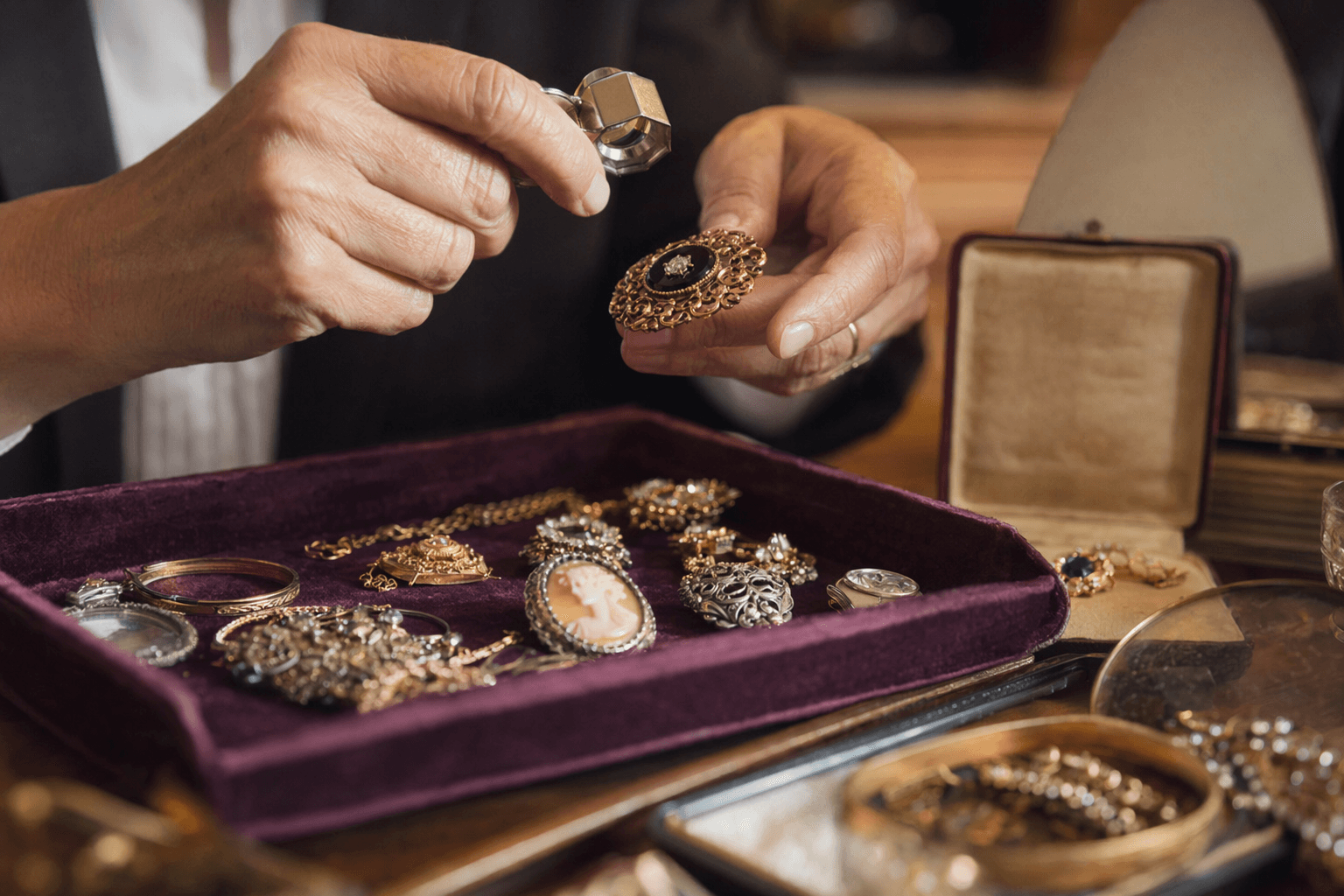
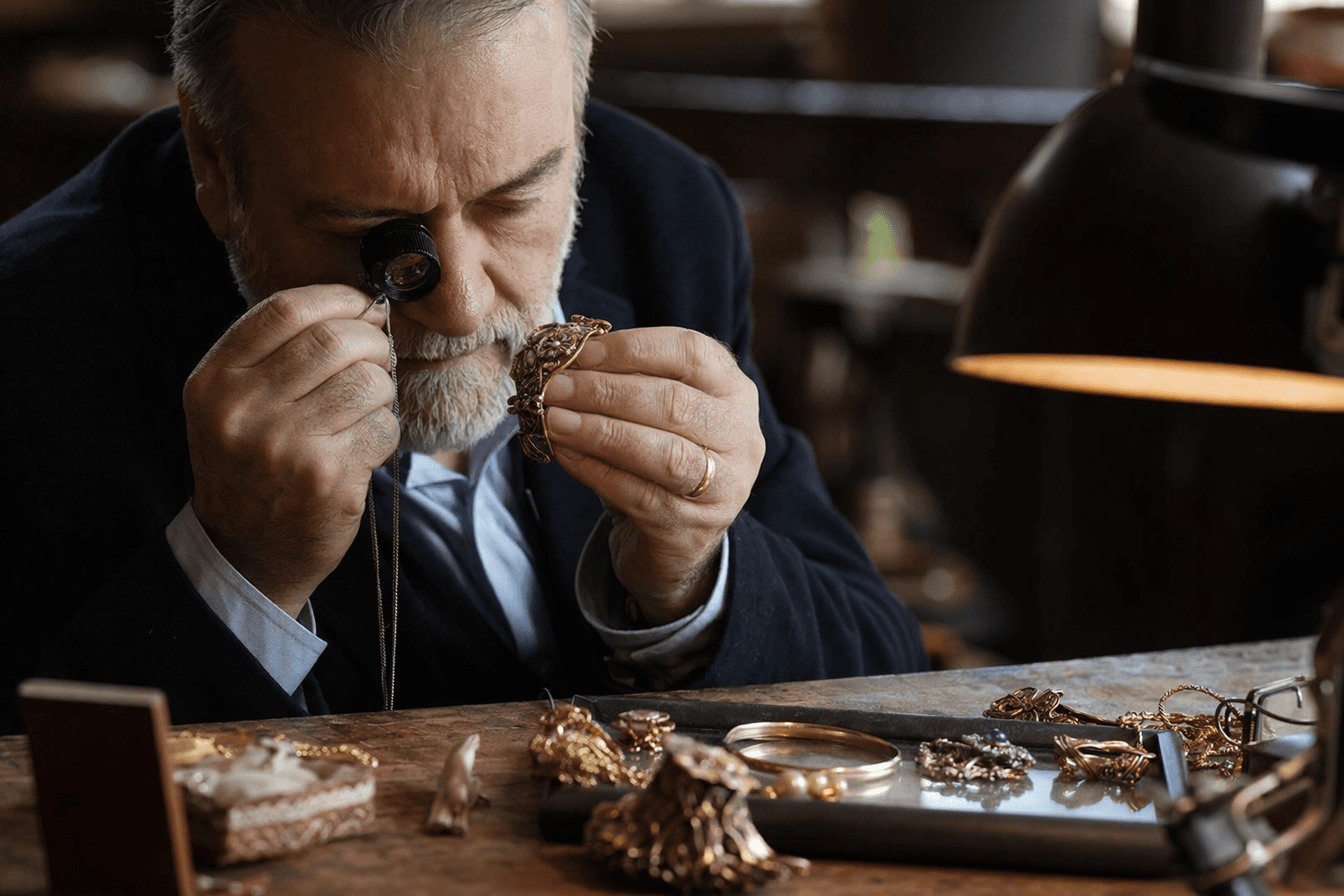
Turn the piece over and look at the least glamorous places first: inside a shank, on a clasp tongue, at the back of a brooch, near a hinge, or along the edge of a pendant bail. Those hidden zones are where marks are most likely to survive wear. A worn stamp may be faint, but even a partial impression can reveal whether you are looking at a maker’s signature, a metal fineness mark, or a country-of-origin clue.
JCK’s identification guide is especially useful here because it treats hallmarks as a material map. The marks that matter most can include signatures, patent or design numbers, the manufacturer’s name, the metal content, and the country of origin. Read together, those details often give a more reliable picture than any single stamp taken alone.
Step 1: Read the metal first
Metal content is the foundation. A stamp that points to gold, silver, or platinum gives you a starting point for verifying the piece against consumer-protection rules that govern precious metals in the United States. The Federal Trade Commission’s Jewelry Guides cover gemstones, laboratory-created and imitation substitutes, natural and cultured pearls and their imitations, and products made from precious metals such as gold, silver, and platinum. In practice, that means the language on a jewel should match what it actually is, not what a seller hopes it looks like.
A second layer of protection comes from the National Gold and Silver Stamping Act of 1906, also known as the Jewelers’ Liability Act. U.S. Customs and Border Protection says the law was enacted to protect consumers from fraud by ensuring that articles marked as gold or silver meet specific fineness standards. For vintage pieces, that makes a gold or silver stamp more than decoration: it is a claim about purity that should make sense in context.
Step 2: Separate maker’s marks from metal marks
A hallmark can tell you who made or submitted the piece, but it can also be a shortcut to a broader history. Maker’s marks are typically organized by country and time period, which is why reference books are arranged that way as well. That structure helps collectors date pieces and connect them to specific manufacturers, especially when a signature or manufacturer name appears alongside a fineness mark.
This is where authenticity gets interesting. A signed piece from a famous house can fetch high prices, but only if the signature belongs to the right era and style. A mark alone is not enough. The clasp construction, the setting style, the alloy color, and the wear pattern should all support the same timeline. When they do not, you may be looking at a later marriage, a repaired piece, or a reproduction that borrowed the language of the original.
Step 3: Decode the full UK hallmark
British jewelry offers one of the clearest systems in the field. Official guidance from the Government of the United Kingdom says a full hallmark tells you who submitted the article for hallmarking, what the final metal is made of, where the article was hallmarked, and, optionally, when it was hallmarked through a date letter. That is a remarkably dense set of clues for one tiny marking.
The assay-office town mark is especially useful because it ties the object to a place of testing. The UK currently identifies four Assay Offices: Assay Office London, Sheffield Assay Office, Edinburgh Assay Office, and Birmingham Assay Office. If you are trying to establish provenance, that town mark can be the difference between a vague attribution and a specific place in the item’s biography.
Step 4: Look for signatures, patent numbers, and design numbers
Some of the most revealing marks are not metal-related at all. A signature from a jeweler, a patent number, or a design number can point you toward a documented model, a production era, or a known manufacturer. Those identifiers are especially valuable in pieces with complex construction, because the design reference can help confirm whether a clasp, brooch mechanism, or mounting belongs to the period you think it does.
When a piece has both a signature and a country mark, the combination becomes even more useful. A signed jewel that also carries a hallmark appropriate to its country and period is more convincing than a single isolated name. If the signature looks right but the manufacturing style feels modern, the mismatch is worth attention. In vintage jewelry, one mark can whisper; several marks speaking together are far louder.
Step 5: Compare the mark to the object itself
A good identification workflow never stops at the stamp. Check whether the metal color, wear, and fabrication align with the mark. An older ring with softened engraving, hand-finished details, and a coherent fineness stamp reads differently from a piece that has a crisp signature but machine-perfect surfaces. The same is true for estate-sale brooches and chains, where later clasps or replaced components can create a false sense of age.
This is also where provenance becomes practical rather than romantic. A jewel with a consistent mark, a believable construction, and a documented maker has a stronger claim to authenticity than one with only a glamorous name. The goal is not to chase a fantasy label. It is to understand whether the piece is original, altered, or assembled from later parts.
Why the marks matter to value
For collectors, the stakes are real. Rarity and prestige drive interest, but provenance turns interest into confidence. A documented maker, a correct country mark, and a hallmarked metal content stamp can materially affect value, especially when the piece comes from a historically important house. The same is true in reverse: vague, inconsistent, or missing marks can lower confidence fast, even when the jewel is beautiful.
That is why hallmarks are so powerful in the vintage market. They do not just authenticate material. They anchor a piece in a place, a system, and a period of manufacture. In a field where so many objects have been repaired, resized, restamped, or copied, the smallest stamp often tells the truest story.
Know something we missed? Have a correction or additional information?
Submit a Tip