How to Identify, Authenticate, and Value Your Vintage Jewelry Pieces
A jeweler's loupe and the right hallmark databases can unlock the full story hiding inside your vintage ring's shank.
Pick up an inherited brooch or a ring pulled from an estate sale, and you're holding a small archive. The metalwork, the stone cut, the faint stamping inside the band: each detail is a sentence in a story that, with the right tools and knowledge, you can learn to read.
Start with the period
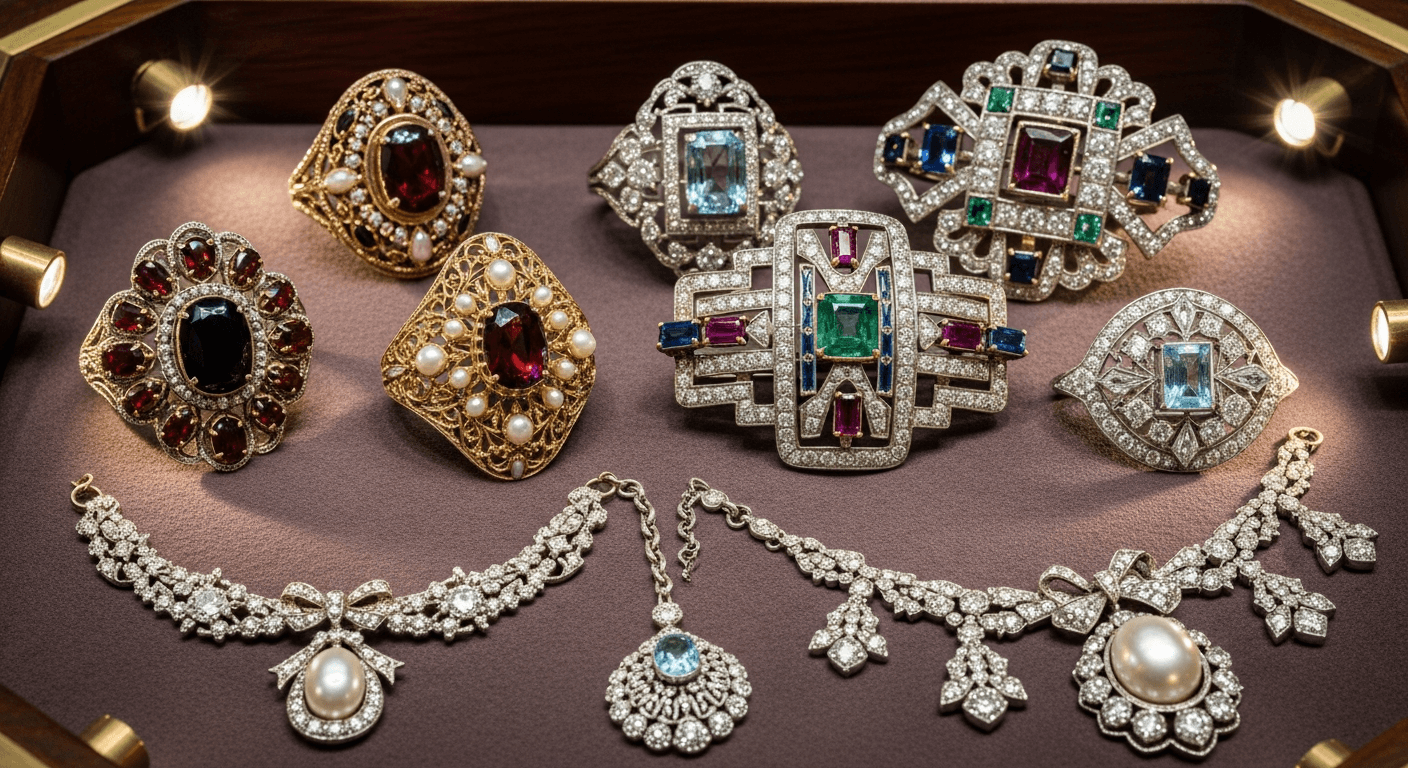
Every era of jewelry history left a distinct visual fingerprint. Victorian pieces tend toward intricate ornamentation and antique finishes, reflecting the period's taste for romantic, layered detail. Edwardian and Art Deco work represents some of the most collectible jewelry ever made: Edwardian designs prize delicate elegance, while Art Deco pivots sharply toward bold geometric shapes and vibrant color contrasts. The Retro Era of the 1940s and 1950s takes yet another direction entirely. Retro rings are characterized by their glamorous scale: large, eye-catching center stones in diamonds, sapphires, rubies, or emeralds, set within metalwork that is intricate and detailed, often featuring filigree or engraving as key decorative elements. Knowing these period signatures before you reach for a loupe gives you a framework. If a piece's design language matches a known era, that's your first data point.
Where to look for hallmarks
Hallmarks are the jewelry world's paper trail, and they hide in predictable places. On rings, check the inside of the band and the underside of the setting. On bracelets, examine the clasp. On chains, the clasp is again the primary location. Earrings require the most patience: stud earrings often carry marks along the post or stem itself, so examine carefully with good lighting. Earring backs are sometimes stamped with purity numbers or maker's symbols. Larger hoops and drop earrings may have marks inside the hoop or near the hinges, locations that see less friction and therefore preserve stamping better.
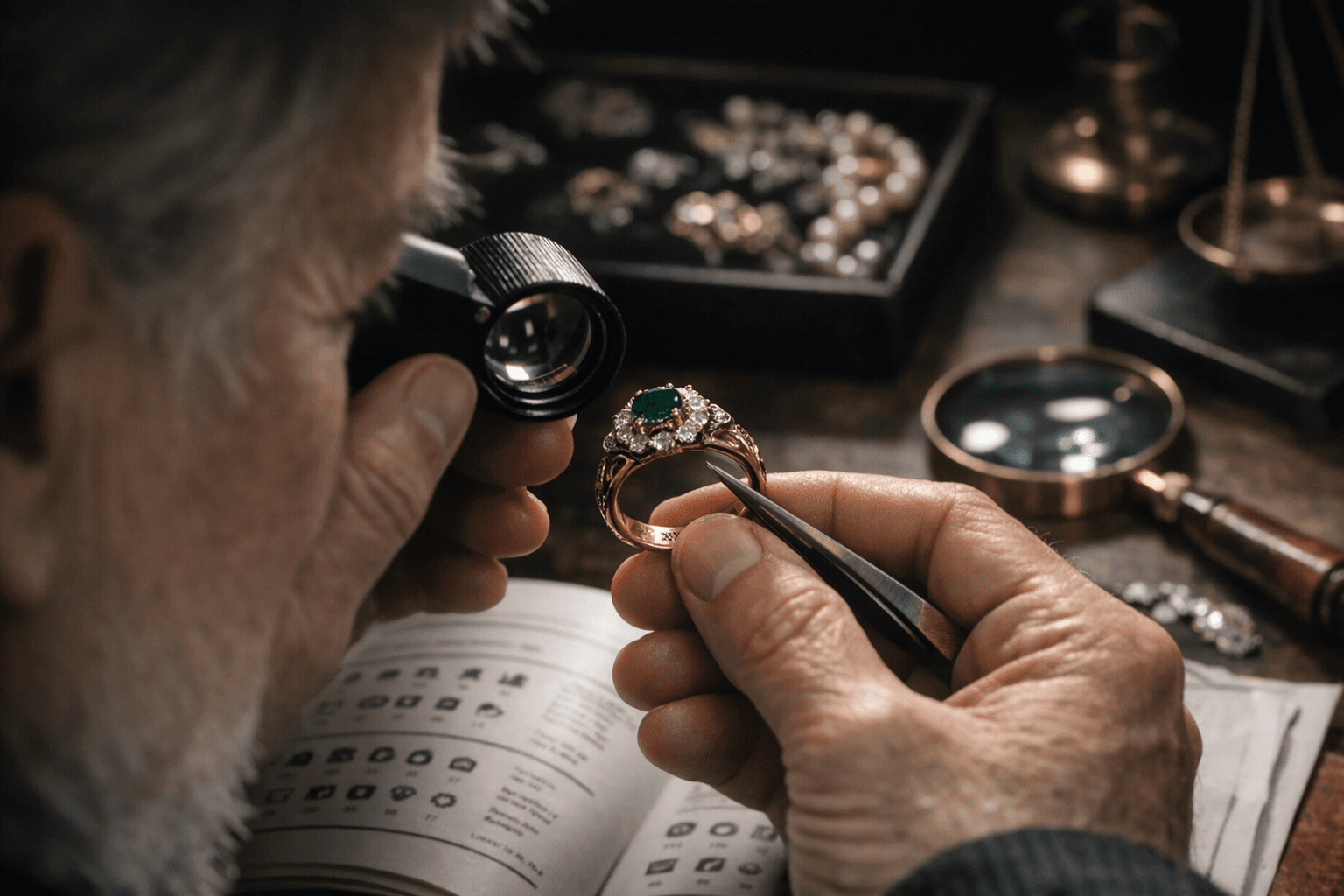
The critical tool here is a jeweler's loupe at 10x magnification. As Andrew Parson writes: "Use a jeweler's loupe (10x magnification) for best results when searching for elusive hallmarks, especially on vintage pieces where wear can obscure details." Hallmarks can be minuscule, and ordinary eyesight simply won't resolve them. Pair the loupe with strong, direct lighting.
"Careful inspection ensures that nothing is overlooked. Even intricate or antique jewelry will often preserve at least a partial hallmark in these classic locations. Recognizing these subtle placements elevates your confidence as both buyer and curator."
Decoding what the marks mean
Once you've located a mark, the work of identification begins. Hallmarks can include purity marks showing metal content, maker's marks identifying the craftsperson or manufacturer, date letters indicating year of manufacture, and assay symbols from the office that tested the metal.
"Maker's marks are an invaluable clue in identifying the origin and history of a piece of jewelry." These marks take the form of initials, full names, logos, or unique symbols, typically stamped onto the inside of the ring shank or another discreet location. Cross-referencing them with authoritative sources is the next step.
Two references deserve a place on every collector's shelf. Jackson's Hallmarks Pocket Edition is explicitly recommended for identifying maker's marks and assay symbols. Antique Jewelry University offers visual glossaries with examples from renowned makers and regions across history. High-resolution images from these databases are invaluable when comparing subtle differences in font styles or border shapes on a mark. Online databases serve the same comparative function. If you photograph a hallmark at high resolution and then compare it side by side with database images, you can often pin down a regional origin, a maker, or a narrow production window. Matching hallmarks against authoritative references provides clarity about precious metal content, maker identity, and origin: the foundation for accurate authentication.
Not every piece will yield a clear mark. Some rings never carried maker's marks; others have had theirs worn down through decades of use and cleaning. When marks are absent or illegible, shift your focus to design, materials, and overall handiwork as substitute evidence. Era-appropriate construction techniques, the style of stone setting, and the metal type all contribute to an educated attribution.
Reading physical evidence
Beyond stamps, the physical body of a piece carries authentication information. "Watch out for signs of wear consistent with age. Vintage jewelry often shows some signs of use, like gentle scratches or slight tarnishing, which can help confirm its authenticity. Be cautious if a piece looks too modern or polished; it might be a reproduction."
Examine the shank or band of a ring, the underside of the setting, and every clasp and hinge. Identifying physical damage is essential because it directly affects value, but so does the pattern of wear: authentic aging tends to be uneven, concentrated on high-contact surfaces, while reproductions sometimes show uniform artificial distressing. Look at how stones are set. Some vintage jewelry showcases superior quality with meticulously set stones and high-grade metals, a level of hand-finishing that modern mass production rarely replicates.
For stone assessment, use your loupe again. Although antique gemstones are evaluated differently from modern ones, the core criteria remain: color, clarity, cut, and carat all contribute to value. An unusual cut, for example an antique cushion, an old European, or a rose cut, can itself be a dating tool and a value driver. An antique engagement ring with an unusual cut diamond is likely to have more value than a piece set with a more common modern cut.
Determining value
Age is a starting point, not a conclusion. "While age does not necessarily define the value, the historical context does give it a perspective. For instance, Edwardian and Art Deco jewelry are highly prized for their distinctive quality and elegance."
The factors that move value are: design rarity, condition, stone quality, maker identity, provenance, and alignment with current collector demand. "The design of a piece of antique jewelry directly impacts its value. Unique or uncommon designs typically have higher values due to their rarity. Like any piece of art, the desirability of a jewelry piece can elevate its value."
Provenance and maker carry particular weight at the top of the market. "Jewelry pieces by renowned makers have a timeless appeal that attracts collectors and enthusiasts alike. For example, vintage pieces from Tiffany & Co., Cartier, or Van Cleef & Arpels are highly sought after and can fetch a premium price in the market." Knowing who designed or crafted a piece allows buyers to appreciate its historical significance alongside its artistry. Estate jewelry made by well-known makers holds not only monetary value but also sentimental value for those who admire fine craftsmanship.
A practical valuation sequence works as follows:
1. Identify all stamps and markings on the piece.
2. Test the metal to determine its purity and authenticity.
3. Carefully examine the stones and settings for damage or wear.
4. Research the maker using hallmark databases and reference books.
5. Seek a professional assessment from a reputable jewelry expert or accredited appraiser.
That last step is not optional for high-stakes pieces. A professional appraiser can authenticate rarity claims and substantiate higher valuations, which matters significantly when buying, selling, insuring, or dividing an estate.
When to call a specialist
Consulting a qualified gemologist or antique jewelry specialist is particularly important for Art Deco identification, where the line between period originals and skilled reproductions can be narrow. It's equally important for any piece where the maker's mark is ambiguous, where stones appear unusual, or where provenance documentation exists and needs verification. The investment in a professional consultation typically returns multiples of its cost in clarity, accuracy, and confidence.
The hallmark on the inside of a ring shank is often no larger than a grain of rice. But followed carefully through the right databases and into the hands of the right specialist, that grain of rice can resolve into a name, a city, a decade, and a price. That chain of discovery is what makes vintage jewelry so persistently worth pursuing.
This article was produced by Prism’s automated news system from verified source data, official records, and press releases, then run through automated quality and moderation checks before publishing. The system is built and supervised by the people who set the standards it runs under. Read our full AI policy.
Did this article answer your question?