How to Identify Mid-Century Makers' Marks, Studio Stamps, and Hallmarks
That inherited silver brooch could be a Georg Jensen or a Lapponia Weckström; knowing where to look and what to photograph gets you to an answer in minutes.
Pick up an inherited piece and you are holding a compressed archive. The brooch with the organic, almost molten form, the ring with the unfamiliar initial stamp on its inner shank, the pendant whose setting technique you cannot quite place: each is a document waiting to be read. Mid-century jewelry, made between roughly 1950 and 1970, requires a slightly different literacy than Georgian or Victorian work. Many of the era's most significant makers bypassed formal assay houses in favor of small studio stamps, hand-punched initials, or abbreviated location codes. Knowing how to decode those marks — and where to find them when they seem to have disappeared entirely — can shift a "pretty old piece" into a confirmed attribution worth serious collector attention.
The Fast Mark-Reading Workflow
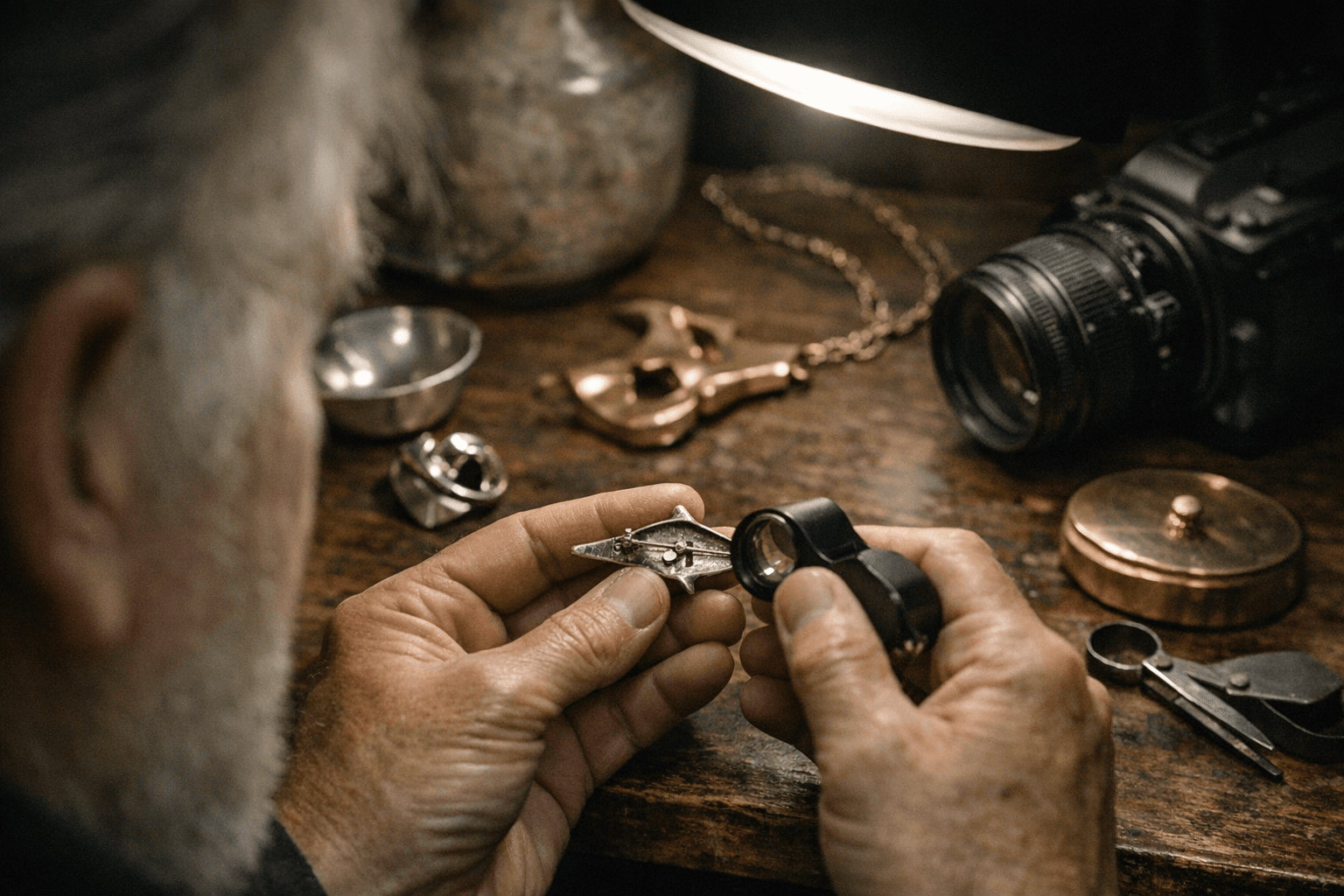
Before reaching for a loupe, get oriented. Mid-century pieces hide their stamps in predictable places: the inner shank of a ring, the tongue of a clasp, the underside of a brooch back, and occasionally the edge of a pendant bail. Begin there. Once you locate a mark, the goal is a clean photograph, not an immediate identification. Use a macro lens or smartphone macro attachment, position a bright point light source at a low angle to the surface (raking light pulls shallow engravings into relief), and shoot multiple frames. A sharp image you can enlarge on screen is far more useful than squinting through a loupe.
Once you have the image, train yourself to distinguish three distinct stamp types that often appear together:
- Maker's mark: identifies the workshop or designer; typically initials, a name, or a symbol inside a shaped cartouche
- Assay or purity mark: a number (826, 830, 925) indicating silver content, sometimes accompanied by a national assay office symbol
- Designer's mark: a secondary initial stamp placed alongside the maker's mark when a named artist worked within a larger workshop
Conflating these is the single most common misread. A piece might carry the oval "GJ" cartouche of Georg Jensen's workshop alongside a separate set of initials for the individual designer who conceived the piece, plus a numeric purity stamp — three marks, three different authors of information.
Scandinavian Silver: What the Numbers Mean
Scandinavian silver from this period is among the most systematically marked vintage jewelry you will encounter, though the system shifted across decades. Denmark used an 826S standard until around 1915, when workshops raised their silver content to 830, and eventually to the international sterling standard of 925. By the mid-twentieth century, Georg Jensen pieces were typically marked "GEORG JENSEN" in block letters alongside "Sterling Denmark" and "925 S," confirming both origin and purity. Earlier Jensen pieces carry the GI mark inside a circle of beads, used between 1915 and 1930, or a crown-crowned "Georg Jensen" stamp used between 1925 and 1932. On occasion, individual designer initials appear alongside: a piece bearing the mark of Harald Nielsen, for example, will show his initials beside the standard Jensen cartouche.
Norway's mid-century silver is frequently stamped 830S, reflecting the 83% silver content that Northern European smiths preferred for its durability in everyday work. David Andersen of Oslo is one of the most widely encountered Norwegian makers from the period; his pieces carry both a maker's mark and the national 830 purity stamp. The key misread to avoid with Norwegian work is assuming 830 denotes inferior silver: it is simply a different, older standard, not a downgrade.
Finland produced some of the era's most architecturally adventurous work. Lapponia, founded in Helsinki in 1960 by Pekka Anttila, carries the straightforward stamp "LAPPONIA" — one of the more legible maker's marks you will find — alongside Finnish national assay marks. Björn Weckström, born in 1935, became Lapponia's defining designer and his work from the 1970s Space Silver line is now a touchstone of mid-century modernism. Pieces like the Planetoid Valleys necklace and the Petrified Lake ring, which combined silver with acrylic, carry that clean "LAPPONIA" stamp, Finnish purity marks, and sometimes a date letter. Finnish silver from this period also frequently incorporates semi-precious stones: amethyst, labradorite, carnelian, and chrysoprase appear often, sometimes set in kinetic configurations where the stone moves freely inside a silver cage.
Common Misread: The Scandinavian Designer-vs.-Maker Confusion
The most persistent Scandinavian misread is treating a designer's initials as a maker's mark. When a piece has both a workshop stamp and an artist's initial punch, beginning collectors often log only one or the other. If you find what looks like a lone initial stamp on a Danish or Finnish piece, look again within a 5mm radius for a secondary mark; the two are almost always paired.
American Studio Marks: A Different Language
American studio jewelry from the same decades operates almost entirely outside the national hallmarking system. The United States had no federal silver assay requirement for jewelry during this period, which means purity stamps are common but not mandatory. A piece may carry "STERLING" in full, ".925," or nothing at all regarding metal content. What you will reliably find is some form of maker identification: initials hand-punched in block letters, a city abbreviation, or an individual's full surname.
The key to reading American studio marks is recognizing that they were often applied with hand stamps rather than machine dies. This produces slightly uneven letterspacing, a variable depth of impression, and occasionally a stamp that sits at a small angle to the piece's edge. All of these are authenticating features, not defects. Machine-perfect, rigidly centered stamps on a supposedly mid-century American studio piece deserve a second look.
Mid-Century Marks Cheat Sheet: 1950s-1970s at a Glance
Keep this section scrollable for reference when a piece is in hand:
- 925 S / Sterling Denmark alongside block-letter "GEORG JENSEN": post-1945 Jensen; confirms sterling standard
- GI inside beaded circle + 830S: Jensen, 1915-1930 range; pre-sterling silver content
- Crown + "Georg Jensen": Jensen, 1925-1932; watch for designer initials nearby
- LAPPONIA + Finnish lion assay mark: Lapponia, Helsinki; post-1960 founding date
- 830S alone or with a maker's initial: Norwegian silver; David Andersen, Nils Erik Elvik, and other Oslo workshops common
- 826S: Danish silver, pre-1915; if found on a piece otherwise reading as mid-century, re-examine the construction
- Full surname or initials + STERLING: American studio; uneven hand-punch impression is a positive indicator
- Initials only, no purity mark: American studio or Scandinavian workshop; cross-reference with construction and stone type before concluding
Troubleshooting Worn or Partial Marks
A stamp worn to near-illegibility is not a dead end. Three parallel approaches recover information:
1. Raking-light photography in multiple directions: rotate the light source 90 degrees and shoot again; different angles reveal different parts of a shallow impression
2. Construction as corroboration: if the soldering style is consistent with mid-century Scandinavian work (clean, internal solder seams; open-back settings for stones; hand-chased surface texture) and the mark's outline suggests a cartouche rather than a rectangular punch, the regional attribution is already narrowing
3. Database cross-referencing: the 925-1000.com Encyclopedia of Silver Marks and the Antique Jewelry University at Langan Antiques are the two most reliable free image libraries for comparing partial marks against documented examples
When only one or two characters of a stamp survive, record them exactly as they appear and search the databases by those characters plus the suspected country. A partial "GI" on a piece with an organic, nature-inspired form and Scandinavian-style stone setting should go straight to the Jensen hallmarks archive before anywhere else.
Ruling Out Modern Reproductions
Construction and wear patterns close the case when mark evidence is ambiguous. Genuine mid-century pieces will show:
- Patina distributed consistently with age: deeper in recessed areas, polished on contact points
- Evidence of hand-finishing: slight tool marks on the interior of bezels, minor asymmetry in organic forms
- Gem cuts characteristic of the period: cabochons dominate mid-century modernist work; faceted stones, where present, tend toward older cutting styles rather than the precision of post-1980 computer-aided cuts
- Solder seams that predate modern laser-welding: visible as a slightly different color or texture along joins, rather than the seamless fusion of contemporary repair work
No single indicator is conclusive on its own. The method that consistently produces confident attribution combines a legible or partially legible mark, corroborating construction evidence, and a stone or material consistent with the period. A piece that passes all three checks has essentially made its own case. The marks are where you start; the object itself is where you finish.
This article was produced by Prism’s automated news system from verified source data, official records, and press releases, then run through automated quality and moderation checks before publishing. The system is built and supervised by the people who set the standards it runs under. Read our full AI policy.
Did this article answer your question?