How to identify vintage jewelry using hallmarks and maker’s marks
Hallmarks can reveal metal, origin and date, but pseudo marks can mislead. Learn how to separate a true period jewel from a later reproduction before you buy.
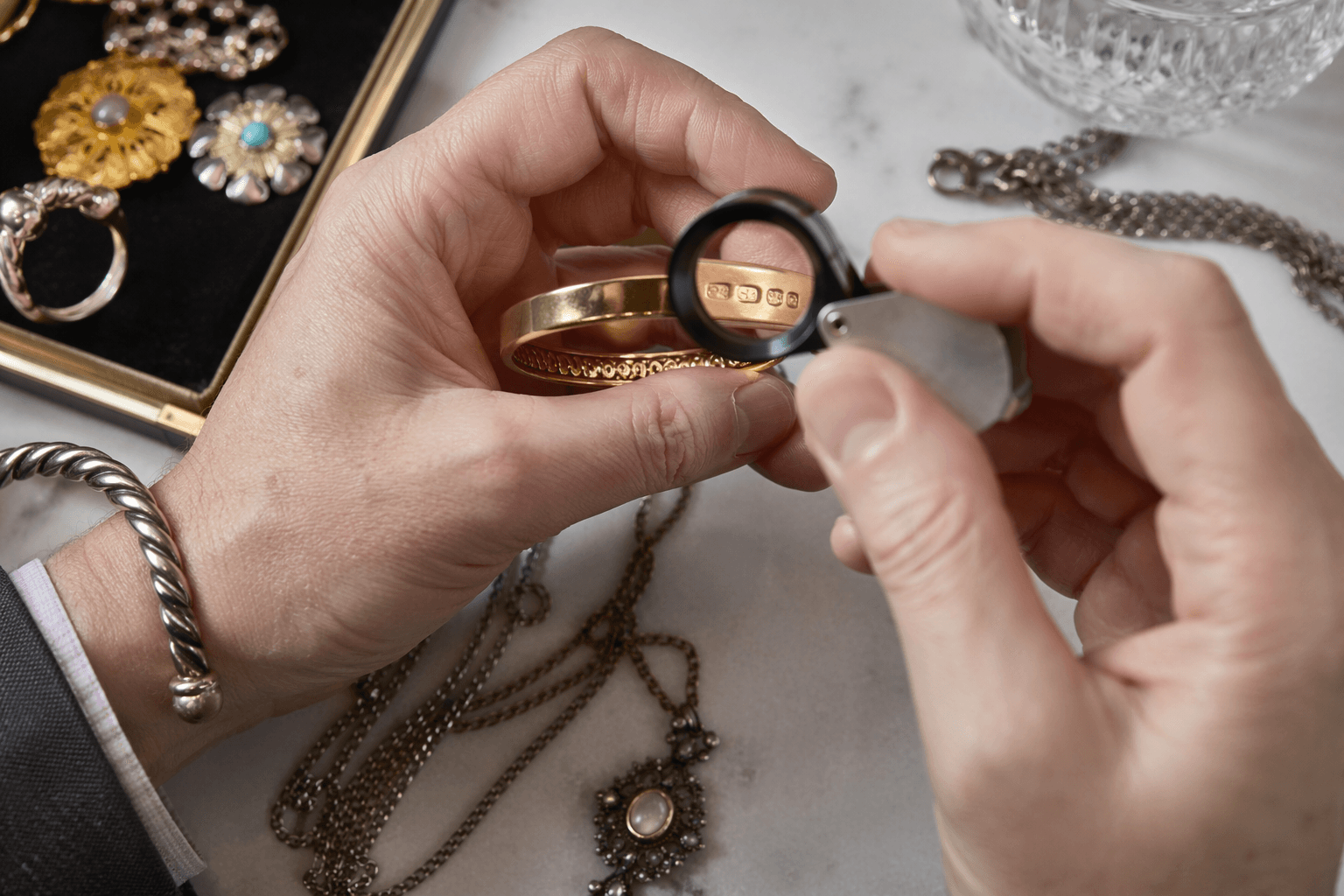
A tiny stamp inside a ring shank, on a clasp, or under a brooch pin is often the first clue that a vintage jewel is genuine. Hallmarks and maker’s marks can tell you far more than a sales tag ever will, including what the piece is made of, where it began its life, and sometimes when it was made.
Start with the stamp, then test the story
A hallmark is a tiny symbol or word stamped on jewelry, accessories, objets de vertu, flatware, and other small precious-metal items. Those minuscule marks can provide assurances about metal content, origin, and date of creation. A maker’s mark is different but just as important: it is an identification symbol stamped on jewelry, a signature of sorts that can help collectors, appraisers, and historians uncover the story behind a piece.
In practice, the stamp is not the finish line. If a ring claims old-world pedigree but the mark looks crude, oddly placed, or out of scale, the next step is to examine the construction, the wear, and the finish around it. A true period piece usually reads consistently across every detail, not only in the stamp.
If you see this, check that
A practical way to look at vintage jewelry is to work from the mark outward:
1. If the piece has a hallmark, check whether the metal content, origin, and date it suggests fit the object in your hand.
2. If it carries a maker’s mark, look for consistency across the clasp, gallery, shank, hinge, or pin back.
3. If the mark looks unusually neat or oddly familiar, compare it with the overall workmanship and weight of the piece.
4. If the story seems too tidy, inspect for a pseudo hallmark.
Pseudo hallmarks are marks from the 18th, 19th, and early 20th centuries that imitate marks from other makers, towns, countries, and assay offices, or that are complete fantasy marks. They appear on reproductions made primarily in Hanau, Germany, but also on reproductions by Dutch and Italian makers and by other German manufacturers.
Read the period, not just the stamp
Style remains one of the strongest cross-checks. In jewelry history, the Victorian Era ran from 1837 to 1901, the full reign of Queen Victoria. Antique Jewelry University divides it into the Romantic, Grand, and Aesthetic periods. If a seller describes a piece as Victorian, the construction, materials, and decorative language should sit comfortably inside that span.
A brooch that looks mechanically consistent with late 19th-century work but bears a suspiciously theatrical mark deserves a closer look. So does a ring with a convincing maker’s stamp that feels too fresh in the hand, or one whose wear patterns do not match its supposed age.
Use the object itself as corroboration
A true vintage piece often shows age in the right places, not everywhere. Edges on a clasp may soften from repeated use, a hinge may carry honest wear, and the back of a brooch may show finishing that is careful but not factory-perfect in a modern sense.
Materials should also make sense together. A mark suggesting precious metal should sit on a piece whose surfaces, joints, and setting style feel consistent with the same level of value. If the stamp says one thing and the construction feels generic or overly uniform, the discrepancy deserves attention before you price the jewel, inherit it, or insure it.
- Look for crisp, legible stamps rather than marks that seem freshly punched or overly polished.
- Compare the front of the jewel with the reverse, because honest age usually appears on both sides.
- Treat a maker’s mark as a clue to authorship, not proof of desirability.
- Let wear, finishing, and mark placement work together before you decide a piece is original.
Why provenance changes the conversation
For collectors, provenance can make a meaningful difference in the market, especially when a piece’s history is documented and its marks support the narrative. A jewel with identifiable origin and period consistency is easier to place, easier to compare, and often easier to value than one that only looks old.
Rapaport ran coverage under the headings Old Jewels Are Attracting New Fans and A Solid Auction Market for 2024, pointing to sustained collector interest in older jewelry rather than a narrow obsession with modern luxury alone. Sotheby’s maintains an active jewelry department, with auctions including The Gem Drop July in New York, July 13-16, 2026.
A collector’s final check
When you inherit a ring, browse a dealer’s case, or consider an online listing, begin with the smallest evidence and work outward. The hallmark should make sense, the maker’s mark should belong to the object’s world, and any period claim should fit the Victorian dates of 1837-1901 or another clearly legible era. If a mark looks borrowed, especially in the way pseudo hallmarks often do, the piece deserves skepticism before sentiment or price takes hold.
This article was produced by Prism’s automated news system from verified source data, official records, and press releases, then run through automated quality and moderation checks before publishing. The system is built and supervised by the people who set the standards it runs under. Read our full AI policy.
Did this article answer your question?