How to Insure Vintage Jewelry, Appraisals, Coverage Limits, and Policy Reviews
Most vintage jewelry is insured too casually. A standard homeowners policy can leave an heirloom ring capped far below its true value.
Why vintage jewelry is easy to underinsure
The first mistake is assuming jewelry lives safely inside a homeowners policy. It often does, but only up to a special theft limit that can be startlingly low, commonly around $1,000 to $1,500, even when the rest of your personal property coverage is much higher. A sample HO-3 homeowners form shows a $1,500 theft limit for jewelry, watches, furs, and precious and semiprecious stones, which is why an inherited diamond ring or Art Deco bracelet can be underprotected long before you realize it.
That gap matters most for vintage pieces, because their worth is not just metal weight and stone size. Era, style, motifs, authenticity, originality, condition, and the right comparables can change value dramatically, especially for Victorian, Edwardian, and Art Deco jewels whose appeal lies in design integrity and provenance as much as materials.
Start with documentation, not just sentiment
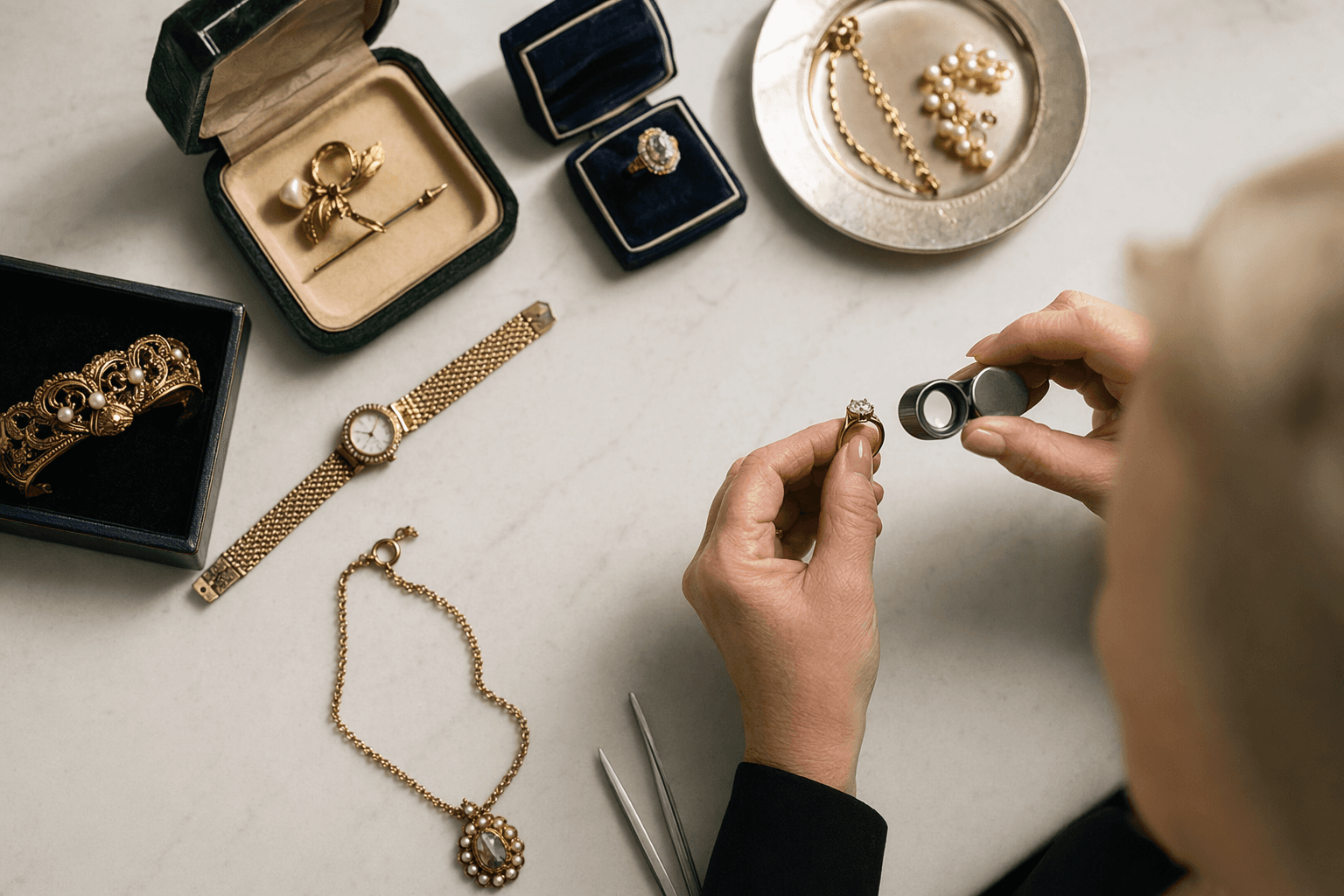
Before you think about coverage, build a record of the piece as it exists in your hand today. Photograph it in daylight and in close-up, then turn it over and capture the back, the clasp, the prongs, the gallery, the hinge, the pin stem, and any engraving or hallmarks. For a ring, that means the shank interior, the basket, and any wear that might help date the setting; for a brooch, it means the clasp mechanism and pin construction, which often tell you more than the front.
Keep the images with a written description of the stone count, shape, estimated carat weight, color range, clarity range, metal testing results, total weight, markings, and overall jewelry description. GIA notes that those details belong in a jewelry report, and they are the exact clues that help prove identity if something is lost, stolen, or later recovered.
What a strong appraisal should actually include
A proper appraisal for vintage jewelry should read like a measured interpretation, not a generic replacement estimate. It should address the piece’s materials, but also its age, craftsmanship, originality, condition, and how comparable pieces are priced in the market. That is especially important for one-of-a-kind or estate pieces, where a standard mass-market replacement can miss the qualities that make the jewel distinct.
GIA does not provide appraised values for gemstones or jewelry and recommends that the work be done by an independent appraiser. That independence matters because the valuation should support insurance, not salesmanship. Jeweler-focused appraisers also help identify repair issues, such as loose prongs before a stone falls out, which can turn a document into an early warning system rather than a paper exercise.
A practical checklist for protecting an heirloom
1. Photograph the piece from every angle, including the reverse, the clasp, the underside of settings, and any marks or engravings.
2. Record measurements, metal type, stone type, and any visible damage or wear.
3. Obtain an independent appraisal that reflects vintage value, not just material content.
4. Make sure the policy covers the item for the amount listed on the appraisal, not only the homeowners sublimit.
5. Review the coverage again after inheritance, restoration, or a major market shift.
That sequence is especially useful for family jewelry, because inheritance is often when coverage quietly falls out of sync with reality. A ring handed down from a grandmother may have moved from a drawer to a daily-wear role, or a brooch may have been restored, both of which can change condition, value, and risk.
Choose the coverage that matches the piece
If the jewelry is valuable, insurers and educators consistently point toward floater, rider, endorsement, or scheduled personal property coverage. Those options are designed to move the piece beyond the basic homeowners sublimit and insure it for the appraised amount, which is the difference between a partial payout and real replacement protection. The National Association of Insurance Commissioners warns that standard homeowners and renters policies may not fully cover jewelry and may require special coverage, and that advice is still the most useful sentence in the whole category.
A dedicated jewelry policy can add another layer of protection, including worldwide coverage in some cases. That matters for travel, because a ring worn through an airport, a hotel, or a foreign taxi should not lose protection simply because it crossed a border. Travelers says jewelry and valuable-items insurance can cover jewelry if it is stolen or damaged in a covered event, which is the kind of scope that everyday owners often assume they already have.
Read the policy language that can make or break a claim
The fine print matters as much as the appraisal. Standard homeowners forms often cover jewelry only for named perils such as fire, windstorm, theft, and vandalism, not for every possible loss. Accidental loss can fall outside that protection unless you have added broader coverage, which is why a ring slipping from a pocket or a bracelet disappearing at the gym may not be handled the way you expect.
Look closely at the theft limit, the deductible, the listed perils, and whether the policy pays actual cash value or replacement cost. Those terms determine whether a Victorian ring with a hand-cut stone is treated like a generic item of personal property or like the singular object it truly is.
Update appraisals before the market moves on you
Vintage jewelry should not be appraised once and forgotten in a drawer. Revisit the valuation after inheritance, after restoration, after a major market move, or whenever a piece changes in condition. A newly tightened prong, a replaced stone, or a fresh polishing can affect both value and how an insurer views the item.
Jewelers Mutual notes that appraisals can help align coverage and premium, determine replacement cost, prove ownership if a stolen item is recovered, and identify maintenance issues before damage becomes loss. That is the quiet power of paperwork done well: it helps your insurer price the risk accurately, and it helps you understand the object as an artifact with a life and history, not just a receipt.
The goal is not just coverage, but clarity
Vintage jewelry asks for a different kind of attention than modern mass-produced pieces. The setting, the clasp, the hallmarks, the wear on the shank, and the originality of the stones are all part of the story, and all part of the value. Once you document the piece, secure an independent appraisal, and match it with the right policy terms, you are no longer relying on a vague homeowners line item. You are protecting an heirloom on its own terms, which is the only way a jewel with history should ever be insured.
This article was produced by Prism’s automated news system from verified source data, official records, and press releases, then run through automated quality and moderation checks before publishing. The system is built and supervised by the people who set the standards it runs under. Read our full AI policy.
Did this article answer your question?