Queen Mary of Denmark turns historic diamonds into modern statements
Queen Mary’s newest diamond bandeaus show how royal provenance can make antique stones feel strikingly modern, not sealed behind glass.
Queen Mary of Denmark and the modern life of historic diamonds
Queen Mary has a gift for making heirloom diamonds look freshly minted. Worn with restraint and clarity, her historic jewels do not read as relics of protocol; they look like living objects, sharpened by provenance and made contemporary by the way she styles them.
That is the quiet force behind her most recent appearances. A single bandeau, a brooch-like frame, or a tiara with royal custody stretching back centuries becomes something more than ornament when it is worn with conviction. In Mary’s hands, the message is simple: history is not only preserved in jewelry, it is activated by wear.
A collection built to move, not sit still
The Danish Royal House describes its jewelry collection as a working archive of inherited, gifted, purchased, and borrowed pieces. These jewels are especially visible at New Year’s banquets, state visits, and round birthdays and anniversaries, where they serve two purposes at once: court splendor and a tangible expression of Denmark’s familial and diplomatic relationships.
That system matters. The Danish Royal Property Trust, established in 1910 by Frederik VIII and Queen Lovisa, was created to keep important inherited collections together. Its holdings help explain why these jewels remain legible across generations. They are not merely old objects preserved behind velvet ropes; they are part of a dynastic structure that still has a public life.
For vintage jewelry lovers, that is the first lesson. Provenance is not decorative paperwork. It is what turns a jewel from a beautiful artifact into a piece with weight, continuity, and authority.
Why Queen Mary’s bandeaus feel so current
On January 1, 2026, Queen Mary wore a diamond bandeau that was described as a reimagining of crown-jewel material. The rose-cut diamonds in the bandeau came from the Danish crown jewelry collection, which gives the piece a soft, antique glow even as its low, linear profile feels strikingly modern.
That combination is the trick. A bandeau sits close to the head, so it can read almost like a band of light rather than a formal tiara. Rose-cut diamonds, with their domed tops and flatter backs, do not flash the way modern brilliant cuts do; they offer a gentler shimmer, the sort that looks especially elegant in candlelight and under gala lighting. The result is less museum case, more wearable line drawing.
The same principle drives the Danish Rose Diamond Bandeau, unveiled in 2026 and commissioned by Queen Mary. It uses rose-cut natural diamonds that once formed part of a diamond belt or girdle owned by Princess Charlotte Amalie of Denmark in the 1700s. That is a remarkable chain of custody, and one that gives the piece an unusual charge: it is historically loaded, yet newly legible because its design translates an 18th-century source into a form that feels current on the head today.
A jewel that can trace its life from the 1700s to 2026 is not simply old. It is culturally alive.
The Diamond Frame and the language of gala dress
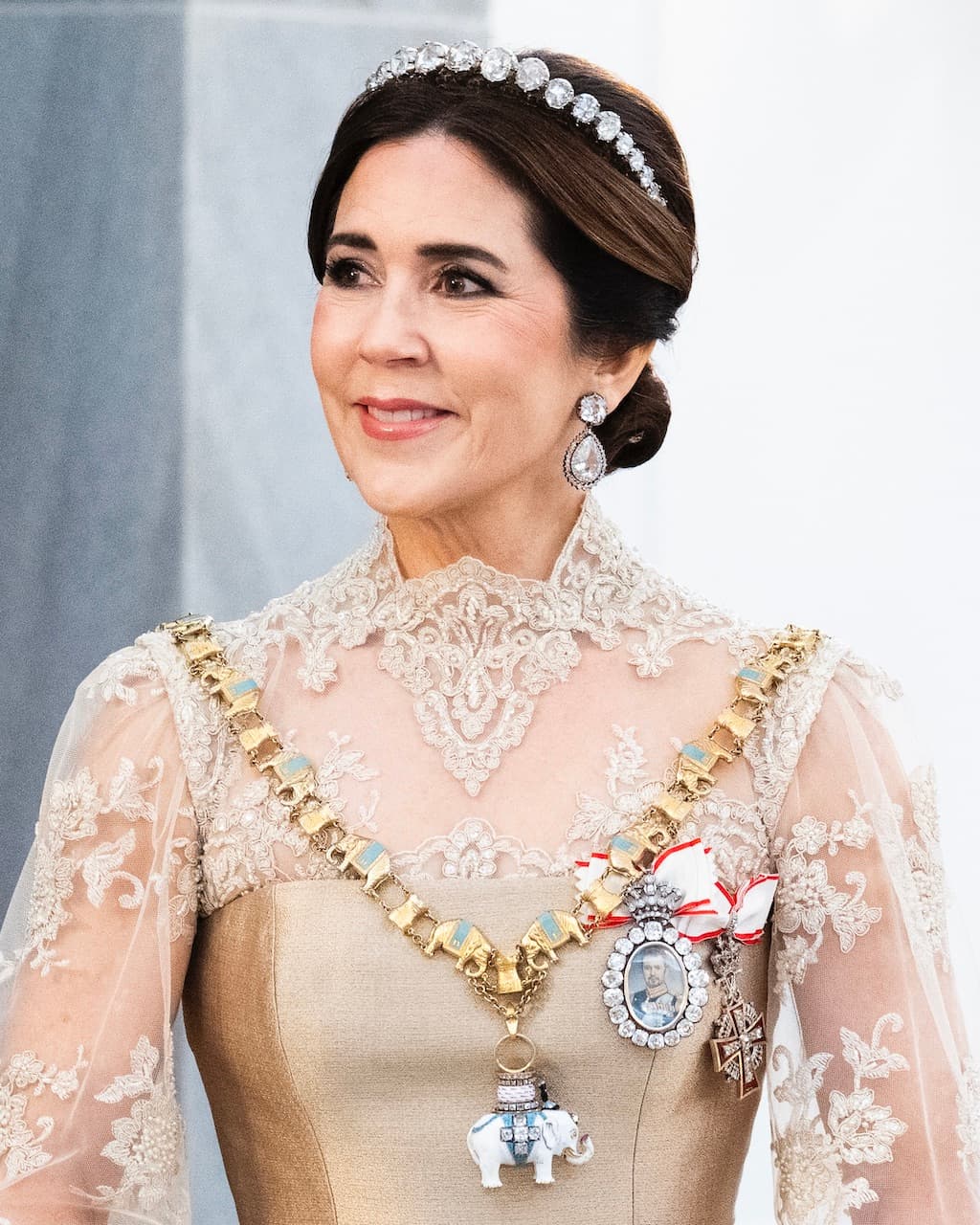
Mary has also worn the Diamond Frame, a brooch-like jewel made of white gold and decorated with 18 very large old-cut diamonds and a diamond royal crown at the top. The Royal House says it is used in formal gala dress and that it originally belonged to the Danish Royal Property Trust.
The visual effect is telling. Old-cut diamonds have a romantic, less icy sparkle than many modern stones, and the white gold setting gives the piece a cleaner, more contemporary edge. The crown motif at the top keeps the object unmistakably royal, but the design is compact enough to feel wearable rather than monumental. That is precisely why it works on Mary: it reads as a jewel, not a trophy.
This is where royal style becomes useful to anyone studying vintage jewelry. Pieces with strong provenance often survive because they are versatile enough to keep moving between occasions, settings, and generations. A jewel that can be worn in formal gala dress and still feel sharp on a modern wearer has already proven its design intelligence.
A lineage that makes the stones more than stones
The deepest historical anchor in this story is the Brilliant-cut Diamond Set. The Royal House says its current form dates to around 1840, when Queen Caroline Amalie wore it at her anointing at Frederiksborg Castle Church. Several of the gems in the set belonged to jewels bequeathed to the Danish Crown in 1746 by Queen Sophie Magdalene.
That chain matters because it gives the stones a documented life. They are not anonymous antiques circulating without context. They are royal objects with traceable ownership, ceremonial use, and a place in the national story. For collectors, that kind of continuity is what separates decorative age from true significance.
It also explains why these pieces still resonate. A historic diamond feels more compelling when you can place it in time, name the people who wore it, and understand how its shape or setting changed to suit a new era. Provenance does not diminish beauty; it concentrates it.
Mary’s own path from bride to custodian
Queen Mary’s relationship with these jewels began publicly at her 2004 wedding, when then-Crown Princess Mary debuted in a petite diamond tiara given to her by Queen Margrethe II and Prince Henrik. Since King Frederik’s accession in January 2024, she has become custodian of multiple Danish royal tiaras and the crown-jewel collection.
That shift is significant. Mary is not only the wearer of these pieces, she is their steward. Her role gives the collection a visible present tense, which is why her styling feels so persuasive. She does not treat the jewels as untouchable heirlooms; she presents them as adaptable forms of beauty that can still speak in the language of now.
For anyone drawn to vintage jewelry, that is the standard to watch for: documented history, visible craftsmanship, and a design that still invites wear. Look for hallmarks, maker’s marks, clasp stamps, band engravings, and evidence of thoughtful repair or reworking. Those details are the archive in miniature.
Queen Mary’s historic diamonds show why provenance is not a footnote to beauty. It is the feature that lets an heirloom remain elegant, credible, and fully alive.
This article was produced by Prism’s automated news system from verified source data, official records, and press releases, then run through automated quality and moderation checks before publishing. The system is built and supervised by the people who set the standards it runs under. Read our full AI policy.
Did this article answer your question?