Portrait Jewelry, Georgian Miniatures and Victorian Lover’s Eyes Endure
A painted eye can outlast a diamond trend. Georgian miniatures and Victorian Lover’s Eyes still reward close looking, with clues that reveal age, secrecy, and sentiment.
Portrait jewelry begins where sentiment meets evidence
A painted eye can feel more intimate than a carat count. Portrait jewelry survives because it turns affection, loyalty, and private memory into something you can wear on a lapel, a finger, or a chain, and because the best examples still ask to be read like archives.
The form reaches back to Europe’s Renaissance portrait tradition, then flourished in England in the 17th century through artists such as Lucas Horenbout and Hans Holbein the Younger. By the Georgian period, portrait miniatures had become portable declarations of rank and feeling, the kind of object handed down, tucked away, and worn close enough to the skin to keep a person present after absence.
How to tell a Georgian portrait miniature from a Lover’s Eye
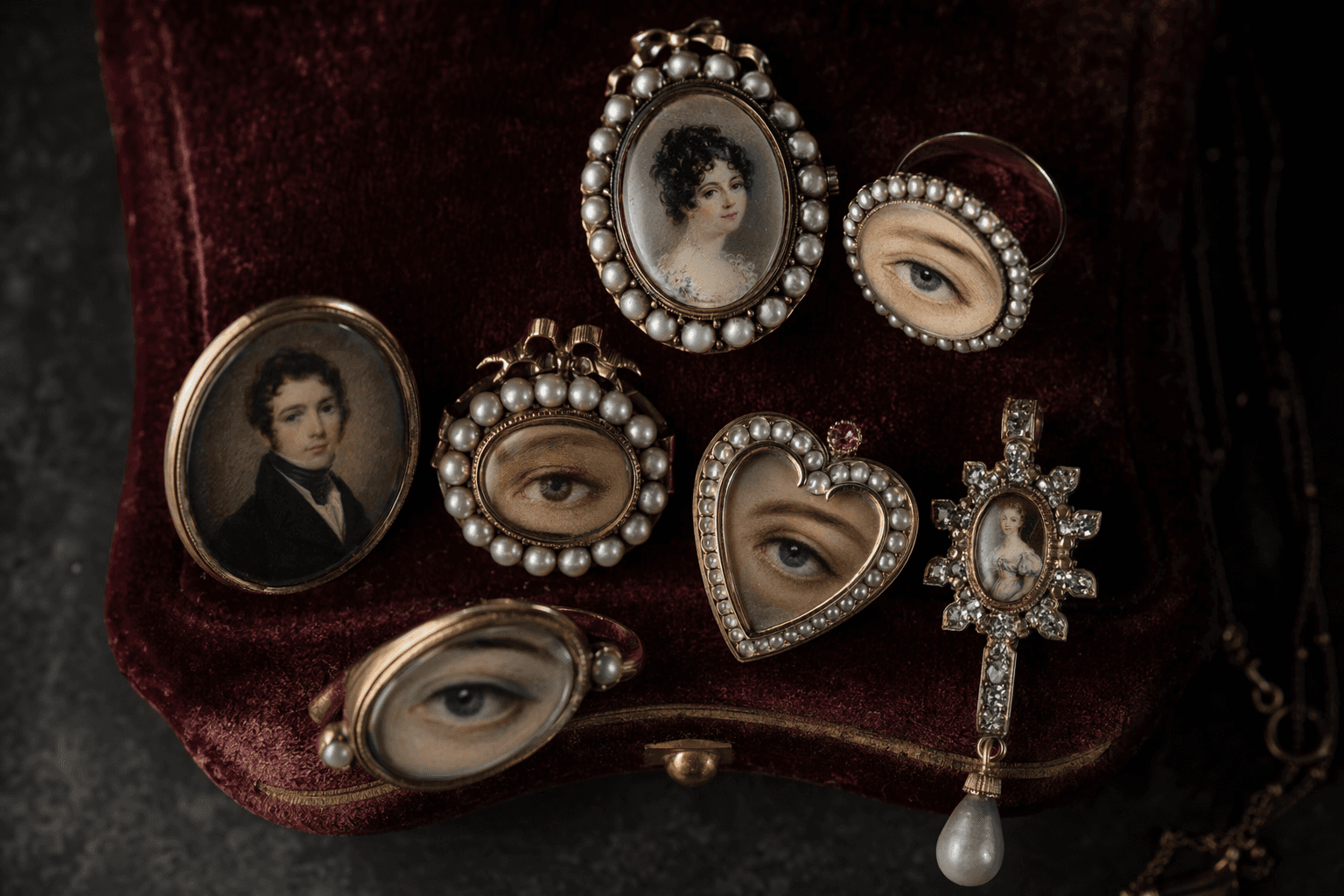
The first distinction is simple: a Georgian portrait miniature usually gives you the whole person, while a Victorian or late 18th-century Lover’s Eye gives you only the eye. The full portrait can show face, hairstyle, costume, and sometimes military dress or court fashion, making it useful as both likeness and social document. The eye miniature, by contrast, was a brief but intense fashion, introduced first in France, then made popular in Great Britain in the late 18th century, with a modest spread to the United States by the early 19th century.
That single eye carried a private charge. The Metropolitan Museum of Art notes that these pieces were worn publicly while remaining legible only to the intended recipient, which made them both intimate and strategic. In other words, the jewelry could broadcast attachment without naming names, a discreet form of devotion in an era when privacy mattered as much as display.
Why the craft still matters under magnification
The Victoria and Albert Museum holds about 2,000 portrait miniatures spanning the 16th to the 19th centuries, and that breadth shows how varied the genre can be. These are small works, but the best survive because the painting is precise, the mounting is carefully made, and the object was intended to travel. A miniature is usually watercolor on ivory, often set in gold, sometimes with pearl or jeweled surrounds, and frequently finished as a brooch, ring, pendant, bracelet, or locket.
Look for the physical decisions that make the piece believable as period work:
- A finely painted face with soft modeling rather than a flat printed image
- A mount that feels designed for the portrait, not added as an afterthought
- Concealed hair on the back, especially in sentimental lockets and brooches
- Pearl or gem accents that frame the image without overpowering it
- Wear consistent with hand use, not artificial distressing
That back panel matters. Some portrait jewels hide a lock of hair beneath the cover, turning the object into a double archive, one side visual, the other bodily. In sentimental jewelry, that intimacy is not decoration. It is the point.
The eye motif was tiny, but never trivial
Eye miniatures are easy to overlook because the subject is so narrow. Yet the V&A describes them as a curious but brief anomaly, a late-18th-century fashion that tried to capture the window of the soul. That phrase explains why the format endured in collector circles: the eye is both anonymous and revealing, public and secret at once.
The best preserved examples feel almost conversational. They do not ask you to admire scale alone. They ask you to think about who could recognize the sitter, who was meant to look, and why the rest of the world was left out. That tension between secrecy and visibility gives Lover’s Eyes their enduring grip.
Photography changed the market, but not the fascination
Portrait miniatures began to fade after photography arrived in 1839, when the need for a painted likeness as a keepsake started to diminish. Still, the form did not vanish. Queen Victoria briefly revived eye miniatures with artist William Charles Ross, and a larger resurgence followed in the early 20th century, when miniature painting found new advocates and new audiences.
The American Society of Miniature Painters was organized in March 1899, and related societies soon appeared in Philadelphia, Brooklyn, Los Angeles, Chicago, and Washington, D.C. That network mattered because it kept the discipline visible when mass photography might have pushed it aside for good. The result is a collecting field that bridges historic sentiment and modern connoisseurship.
What the market says about value
Portrait jewelry is valued for more than materials, though the materials matter. A diamond or pearl setting may lift the price, but the strongest examples are often prized because they preserve identity, grief, courtship, or family history in a way no standardized jewel can match.
The market reflects that range. 1stDibs currently shows antique miniature portrait jewelry from about $146 to as high as $89,000, a spread that captures everything from modest keepsakes to exceptional museum-quality pieces. LiveAuctioneers says its auction-results database includes 29 million results, and Artnet’s price database includes 18 million auction results, proof that these intimate objects remain active in the broader trade, not tucked away as curiosities.
That breadth is useful for anyone sorting an inheritance or judging an estate-sale find. A small brooch with a painted face, a closed-back setting, and an old hair compartment may carry far more historical and emotional weight than its surface suggests. The price is only the starting point. The true value lies in whether the object still holds the person it was made to remember.
Reading a piece in hand
If you have one of these jewels in front of you, start with the picture itself. A Georgian portrait miniature usually presents a full likeness, often in a format meant to identify the sitter clearly, while a Lover’s Eye narrows the story to a single gaze. Then turn the piece over and study the mounting, because the back can reveal hair, initials, or a compartment that confirms the jewel was designed as a personal token rather than a decorative afterthought.
The most convincing portrait jewelry does not scream rarity. It rewards patience. Under a loupe, the brushwork, the setting, and the wear pattern should feel related, as if image and jewel grew old together. That is why collectors keep returning to these pieces. They are not merely old ornaments. They are small, wearable records of who was loved, who was hidden, and who was worth remembering.
This article was produced by Prism’s automated news system from verified source data, official records, and press releases, then run through automated quality and moderation checks before publishing. The system is built and supervised by the people who set the standards it runs under. Read our full AI policy.
Did this article answer your question?