How to Sell Inherited Jewelry: A Step-by-Step Guide for New Owners
Inheriting jewelry means navigating appraisals, provenance, and timing before you sell. Here's what to do first.

Inherited jewelry arrives with weight beyond the physical: the heft of memory, the uncertainty of value, and often a complete absence of paperwork. Whether you've received a single Art Deco brooch or a full velvet-lined case of estate pieces, knowing how to move thoughtfully from "what do I do with this?" to a fair sale price is a process worth taking seriously. Rushing it almost always costs money; doing it well can mean the difference between a few hundred dollars and several thousand.
Start with what you have
Before you contact anyone or post anything online, lay out every piece and document it thoroughly. Photograph each item under good natural light, capturing the front, back, any hallmarks, stamps, or engravings, and the condition of stones and settings. Note what you can observe with the naked eye: Is the metal yellow gold, white metal, or a rose-tinted alloy? Are stones faceted or cabochon cut? Is there a maker's mark stamped inside a ring shank or on the clasp of a necklace? These details matter because they determine which specialist you should approach first, and they protect you from misrepresentation down the line.
Check with other family members about what they know. Estate pieces frequently come with oral histories that never made it onto paper: a grandmother who mentioned buying a ring in Florence, a great-uncle who described a watch as a gift from a particular employer. These details can add meaningful provenance context, which professional appraisers and specialist buyers value.
Get a professional appraisal before you name a price
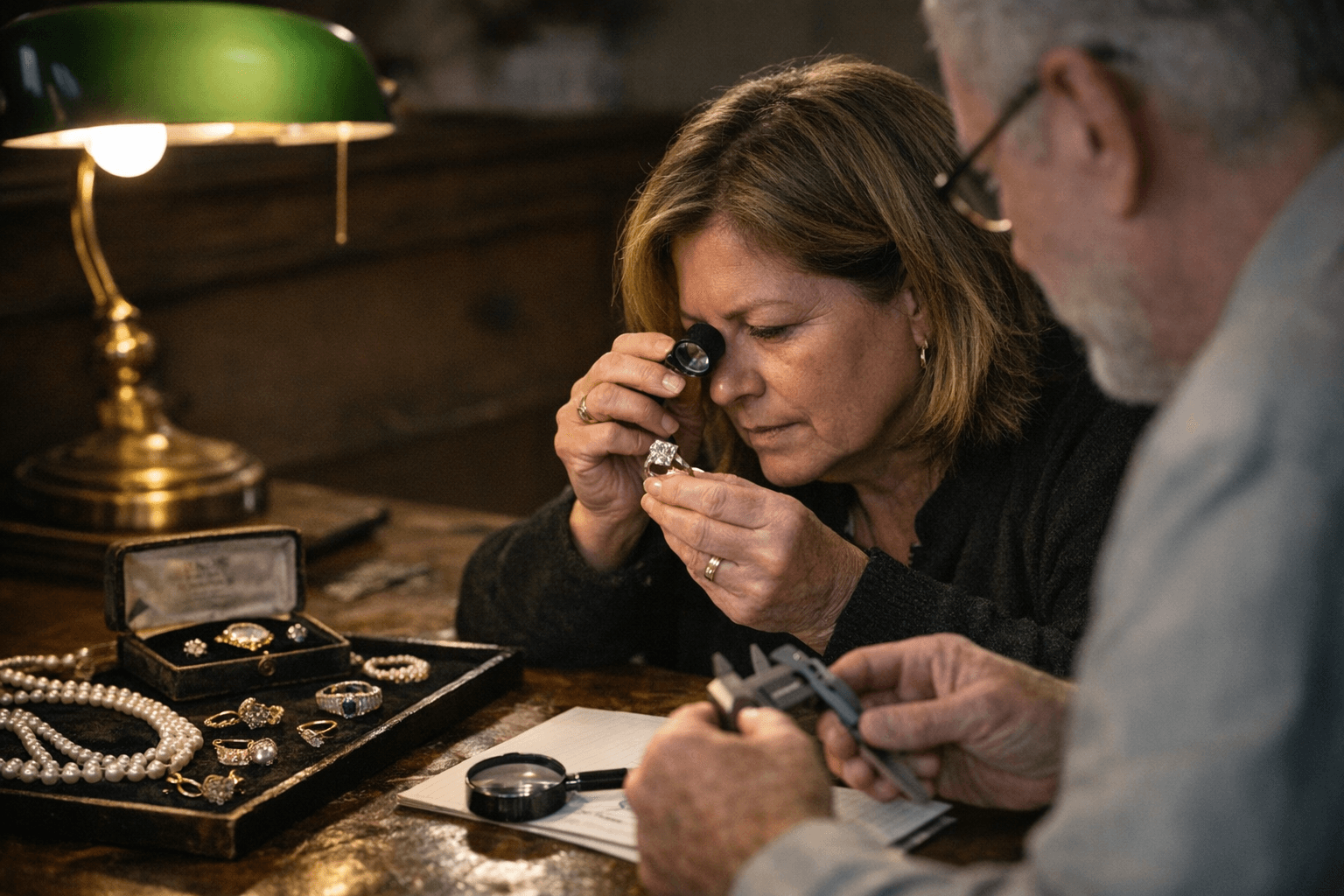
The single most important step before selling inherited jewelry is a formal appraisal from a qualified, independent gemologist, ideally one credentialed by the Gemological Institute of America (GIA) or the American Society of Jewelry Appraisers (ASJA). An appraiser who is also a buyer has a conflict of interest; seek someone who charges a flat fee or hourly rate rather than a percentage of the appraised value, which creates the same problem in reverse.
A professional appraisal will distinguish between replacement value (what insurance would pay to replace the piece new) and fair market value (what a willing buyer would actually pay in the current market). These figures can differ substantially. A piece with a replacement value of $4,000 might command only $900 to $1,400 in a resale context, depending on the rarity of the stone, the desirability of the period, and the weight of recoverable metal. Understanding both numbers going in prevents sticker shock and protects you from undervaluing something genuinely rare.
For pieces you suspect have significant value, consider getting two independent appraisals. Discrepancies between them are instructive and not uncommon.
Understand what you're actually selling
Inherited jewelry covers an enormous range of categories, and each has its own market. A strand of natural saltwater pearls, for instance, sells in an entirely different channel than a gold charm bracelet valued primarily for its melt weight. Period pieces, whether Victorian mourning jewelry, Edwardian filigree, or Mid-Century modernist designs, attract specialist collectors who pay premiums above melt value. Costume jewelry, including signed pieces by houses such as Miriam Haskell or Trifari, has a passionate secondary market, but unsigned pieces rarely fetch significant sums.
Hallmarks are your most reliable starting point for identification. In British pieces, hallmarks can tell you the metal purity, the year of assay, the assay office city, and sometimes the maker's mark. American pieces are less systematically marked, but karat stamps (10K, 14K, 18K) and maker's stamps appear on most manufactured jewelry from the 20th century onward. European pieces often carry fineness marks expressed in parts per thousand (750 for 18-karat gold, 925 for sterling silver). Knowing what you have before you approach a buyer is not just useful; it is essential armor against lowball offers.
Know your selling channels
The venue you choose to sell through significantly affects your final return. The main options each carry trade-offs:
- Auction houses, from major firms to regional estate specialists, work well for pieces with strong provenance, period significance, or high individual value. They take a seller's commission, typically 10 to 25 percent, but provide authentication, marketing reach, and access to competitive bidding among serious collectors.
- Estate jewelry dealers and antique shops offer the convenience of a fast transaction, but their offers will reflect their need to profit on resale. Expect offers of 30 to 50 percent of retail value, sometimes less for pieces outside their specialty.
- Online marketplaces including specialized platforms for estate and vintage jewelry can return more than a dealer transaction, but require your own photography, description writing, shipping logistics, and tolerance for the time it takes to find the right buyer.
- Private sale directly to a collector, especially for pieces in a niche category with an identifiable enthusiast community, can yield the strongest return of all, but requires the most research to find the right buyer.
- Pawn shops and cash-for-gold operations should generally be a last resort. They typically offer only melt value or close to it, which is the floor of what any piece is worth.
Timing and emotional readiness
There is no rule requiring you to sell quickly. Grief and urgency make poor financial companions, and most inherited jewelry loses nothing by sitting in a safe deposit box while you take the time to research properly. Prices for vintage and estate jewelry are influenced by fashion cycles, auction season momentum, and broader economic conditions; a piece that draws modest interest today might attract a premium buyer in six months.
If you are emotionally conflicted about selling, it is worth considering whether the piece could be reset or repurposed. A dated 1970s cocktail ring might become a pendant you actually wear; a collection of mismatched single earrings might yield enough gold to commission something new. Selling is not the only option, and it should not feel like the only option.
Protect yourself from fraud and undervaluation
Get every offer in writing before you agree to anything. Understand the difference between a verbal estimate and a formal written offer, and do not hand over pieces without a detailed receipt that includes description, condition, and agreed price. Be cautious of buyers who pressure you to decide quickly or who offer to "take the whole lot" for a single price without itemizing; this almost always benefits the buyer at your expense.
If you receive an offer that feels low, it probably is. Your appraisal documentation is your negotiating foundation. A buyer who refuses to explain how they arrived at their offer, or who dismisses your appraisal without substantive reasoning, is not the right buyer.
The jewelry market for estate and inherited pieces is genuinely robust, and the right piece in the right venue, presented by a seller who understands what they have, can command a price that honors both the object's craftsmanship and the life behind it.
This article was produced by Prism’s automated news system from verified source data, official records, and press releases, then run through automated quality and moderation checks before publishing. The system is built and supervised by the people who set the standards it runs under. Read our full AI policy.
Did this article answer your question?