How vintage rhinestone jewelry turned imitation sparkle into luxury
Early paste, leaded glass, and signed mid-century crystal pieces are where real collecting value lives. The brightest stones often look like luxury first, but the mark, finish, and setting decide the price.
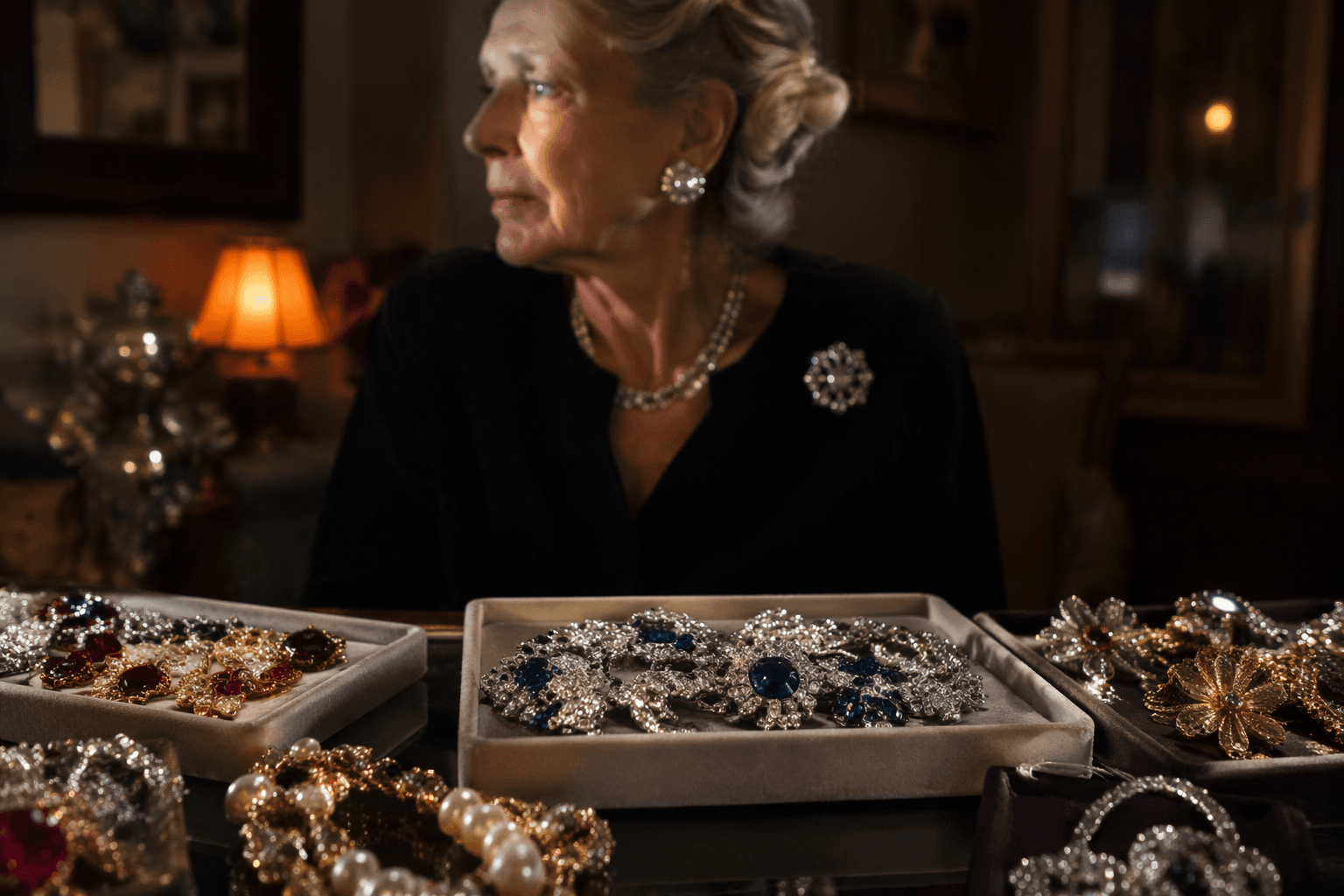
The quickest way to misread a vintage rhinestone brooch is to judge it by glitter alone. The pieces worth pursuing are not simply the ones that flash hardest, but the ones that preserve an era of material innovation: paste, leaded glass, foil-backed crystal, and the signed settings that turn costume into collectible history.
From paste to strass: the first luxury illusion
The story starts well before the modern rhinestone was even named. Collectors Weekly traces paste back to 1724, when Georges Frédéric Strass created leaded glass designed to shimmer like diamond. Britannica places a related breakthrough in 1758, when the Viennese goldsmith Joseph Strasser invented a colorless glass paste that could be cut and came to be known as strass stones.
That early chronology matters because it gives you your first dating clue. Before 1940, most imitation gems were made from glass with a high lead content, and that composition is part of the reason early paste and rhinestone jewelry still has a deeper, heavier glow than many later imitations. For collectors, those older stones are not “fake” in a dismissive sense. They are artifacts of how luxury was engineered before precision crystal cutting changed the field.
Why Swarovski changed the market
If paste introduced the idea of imitation sparkle, Swarovski made it industrial. The company places its founding in Austria in 1895, after Daniel Swarovski patented a mechanical glass cutter in 1892 and later built a system around precision that had not been possible before. Its history also ties that machine to Wattens, Austria, where local hydroelectric power helped run production.
That leap from hand-finished imitation to machine-cut crystal changed the language of costume jewelry. Swarovski crystals were made from high-lead-content glass and finished with permanent foil backing, a combination that allowed makers to imitate not only diamonds but rubies, sapphires, emeralds, onyx, opals, carnelian, and turquoise. The result was a new kind of conspicuous glamour: stones that could borrow the look of precious gems while remaining firmly in the costume-jewelry world.
The company’s social footprint is part of the story, too. Its records note worker housing, a school, and health and safety support in Wattens, which helps explain why Swarovski became more than a stone supplier. It became the engine behind a whole visual economy of modern sparkle.
The mid-century names collectors actually chase
The strongest collecting opportunity usually sits where material innovation meets a recognizable maker. Weiss built a reputation on smoky rhinestones and was among the first to use Swarovski’s polychromatic aurora borealis crystals, a finish linked to Dior in the 1950s. Those pieces often mix colored stones with enamel and japanned finishes, creating contrast that gives the surface real depth rather than simple brightness.
Christian Dior matters here because his 1947 debut collection, with the New Look, reset postwar fashion around rounded shoulders, a cinched waist, and a full skirt. The Metropolitan Museum of Art notes that Dior’s success in the 1950s depended partly on licensing agreements and ready-to-wear, and that matters for rhinestones because it explains why costume jewelry became part of the larger luxury conversation. The era wanted opulence, and rhinestones answered.
Sherman is another name that rewards a careful eye. Founded in Montreal in 1947, the house used specially ordered top-grade Swarovski crystals, often with aurora borealis coating, and set them in sturdy japanned, rhodium-, or gold-plated prong settings. The craftsmanship was so strong that even early examples could sell for as much as $50, a reminder that condition and construction can matter just as much as sparkle.
Kramer’s Dior collaborations from the 1950s and 1960s pushed the look even further, with cascading Swarovski aurora borealis stones, petal-shaped pastes, and baroque faux pearls. Eisenberg offers a different kind of collector puzzle. Eisenberg & Sons began as a women’s clothing company in 1914, founded by Jonas Eisenberg, and the jewelry was originally used to decorate garments so attractively that it was reportedly stolen from the clothing. That origin explains why Eisenberg pieces often feel designed as wearable display, not mere ornament.
How to read the marks, not just the shine
For vintage rhinestone jewelry, the fastest way to separate a true collecting piece from a pretty trinket is to read the clues in the finish and the stamp. Eisenberg is especially useful because the marks shift by period: “Eisenberg Original” was used roughly from 1935 to 1945, plain “Eisenberg” or “Eisenberg Ice” from about 1945 to 1950, and “Eisenberg Sterling” appears on some silver pieces from 1943 to 1948. Some later pieces lack a trademark stamp altogether, which makes them harder to place and more vulnerable to misreading.
A practical eye starts with a few specifics:
- High-lead glass usually gives older stones a denser brilliance.
- Foil backing can intensify light, but it also helps date construction.
- Aurora borealis coating points to the mid-century appetite for iridescence.
- Japanned, rhodium-, and gold-plated prong settings often signal serious workmanship.
- Clear marks, especially on Eisenberg, can be the difference between an attractive brooch and a documented collectible.
That is where resale potential begins to separate from mere beauty. A rhinestone piece that looks expensive is not automatically valuable. The examples that hold value best are the ones where the stone type, setting style, finish, and maker line up in the same historical moment.
Where the real collecting opportunity sits
The best vintage rhinestone buys are usually the ones that preserve their original material logic. Early paste and strass carry the appeal of the first attempts to imitate diamond. Pre-1940 high-lead glass matters because it marks the long phase before modern crystal standardization. Signed mid-century pieces from Weiss, Sherman, Kramer, and Eisenberg matter because they sit at the crossroads of couture, industrial precision, and postwar appetite for glamour.
The pieces most often mistaken for higher-value jewelry are the ones that appear richest at first glance: foil-backed crystals, aurora borealis finishes, and densely set brooches that can read like fine jewelry from across a room. Their appeal is real, but their value depends on whether they are anonymous or signed, later or earlier, altered or intact. In vintage rhinestones, the shine is only the opening argument. The mark, the metal, and the date are the verdict.
This article was produced by Prism’s automated news system from verified source data, official records, and press releases, then run through automated quality and moderation checks before publishing. The system is built and supervised by the people who set the standards it runs under. Read our full AI policy.
Know something we missed? Have a correction or additional information?
Submit a Tip