Itä’s 'Yarí Whirl' Ring — Piece of the Week (design and customization features)
Six spinning faces, one story: Itä's Yarí Whirl ring revives the private-message tradition of historical rotating jewelry as a fully customizable modern relic in 14-karat gold.
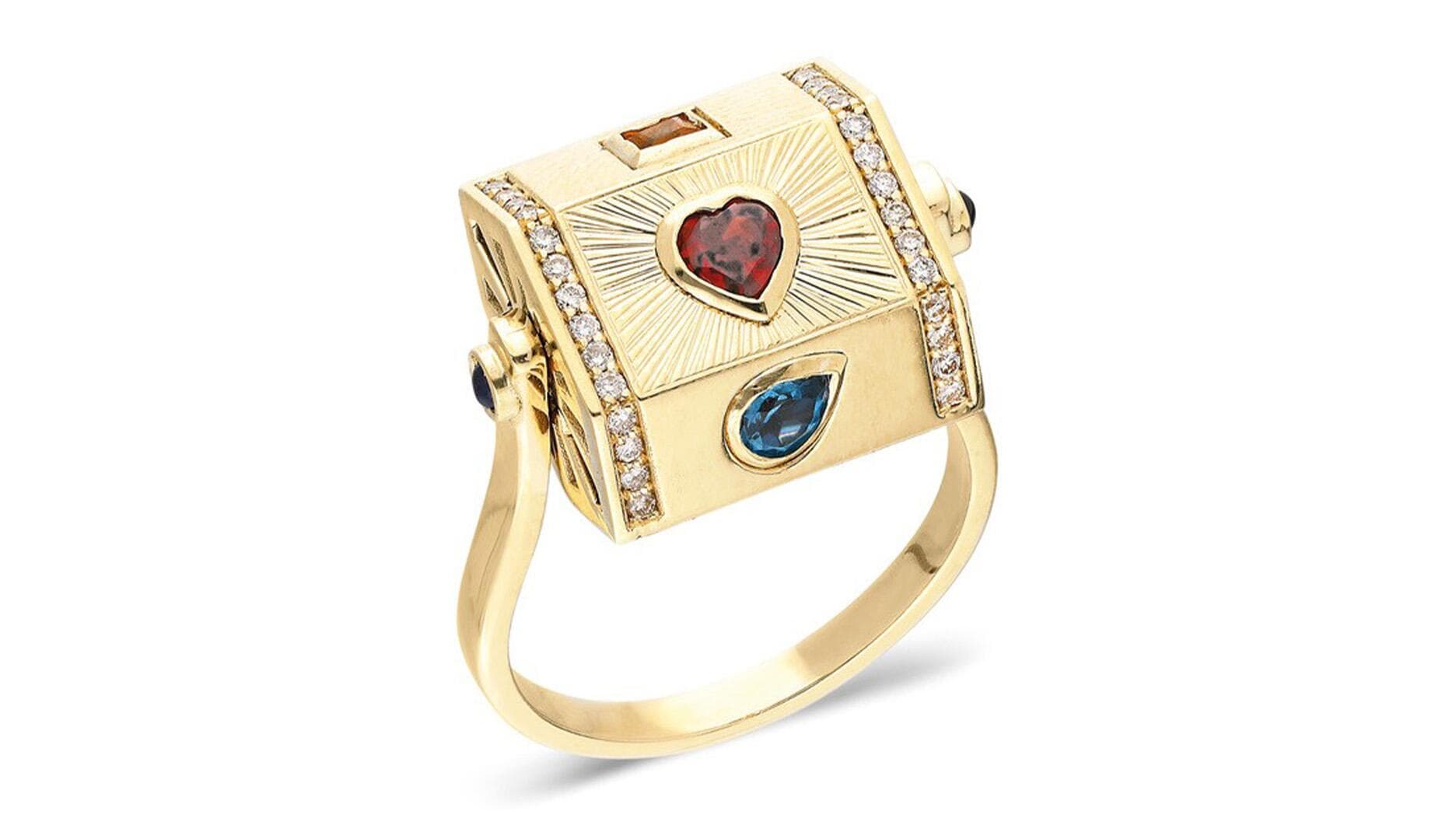
Pick up a Georgian mourning ring or run your thumb across the face of an estate-sale signet, and you are holding a small archive: initials pressed into carnelian, a coat of arms that once sealed documents with the authority of a legal signature, a message carved into the underside of the shank where no one but the wearer would ever see it. The private, biographical language of personalized jewelry stretches back millennia, and it has never fully gone away. What shifts, from era to era, is the mechanism: a rotating bezel here, a hinged compartment there, a whispered motto cut into gold. Itä's Yarí Whirl turn-style ring, spotlighted as National Jeweler's Piece of the Week, explores this idea with a 14-karat yellow gold hexagonal "nugget" that spins. It belongs squarely to a centuries-old lineage while doing something genuinely new with it.
The Object Itself
Each of the six sides is meant to reveal an element from one's story and can be customized with engravings or gemstones. In its Tesoro iteration, the face that greets you at any given rotation presents a unique colored gemstone design: no two sides are alike, and the overall effect is that of a small polychrome archive, each facet a different chapter told in stone and gold. The ring is the centerpiece of Itä's Caona collection, and its six facets can be personalized with birthstones, initials, and even small messages or affirmations, all hand engraved by the brand's master engraver. The Tesoro design retails for $9,450 and is made to order, with a lead time of 20 to 30 business days.
The intricate element is handcrafted and consists of up to 10 separate components that are assembled and then finished with the combination of multi-color faceted gemstones and engravings a client selects to tell their story. That construction is itself a form of craft biography, each join and solder point a record of the hands that made it.
A Six-Century Tradition in Your Hands
What makes the Whirl ring feel genuinely ancestral is the logic of its spinning mechanism. Rotating and multi-face rings have appeared throughout jewelry history for precisely the same reason they appeal now: the desire to carry private meaning that reveals itself only to the person who knows where to look.
Signet rings trace their origins to ancient Egypt and Mesopotamia, reaching their peak importance in medieval Europe, where kings, nobles, and clergy all carried them. Pressing your seal into wax was a legally binding act, a signature with the force of law, and forging a signet impression was a capital offense in many jurisdictions. The signet's face carried everything that mattered: initials, crests, personal mottoes. Parallel to this, the poison ring featured a hidden compartment, often beneath a gemstone or behind a rotating top, designed to hold a small quantity of material, liquid or powder. Contemporary adaptations by houses such as Boucheron include rings with a flat disc that rotates to reveal a hidden chamber, set with rubies and mounted in blackened white gold. In both the signet and the compartment traditions, the exterior presents one story; the interior, or the underside, tells another.
The Yarí Whirl does not hide its faces. It multiplies them. Where a signet had one authoritative surface, the Whirl offers six, each capable of holding a different chapter of a life. That is the architectural leap from historical precedent to contemporary design, and it is precisely what makes this ring interesting to collectors who work with vintage pieces and period stones.
The Makers Behind the Nugget
Itä was founded in 2019 by Inés Capó, a Puerto Rican native, and Äfet Burcu Salargil, who is based in Istanbul. The name İTÄ is a fusion of their first names. The two met as undergraduates, Capó studying magazine journalism and Salargil studying fashion design, and spent nearly two decades crossing in and out of each other's worlds before formalizing the collaboration. The jewelry incorporates Capó's heritage with designs inspired by mythical stories from the indigenous Taíno people of Puerto Rico, and honors Salargil's roots by using symbols from her culture and Turkish craftsmanship.
"The concept of Yarí is a labor of love from beginning to end. Its development took nearly a year, with work carried out between Puerto Rico and Turkey," said Capó and Salargil. That geography is not incidental: it is encoded into the object. The Caona collection is deeply inspired by artifacts found across the Caribbean, and within the collection, the Yarí pieces represent modern interpretations of these objects. The Yarí Whirl ring debuted in 2022. The nugget also appears as a charm pendant styled on the brand's gemstone bead strands, and it is slated to be seen at Couture's Design Atelier this May, giving buyers a rare opportunity to handle the piece before commissioning.
Designing Your Own Personal Relic
Six faces is enough room to build a complete personal archive without repetition. The key is to organize them thematically rather than decoratively, so that each rotation reveals something distinct rather than simply adding more surface pattern.
What to Engrave on Each Face
Approach the six faces as chapters, not as decoration:
- Origin: A birthstone, a place-specific gemstone (aquamarine for the sea, turquoise for the desert Southwest, green tourmaline for a mountain landscape), or a pair of coordinates engraved small enough to read as a cipher rather than a label.
- Lineage: A family initial in antique script, a motif borrowed from a family crest, or the first letter of a matriarch's name. The Taíno-inspired iconography Itä uses across the Caona collection is a useful model here: single, legible symbols that carry cultural depth without requiring explanation.
- Milestone: A date in Roman numerals reads more archival than Arabic numerals and sits naturally against the visual grammar of engraved gold.
- Word or motto: Short affirmations or single words in Latin connect directly to the signet tradition and hold their legibility at small scale. This is the face that benefits most from engraving rather than gemstone, since script requires flat surface area.
- Color: A single stone in a meaningful color, set flush so it does not interrupt the ring's spin. Colored gemstones with historical resonance, deep red garnets, period-appropriate seed pearls represented in enamel, old-cut sapphire equivalents, read convincingly alongside vintage pieces.
- One face left lightly textured or plain: Restraint has always been part of the engraving tradition. An unmarked face is not an oversight; it is an invitation.
Choosing Fonts and Motifs That Read Vintage
The typeface or engraving style is where contemporary customization either earns its historical credibility or loses it. Old English blackletter, copperplate script, and Roman serif capitals integrate with period pieces and estate jewelry far more naturally than modern sans-serif fonts, which can create visual dissonance when the Whirl ring is stacked alongside Victorian or Edwardian pieces. For motifs, single botanical elements rendered in intaglio rather than relief have the longest unbroken engraving history and age well on gold. Heraldic devices, celestial symbols (stars, suns, crescent moons), and geometric patterns drawn from specific cultural traditions carry historical depth. Itä's own Taíno iconography offers a precise example of how to use culturally specific symbols without reducing them to decoration. Avoid illustrative motifs that work at large scale but lose legibility when compressed to the face of a small hexagonal form.
Durability and Mechanism Questions to Ask Before Ordering
The up-to-10-component construction of the Yarí nugget raises practical questions that any serious buyer should address before commissioning. At 14-karat gold (58.5% fine gold), the alloy is harder and more resistant to daily wear than 18-karat, which is a sound choice for a piece whose six faces will make regular contact with hands and surfaces. But the spinning mechanism introduces specific wear patterns worth understanding:
- Ask how the rotating mechanism is secured and what the intended tolerance is. A spin that is too loose will develop wobble over time; a join with no give at all places stress at the connection point between shank and nugget.
- Ask whether gemstones are bezel-set or prong-set on each face. Bezel settings are significantly more protective on a rotating piece, since prongs are vulnerable to snagging during the spin cycle and against hard surfaces.
- Ask about the repair and maintenance protocol specific to the rotating mechanism. This is a different conversation from standard jewelry maintenance and should be addressed explicitly before you own the piece.
- Ask about engraving depth. Shallow cuts on gold can polish out over decades of wear; deeper cuts are more archival and hold their legibility through resizing and refinishing.
- If you plan to stack the Whirl ring with antique or vintage pieces, ask about finish options. A hand-finished or brushed surface integrates with period jewelry far more naturally than a high-mirror polish, which reads as newly made and creates visual contrast with older patinated gold.
The Case for the Wearable Archive
The story behind a piece of jewelry truly brings it to life and imbues it with a deeper meaning than simply a combination of materials. The Yarí Whirl ring is built on that conviction and gives it a structure: six faces, each a decision, each a commitment to specificity over sentiment. For collectors drawn to the personalized tradition of historical jewelry, the ring offers something rarer than a period piece: the chance to commission the heirloom from the beginning, to be the first wearer of an object designed to carry private meaning through decades of use. The signet ring understood this logic for six centuries. The Whirl ring, with its 10-part construction and its handcrafted gold faces, simply gives that logic six chances to speak.
This article was produced by Prism’s automated news system from verified source data, official records, and press releases, then run through automated quality and moderation checks before publishing. The system is built and supervised by the people who set the standards it runs under. Read our full AI policy.
Did this article answer your question?