Medieval Gold Love Brooch Heads Five Auction Lots Worth Watching
A bifacial gold love brooch from the late 14th century leads Noonans Mayfair's latest sale, with five lots starting from £50 catching expert eyes this week.
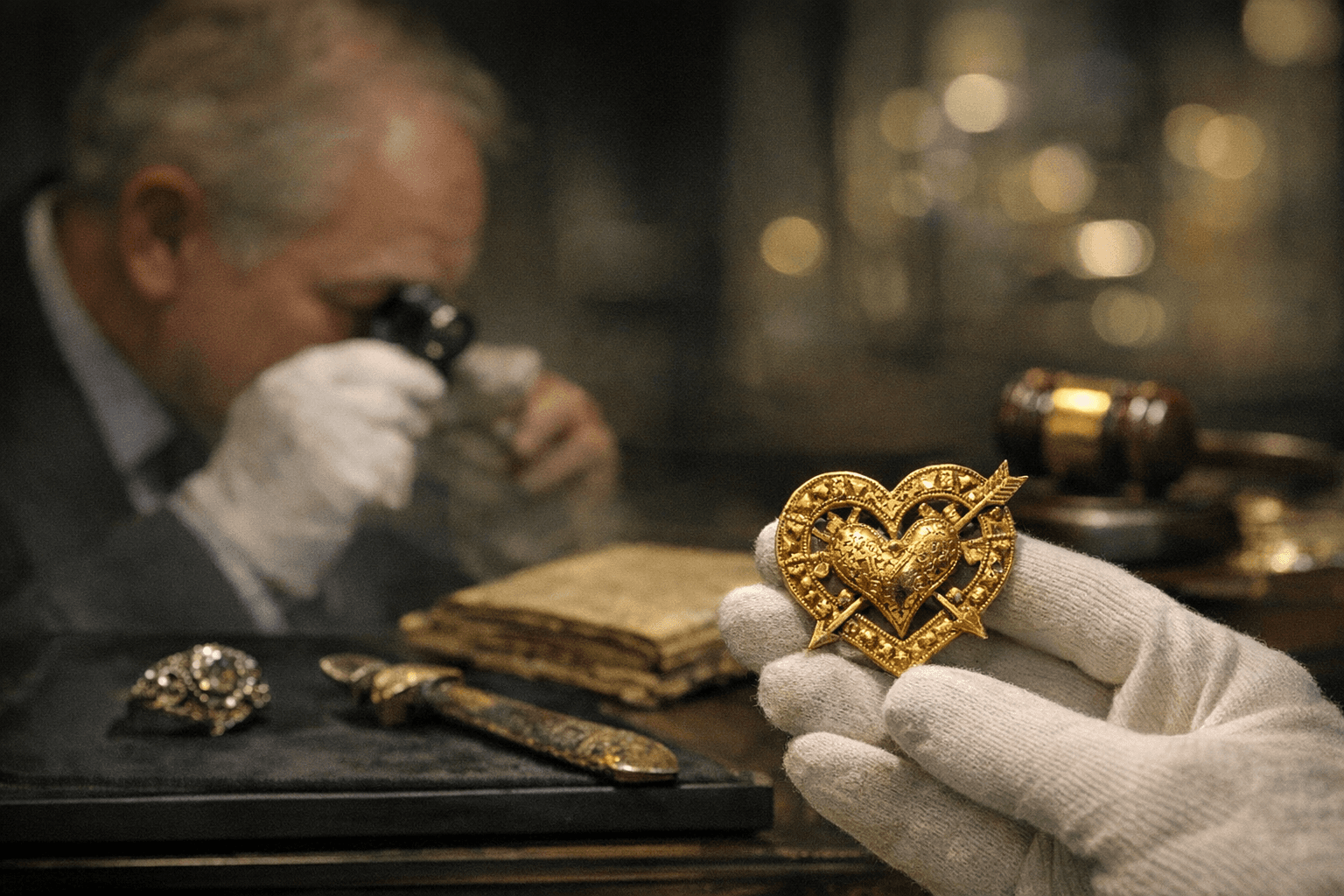
Few objects carry the emotional freight of a medieval love brooch. These small, intimate pieces were not decorative flourishes for public display but private tokens, pressed into palms or pinned close to the body as declarations of devotion. That one such brooch, dated to the late 14th or early 15th century, has been singled out by Antiques Trade Gazette as the headline lot among five auction picks worth watching tells you something about the current appetite for wearable medieval history.
The Star Lot: A Bifacial Gold Love Brooch, Late 14th/Early 15th Century
Catalogued as Lot 53 in Noonans Mayfair's Jewellery, Watches, Silver and Objects of Vertu sale, the brooch is described in the auction listing as a "bifacial" piece, meaning it was designed to be seen and appreciated from both sides. That construction detail matters enormously in understanding what this object once meant to its owner. A bifacial brooch is not a pin meant to be tucked under a collar; it is a piece conceived for full visibility, its decorative programme considered from every angle. The catalogue description trails off in the available text, noting only "the bifacial brooch taking the..." before truncating, which leaves the precise formal treatment of the face and reverse for those who can examine the lot's seven catalogue images or inspect the piece in person at Noonans.
Antiques Trade Gazette's Monday briefing, published on 9 March 2026, placed the brooch in historical context by invoking the tradition of "heart-shaped foliate wreath" motifs that characterise the love brooch type in this period. The phrase, though fragmentary in the available material, is enough to situate the piece within a well-documented late medieval genre. Heart-shaped and floral wreath brooches proliferated across Northern Europe from roughly the 13th century onward, functioning simultaneously as love tokens, devotional objects, and status markers. Gold examples from the late 14th and early 15th centuries are comparatively rare on the open market; most reside in institutional collections. When one surfaces at auction, it commands attention from scholars and collectors in equal measure.
The Sale Context: Noonans Mayfair and the Wider Catalogue
The love brooch does not appear in isolation. The same Noonans catalogue includes a medieval gold and gem-set annular brooch dated to the 13th or 14th century, described as having a "flat circular hoop," and a medieval silver cruciform pendant from the same broad period, its central round disc inscribed with what the catalogue text begins to describe before that entry too cuts short. Neither of those additional lots is illustrated in the available online listing, which makes Lot 53, with its seven catalogue images, the most thoroughly documented of the three medieval pieces in this section of the sale. For a collector assembling a focused holding in medieval personal adornment, the presence of multiple period pieces in a single sale is an opportunity worth noting.
Noonans Mayfair has a well-established reputation for handling precisely this category of material. The house's sale classifications under Jewellery, Watches, Silver and Objects of Vertu place these medieval pieces alongside a broader range of lots, but the specialist nature of the medieval offerings suggests careful sourcing and cataloguing rather than incidental inclusion.
Understanding the Estimate Range
Antiques Trade Gazette's preview headline notes that "estimates from £50" apply across the five lots featured in its weekly picks. It would be a mistake to read that floor figure as applying to the gold love brooch specifically; the £50 entry point almost certainly reflects the range across all five lots in the ATG selection, with simpler or more accessible pieces setting the lower boundary. The specific estimate for Lot 53 was not published in the available catalogue excerpt, and prospective bidders should contact Noonans directly or consult the full lot entry to obtain the official low and high estimates before placing a bid.
That caveat aside, the ATG editorial selection itself carries implicit valuation weight. The Antiques Trade Gazette does not flag lots without editorial judgment behind the choice. Being named among five lots to watch in a publication read by the trade represents a form of curatorial endorsement that tends to correlate with a piece's significance, condition, or rarity, even when the specific estimate is not disclosed in the preview.
What Buyers Need to Know Before Bidding
For anyone considering bidding on Lot 53 or any lot in this Noonans sale, the financial structure deserves careful attention. The buyer's premium is 24% plus VAT on the hammer price, which is standard for a specialist London auction house operating at this level. There is also an additional charge of 4.95% plus VAT, listed separately in the sale terms. The precise circumstances under which that additional charge applies, whether to online bidders, telephone bidders, or as a payment processing fee, are not spelled out in the available listing text, and clarifying this with Noonans before bidding is prudent. Taken together, these charges can meaningfully increase the total cost above the hammer price, a calculation that should be factored into any bidding strategy.
On the question of delivery, Noonans uses Royal Mail Special Delivery for UK purchases, a fully tracked service with next weekday delivery between 9am and 1pm and insurance cover provided by the auction house's own insurer. Heavier or more awkward lots are dispatched by courier after direct discussion with the buyer. The listing does flag that certain categories of lot, specifically those containing glass or sharp implements, may fall outside the standard in-house shipping arrangements, and buyers with concerns about a particular lot should raise them with Noonans directly.
Why This Brooch Matters Beyond the Hammer Price
Medieval gold survives in relatively small quantities compared with what was once made. Secular gold jewellery from the late 14th century is even rarer, because much of it was melted, lost, or absorbed into institutional collections over the intervening six centuries. A bifacial love brooch in gold, with documented visual material across seven catalogue images and the backing of an ATG editorial selection, represents the kind of lot that does not pass through the London saleroom with great frequency.
For a collector who understands the history of medieval personal ornament and is prepared to do the due diligence, this means confirming the full catalogue description, requesting a condition report, and verifying provenance with Noonans before the hammer falls. The object itself, a small disc of late medieval gold worked on both faces in the language of love that the 14th century understood so fluently, makes a compelling case for attention on its own terms.
This article was produced by Prism’s automated news system from verified source data, official records, and press releases, then run through automated quality and moderation checks before publishing. The system is built and supervised by the people who set the standards it runs under. Read our full AI policy.
Did this article answer your question?