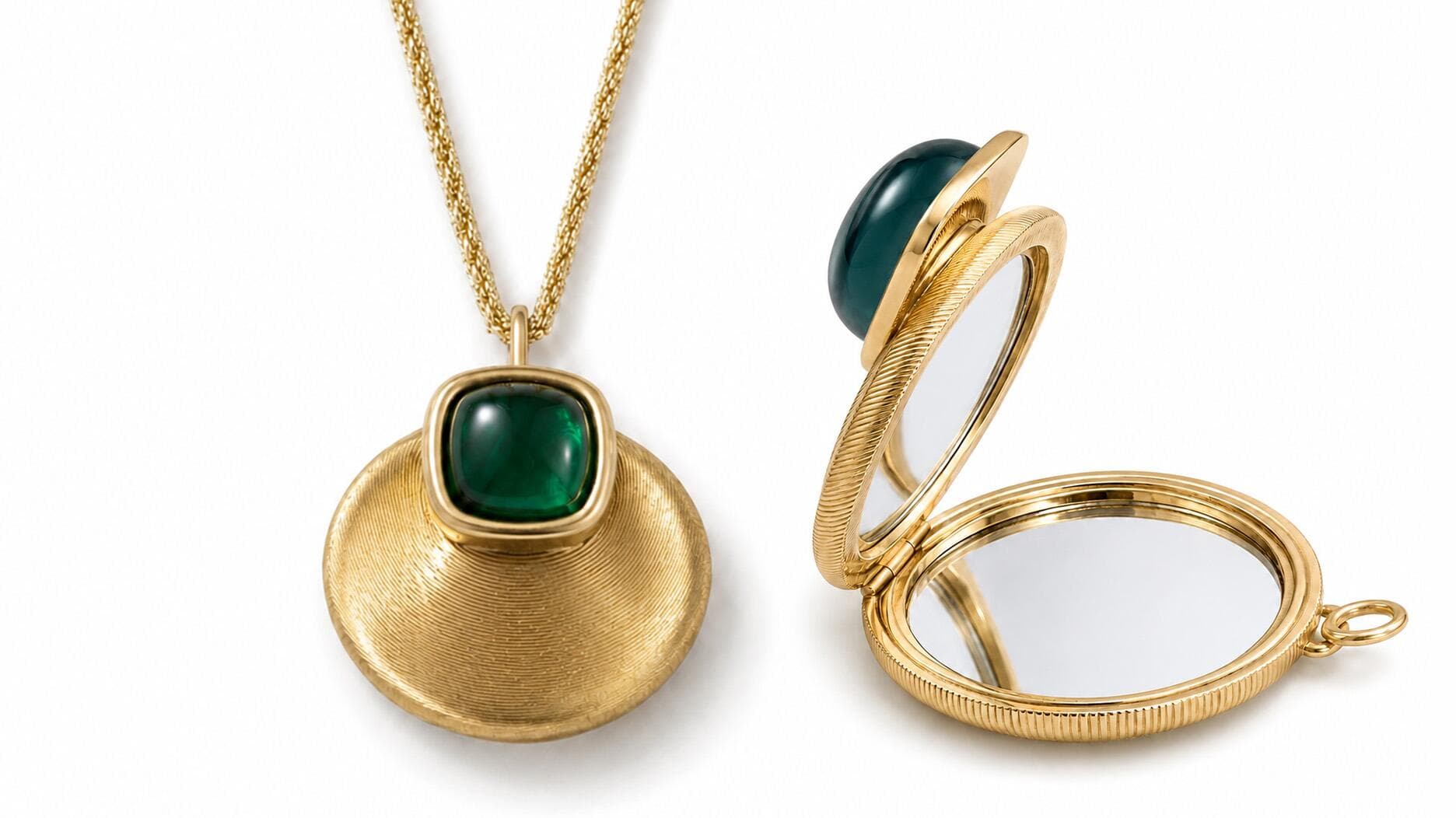
Met's Body Transformed Jewellery Exhibition Debuts in Asia at Hong Kong Palace Museum
From 3,000-year-old Egyptian gold rings to a Victorian emerald tiara that splits into three brooches, The Met brings 200 jewellery masterpieces to Hong Kong from April 15.

Pick up an ancient piece pulled from a private collection and you are holding a small archive: not just of materials or craft, but of the body that once wore it and the authority it conferred. That is precisely the argument the Hong Kong Palace Museum and The Metropolitan Museum of Art are making together from 15 April 2026, when Gallery 8 at HKPM opens one of the most comprehensive travelling jewellery exhibitions the region has ever seen.
"Treasures of Global Jewellery from The Metropolitan Museum of Art: The Body Transformed" runs through 19 October 2026 in Gallery 8 at the Hong Kong Palace Museum. The museum is located at 8 Museum Drive, West Kowloon Cultural District, and is open daily from 10:00 am to 8:00 pm, closed on Tuesdays except public holidays and the first two days of Lunar New Year. A special exhibition ticket also grants access to all seven thematic galleries in the permanent collection. Guided tours of Gallery 8 are available at HK$150 per adult and HK$75 per concession, inclusive of the special exhibition admission. American Express cardholders receive a 5% discount on the regular ticket price.
The show is jointly organised by The Met and HKPM and marks The Met's debut in the Guangdong-Hong Kong-Macao Greater Bay Area, as well as its first major travelling exhibition of its encyclopaedic global jewellery collection in Asia. Around 200 spectacular objects from The Met's holdings are displayed alongside selected pieces from HKPM's own Mengdiexuan Collection and the Chris Hall Collection. Together they span six continents and nearly 4,000 years, from the second millennium BCE to the 21st century.
Hong Kong designer and artist Alan Chan, internationally recognised for his "Oriental Passion, Western Harmony" design philosophy, has provided artistic direction to the exhibition's graphic design and spatial presentation, a decision that signals HKPM's deliberate interest in filtering this global material through a distinctly local sensibility.
The exhibition is structured around five thematic rooms: "The Divine Body," "The Regal Body," "The Transcendent Body," "The Alluring Body," and "The Resplendent Body." Each isolates a distinct function that jewellery has served across cultures and centuries: sacred protection, dynastic authority, spiritual elevation, erotic signal, and sheer material splendour. For collectors, these are not merely curatorial categories. They are a usable taxonomy for every estate sale search, auction lot description, and antique dealer conversation that follows.
Here are the pieces most worth the journey, and what each one has to teach a buyer.
A set of 1,251 gold rings, dated to approximately 1887-1813 BCE and excavated from the tomb of the Egyptian princess Sithathoryunet, daughter of the pharaoh Senwosret II, is among the oldest objects on view. These rings were threaded through the princess's ceremonial wigs, revealing the importance of head ornamentation as a marker of royal identity in ancient Egypt. The structural logic is remarkable: by distributing weight across more than a thousand small linked elements rather than a single rigid form, the maker produced something that moved with the wearer's body while reading, at a distance, as a solid crown of gold. This is the direct ancestor of every articulated chain necklace and flexible bead collar that followed. Estate sale hunters in search of this idiom should target Egyptian Revival jewellery from the 1920s and 1930s. When Howard Carter opened Tutankhamun's tomb in 1922, a wave of Western makers immediately reproduced this structural logic in graduated gold-bead necklaces, many of which remain available and underpriced precisely because they lack the word "Egyptian" in their lot descriptions.
From the opposite end of the Americas, a Calima gold headdress ornament from ancient Colombia, dated to the 1st through 7th century, was worn as a symbol of wealth and status. Its surface was worked through hammered sheet gold and repoussé technique to catch and redirect light, marking the wearer as someone who commanded space. The mid-century Taxco school of Mexican jewellery worked in precisely this idiom. Pieces signed by Hector Aguilar or Antonio Pineda carry the same hammered-gold visual language at a fraction of the archaeological weight, and both makers remain undervalued in the current market relative to their craft level.
HKPM contributes a gold headdress with animals from the Mengdiexuan Collection, dated to the 4th-3rd century BCE, which once adorned a member of the elite in northern China. The animal-motif granulation here makes a quiet but forceful argument against the assumption that ornamental goldwork of this complexity flowed from a single Western centre outward. This piece is contemporaneous with Hellenistic jewellery from Greece and the Near East, not derivative of it. The Italian firm Castellani spent decades in the 1860s and 1880s reconstructing animal-motif granulation for its Etruscan Revival line, and their signed work remains among the most sought-after objects in the Victorian market precisely because the craft is so difficult and the archaeological reference so specific.
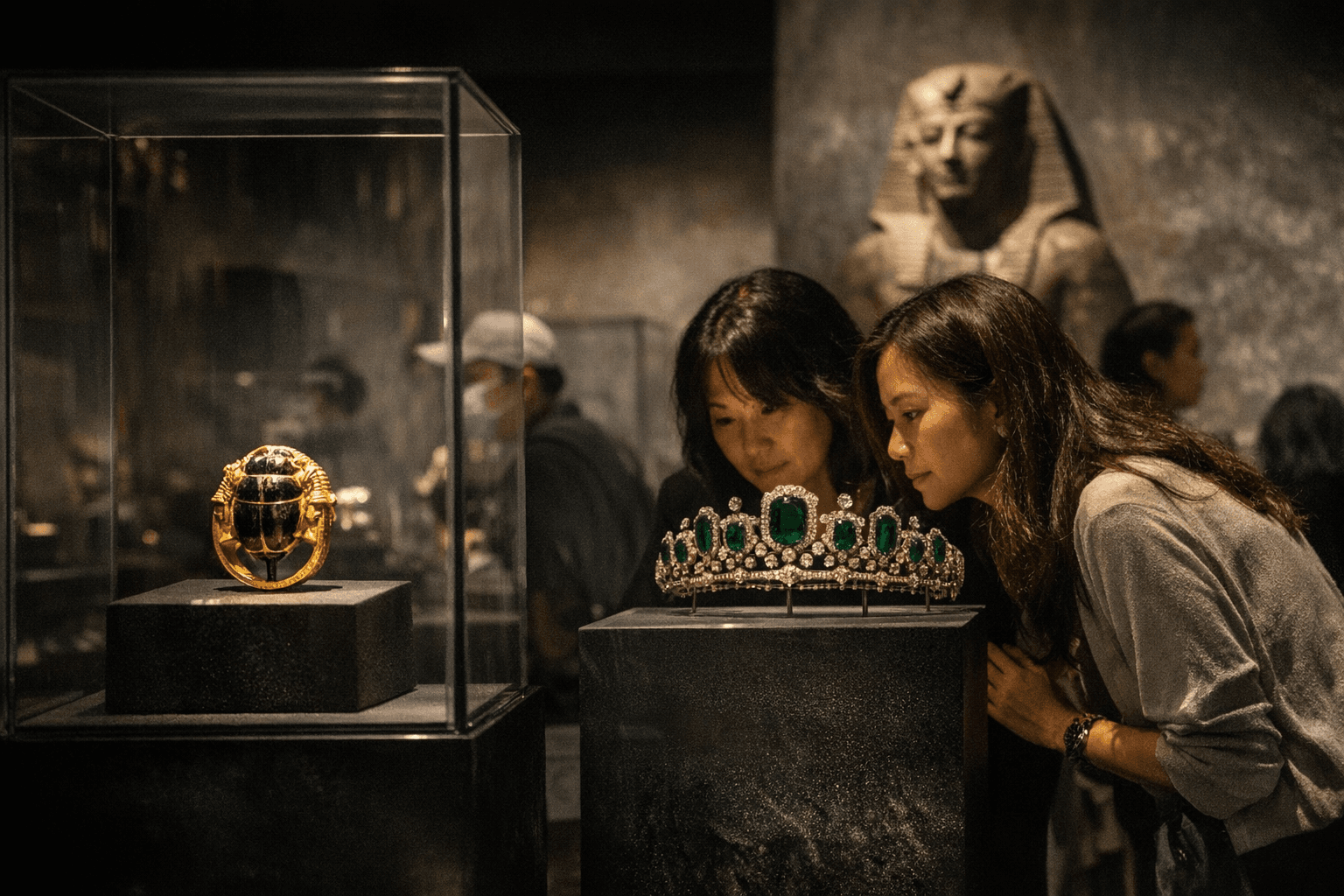
One of the most instructive pieces for anyone shopping auction rooms is an emerald tiara with oak leaves and acorns, dated to about 1840-1850, from The ILLUMINATA Collection. The piece is convertible: its oak-leaf sprays detach as three independent brooches. Oak leaves served as an emblem for national strength and steadfast loyalty in Britain, so the object was encoding ideology at the same time as it was solving a practical design problem. The lesson for auction-goers is to examine any Victorian tiara or parure closely for concealed screws, hinged connections, or detachable elements before bidding. Convertible pieces are systematically undervalued when catalogued as a single item because not all previewing buyers notice the mechanism.
Completing the exhibition's Western arc is a necklace by the New York firm Dreicer & Co., active from 1868 to 1927, made around 1905 from diamonds, natural pearls, and platinum. This is canonical garland-style Edwardian work. Platinum had just replaced silver as the preferred white metal for fine jewellery because its tensile strength allowed settings thin enough to make diamonds appear to float in milgrain lace. The natural pearls are the critical provenance marker here. Any similar Edwardian necklace with pre-1920s platinum construction discovered at an estate sale warrants a pearl testing appointment before purchase; natural and cultured pearls are visually indistinguishable to the naked eye but differ enormously in price, and a pearl sitting in a drawer since 1910 is far more likely to be natural than one assumed to be natural without documentation.
The museum's learning programme will include guided tours, workshops, and public talks, with further details to be announced closer to the opening. Visitors will also be able to virtually try on select pieces through interactive technology, an element designed to extend the show's central argument about jewellery as bodily transformation into lived personal experience.
HKPM has been building toward this scale of international loan partnership since its opening in the West Kowloon Cultural District. The museum previously hosted "The Adorned Body: French Fashion and Jewellery 1770-1910" in partnership with the Musée des Arts Décoratifs in Paris, and welcomed the Cartier and Women exhibition through 2023. The Met collaboration represents a meaningful step up: where those shows drew on single institutional partners, this exhibition synthesises six continents of material through the lens of an encyclopaedic collection that has no peer in its geographic range.
For collectors who cannot make the journey to Hong Kong, the exhibition's five-section structure still serves as a practical shopping map. "The Divine Body" leads to amulet-form pieces: scarab brooches, hands of Fatima, protection-symbol pendants. "The Regal Body" points toward matched parures and demi-parures, the material evidence of dynastic patronage. "The Transcendent Body" covers devotional jewellery: memento mori rings with hair compartments, mourning brooches with black enamel. "The Alluring Body" encompasses sentimental and erotic forms, from padlock pendants and heart lockets to Edwardian negligee necklaces designed to draw the eye downward. "The Resplendent Body" is simply about material maximalism: graduated multi-stone necklaces, articulated bib-collars, and statement bracelets with flexible panelled construction.
The most persuasive thing about any show that places Sithathoryunet's 3,800-year-old gold rings in the same room as an 1840s British emerald tiara and a 1905 New York diamond necklace is the argument it makes without a single label: that the impulse to adorn the body, and to encode meaning in that adornment, is unbroken across every culture and every century represented here. That argument does not require a museum ticket to act on.
This article was produced by Prism’s automated news system from verified source data, official records, and press releases, then run through automated quality and moderation checks before publishing. The system is built and supervised by the people who set the standards it runs under. Read our full AI policy.
Did this article answer your question?