Online Silver Hallmarks Database Helps Collectors Identify Vintage Marks Worldwide
A continuously updated online encyclopedia decodes silver hallmarks from Britain to Russia, giving collectors a single visual reference to date, place, and attribute any marked piece.
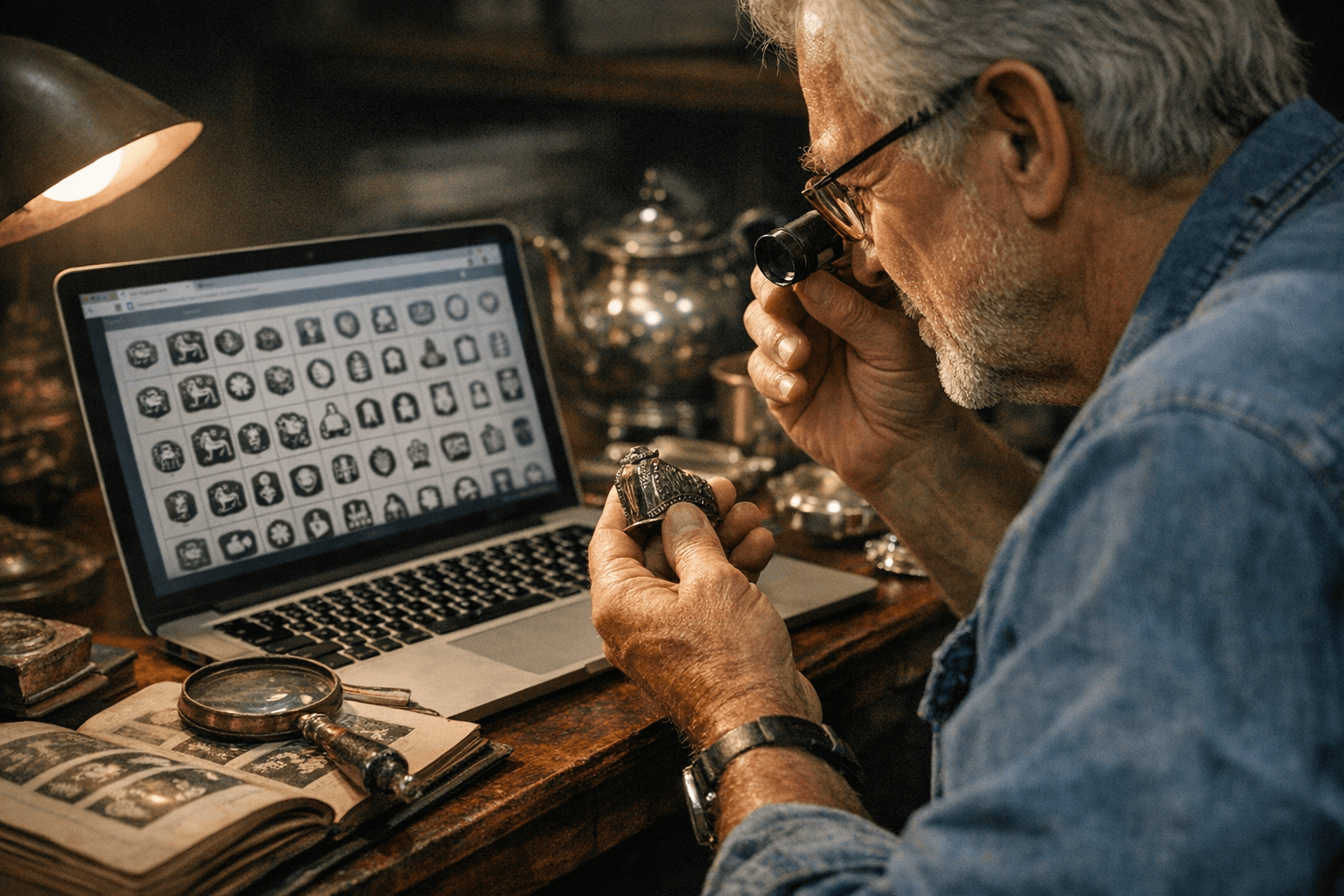
A silver sugar caster sits on your table. The body is graceful, the piercing crisp, the weight substantial. Somewhere on its base, pressed into the metal like a whisper from the workshop, is a cluster of tiny punches: a striding lion, a letter in a shield, an anchor, a set of initials. Each mark is a sentence in a language most of us were never taught to read. Together, they tell you exactly who made this object, where it was tested for purity, and in what year it was approved for sale. The piece is not just decorative; it is a document. Learning to decode it is one of the most rewarding skills a collector can develop, and it begins with the right reference.
The Encyclopedia That Changed Silver Research
The Online Encyclopedia of Silver Marks, Hallmarks & Makers' Marks is the closest thing the collecting world has to a universal translator for struck silver. Maintained as a continuously updated digital resource, it functions as a global visual reference covering hallmarks, assay marks, and makers' marks across dozens of countries and many centuries of silversmithing history. The Library of Congress has preserved it in its web archives, and Collectors Weekly placed it in its Hall of Fame for antiques research tools. Its scope is genuinely remarkable: from Georgian flatware to Scandinavian modernist hollowware, from Indian colonial pieces to Chinese export silver, the database organizes its material by country and by maker, making it navigable whether you know what you are looking for or are working from scratch.
The site's name derives from the two silver standards it bridges: 925 (sterling, 92.5% pure) and 1000 (fine silver, used in some continental and Asian traditions). That range signals the database's ambition from the outset.
British Hallmarks: Where the Database Excels
If you own British or Irish silver, this resource's date-letter tables are the single most efficient place to begin. British silver, when properly hallmarked, carries a minimum of four distinct marks: the lion passant (the standard mark for sterling purity), the maker's initials, a date letter, and a town mark indicating which assay office tested the piece. The town marks are the first key to cracking the cipher. London silver bears a leopard's head; Birmingham, an anchor; Sheffield, a rose or crown depending on the period; Edinburgh, a castle.
The date-letter system, which changed annually through a cycling alphabet before restarting with an altered shield or typeface, allows British silver to be dated with a precision almost unmatched among antiques. A date letter does not tell you when the piece was made, strictly speaking; it tells you when it was assayed and approved, which is usually within the same year as manufacture. The encyclopedia's British tables lay out these cycling alphabets for each assay office in sequence, illustrated with the actual punch shapes collectors will encounter on a piece. This is critical because a gothic "A" in a shield from Birmingham is not the same as the same letter from London in the same year.
Continental European marks present a more complex picture, and the database addresses this directly. Assay punches from Austria, France, Germany, the Netherlands, and Russia operated under national systems that varied significantly from the British model. French guarantee marks, for instance, changed with every major political regime shift, making a piece's marks an inadvertent record of the country's turbulent history. Russian silver from the Imperial period used city marks alongside kokoshnik-wearing figures indicating metal standard, while Finnish and Scandinavian pieces carry their own pictorial town marks. The encyclopedia's comparative illustrations of these continental punches are among its most valuable features, particularly when a mark is worn or struck at an angle.
American Makers: Trademarks Over Assay Offices
American silver operates under a fundamentally different system. The United States never adopted a national assay hallmarking law comparable to Britain's, which means American pieces were never legally required to carry date letters or town marks. Instead, American silversmiths and manufacturers registered their own trademarks and quality designations. "Sterling" stamped on an American piece indicates 92.5% silver but tells you nothing about date or city of origin on its own. This is where maker's marks become the primary tool for attribution.
The database covers the date-mark systems developed independently by major American houses, including Gorham, Tiffany, Kirk, Reed & Barton, Stieff, Tuttle, and Whiting. Gorham, for instance, introduced its own private date-letter system in 1868 that ran alongside the standard sterling mark, giving collectors a way to date pieces with considerable accuracy. Tiffany similarly used an internal coding system. The encyclopedia reproduces these proprietary systems with enough specificity to distinguish pieces made years or even decades apart.
Silverplate, Flatware, and the Marks That Mislead
One of the most practically useful sections of the database covers silverplate trademarks, a category that confuses new collectors with some regularity. Silverplate marks were designed to look authoritative, and some deliberately mimic the visual grammar of solid silver hallmarks. Quadruple plate, nickel silver, and electroplate all carry marks, but the legal standards governing what those marks communicate differ entirely from the rules applied to sterling or coin silver. The database includes a substantial section on American flatware patterns alongside silverplate trademarks, helping collectors identify pattern names, manufacturer identities, and the era of production from the base metal piece itself.
Using the Database as a Cross-Reference
The encyclopedia is most powerful when used alongside a physical piece in hand. When a mark is partially legible, you can search by country, narrow to a date range based on stylistic evidence, and compare your punch against the illustrated examples. The database is particularly recommended as a cross-reference when researching silver items that lack clear maker inscriptions, filling gaps left by wear, polishing, or deliberate removal of marks. It also maintains a Silver Marks Forum where collectors post photographs of unidentified marks for community identification, extending the database's usefulness beyond its catalogued entries.
Beyond Identification: Context for Valuation
Identifying a mark is the first step; understanding what that identification means for value is the next. A Georg Jensen piece from the early 1920s marked with Jensen's pre-1945 hallmark carries significant premium over a later production piece, and the difference is in those punches. Similarly, a piece from the short-lived Newcastle Assay Office, which closed in 1884, carries inherent rarity in its town mark alone. The encyclopedia provides the foundation for that distinction, giving collectors the visual literacy to recognize when a mark signals something exceptional rather than merely authentic.
For anyone building a collection of silver, whether British period pieces, Scandinavian mid-century work, or American sterling hollowware, the Online Encyclopedia of Silver Marks, Hallmarks & Makers' Marks represents the kind of continuously refined reference that used to exist only in specialist libraries. The physical vocabulary of the silversmith's workshop, pressed into metal across five centuries and dozens of national traditions, is now searchable, illustrated, and freely available. The piece on your table is still waiting to speak.
This article was produced by Prism’s automated news system from verified source data, official records, and press releases, then run through automated quality and moderation checks before publishing. The system is built and supervised by the people who set the standards it runs under. Read our full AI policy.
Did this article answer your question?