Pearls, moonstone and alexandrite, June birthstones with vintage appeal
June’s trio offers three very different vintage paths: pearls for easy heirloom style, moonstone for Art Nouveau romance, and alexandrite for rarefied collecting.
The smartest June birthstone shopping starts in the estate case, not the modern display. Pearls, moonstone and alexandrite each tell a different story in vintage jewelry, and together they map a collector’s range from approachable to extraordinary. June is one of only three months, along with August and December, that has three birthstones, which gives you real choice in mood, price and period feel.
Pearls: the most accessible vintage entry point
If you want the quickest route into heirloom style, start with pearls. They have been treasured for centuries, and for much of recorded history natural pearl jewelry ranked among the most valuable adornments in the world. That long prestige still shows up in old strands, brooches and earrings, where pearls read as elegant without trying too hard.
Their history matters because it explains why they sit so comfortably in vintage jewelry. The Gemological Institute of America traces pearl culturing back hundreds of years in China, with Japanese pioneers eventually producing whole cultured pearls around the beginning of the 20th century. Cultured pearls became commercially important in the 1920s as natural pearl production declined, and that shift is part of what made pearl jewelry more attainable without stripping away its association with status.
For collectors, that means pearls are often the easiest birthstone to buy well. You can find them in Victorian mourning pins, midcentury sautoirs, Art Deco clasps and simple 1950s strings. A strand with a well-made clasp, even if the pearls themselves are cultured rather than natural, can still deliver the classic look that makes a piece feel inherited rather than purchased yesterday.
Pearls also carry a historical charge that goes beyond fashion. Smithsonian Magazine has noted that they were markers of extreme wealth in ancient India, the Roman Empire and Egypt, and PBS has emphasized their long-held allure as treasures of nearly incomparable value. That old-world weight is why pearls remain the safest vintage bet for someone building an heirloom wardrobe: they bridge daily wear and ceremonial dressing with almost no effort.
What to look for in vintage pearls
The appeal of pearls is broad, but the details matter.
- Look closely at the clasp. A sturdy, period-appropriate clasp can tell you as much about age and quality as the pearls themselves.
- Expect variation. Older strands may show slight differences in luster or shape, which can be part of their charm rather than a flaw.
- Decide how you want to wear them. Short strands, brooches and pearl drops feel especially linked to earlier eras, while longer ropes suggest later 20th-century styling.
If you want the best heirloom value in the June group, pearls usually win. They are the easiest to verify visually, the most flexible to wear, and the most forgiving in the vintage market.
Moonstone: the period-design stone
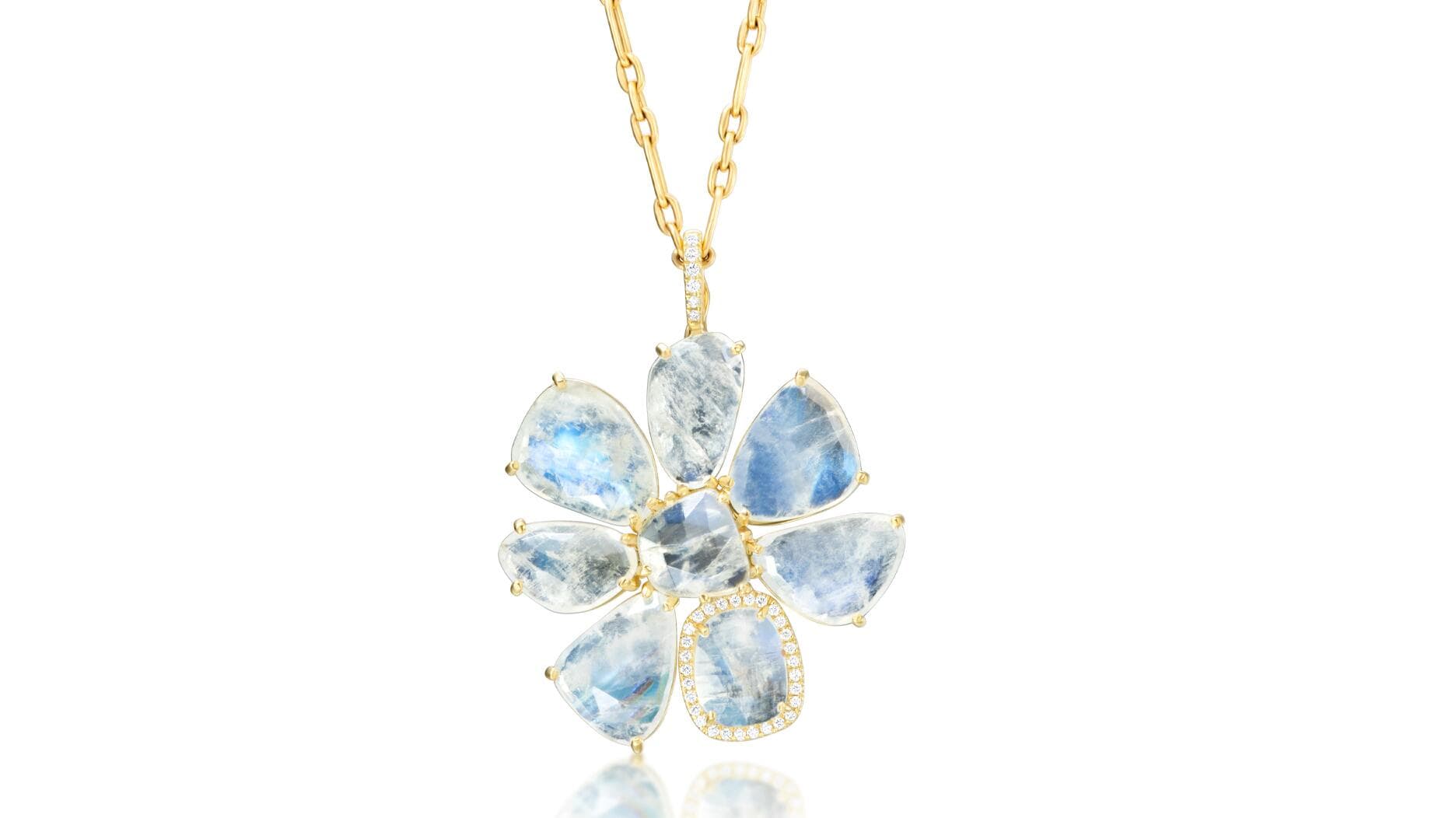
Moonstone is the June birthstone that most clearly signals an era. Its soft glow fits the romantic, handworked look of late 19th-century and early 20th-century jewelry, which is why it remains so closely tied to Arts and Crafts and Art Nouveau design. If pearls are the easy door into vintage, moonstone is the stone that lets you step straight into a particular aesthetic moment.
The Gemological Institute of America notes that fine moonstone was sourced early from Mt. Adular, now St. Gotthard in Switzerland, and that designers such as René Lalique and Louis Comfort Tiffany featured it in custom jewelry. It was also favored by Arts and Crafts artisans in the late 19th century. That pedigree gives moonstone an unusually specific visual language: flowing lines, botanical motifs, matte silver mounts and a sense of movement even in a small brooch.
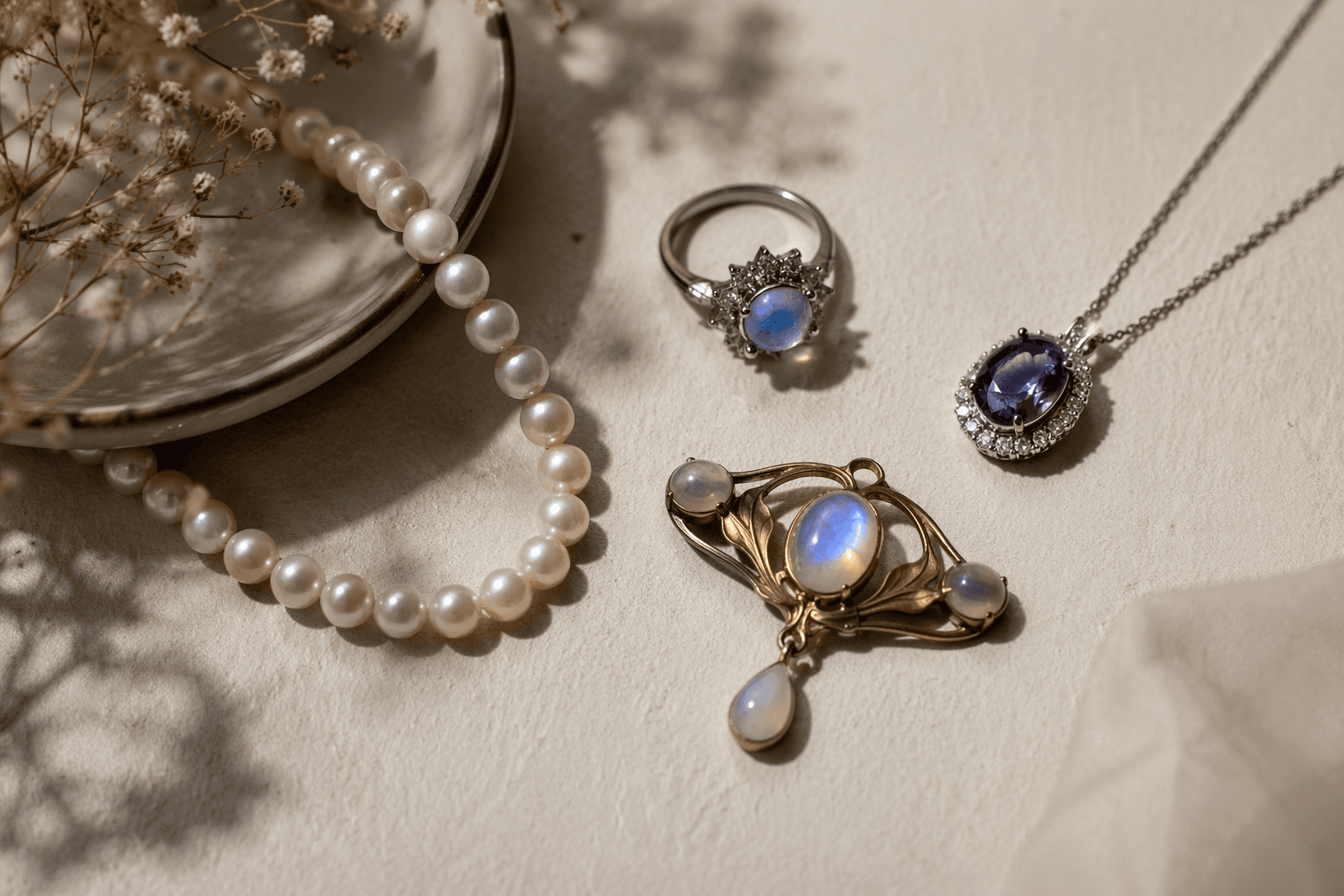
For collectors, moonstone rewards attention to setting as much as to stone. A moonstone in a modern bezel may be pretty, but a moonstone in an early silver mount, especially one with stylized leaves, whiplash curves or hand-finished details, tells a richer story. That kind of piece can be an especially satisfying buy because it feels both wearable and historically anchored.
Moonstone is not the most practical stone in the trio for hard daily use, but that is part of its appeal. It offers the strongest period-design payoff, especially if you love jewelry that looks as though it could have come from a Paris salon, a turn-of-the-century workshop or a handcraft revival studio.
Alexandrite: the collector’s test of rarity
Alexandrite sits at the other end of the June spectrum. If pearls are approachable and moonstone is atmospheric, alexandrite is the stone that turns a birthstone purchase into a serious collecting decision. The Gemological Institute of America says it was first discovered in Russia’s Ural Mountains in 1830 and named for the future Alexander II, which gives it a royal origin story as dramatic as its color change.
That color change is the whole point. Fine alexandrite is prized for shifting appearance under different light, and the best material remains exceptionally rare and valuable. GIA notes that fine alexandrite is now found in Sri Lanka, East Africa and Brazil, but top-quality stones are still scarce enough to command serious prices. In vintage jewelry, that rarity creates a different kind of risk and reward than pearls or moonstone.
If you are looking at old alexandrite jewelry, authentication matters much more than romance. Many pieces marketed as alexandrite may be other color-change stones, treated gems or modern substitutes that borrow the name without the true rarity. The stakes are higher because the market expects alexandrite to justify its price through both scarcity and verified optical behavior.
That makes it a stone for informed collectors rather than casual buyers. A genuine alexandrite ring or pendant can be a remarkable heirloom, but it should be chosen with a jeweler’s eye and a collector’s skepticism. The allure is real; so is the need to verify it carefully.
How June’s trio breaks down for collectors
What makes this month unusually useful is that its three stones serve three different buyers. GIA says June birthstones can suit different moods and budgets because they offer different colors and price points, and that is exactly why the month works so well in the vintage market. You can buy into the category at almost any level without losing the thread of history.
Pearls are the most vintage-friendly choice because they are abundant enough to be accessible and historically rich enough to feel heirloom-ready. Moonstone offers the strongest bridge to Art Nouveau and Arts and Crafts design, especially when the setting matches the stone’s quiet glow. Alexandrite is the prestige play, the one that demands scrutiny and pays off with rarity.
For anyone building a June collection, the order of operations is clear. Start with pearls if you want wearability and confidence. Move to moonstone if you want a piece that speaks fluently in period style. Save alexandrite for the moment you are ready to authenticate carefully and pay for real rarity.
That is the beauty of June in vintage jewelry: one month, three distinct collecting strategies, and a clear path from everyday elegance to museum-level scarcity.
This article was produced by Prism’s automated news system from verified source data, official records, and press releases, then run through automated quality and moderation checks before publishing. The system is built and supervised by the people who set the standards it runs under. Read our full AI policy.
Know something we missed? Have a correction or additional information?
Submit a Tip