Vintage diamonds and alternative engagement rings gain lasting appeal
Alternative engagement rings are moving past hype, with east-west, toi et moi, and old mine cuts proving the most durable bets.
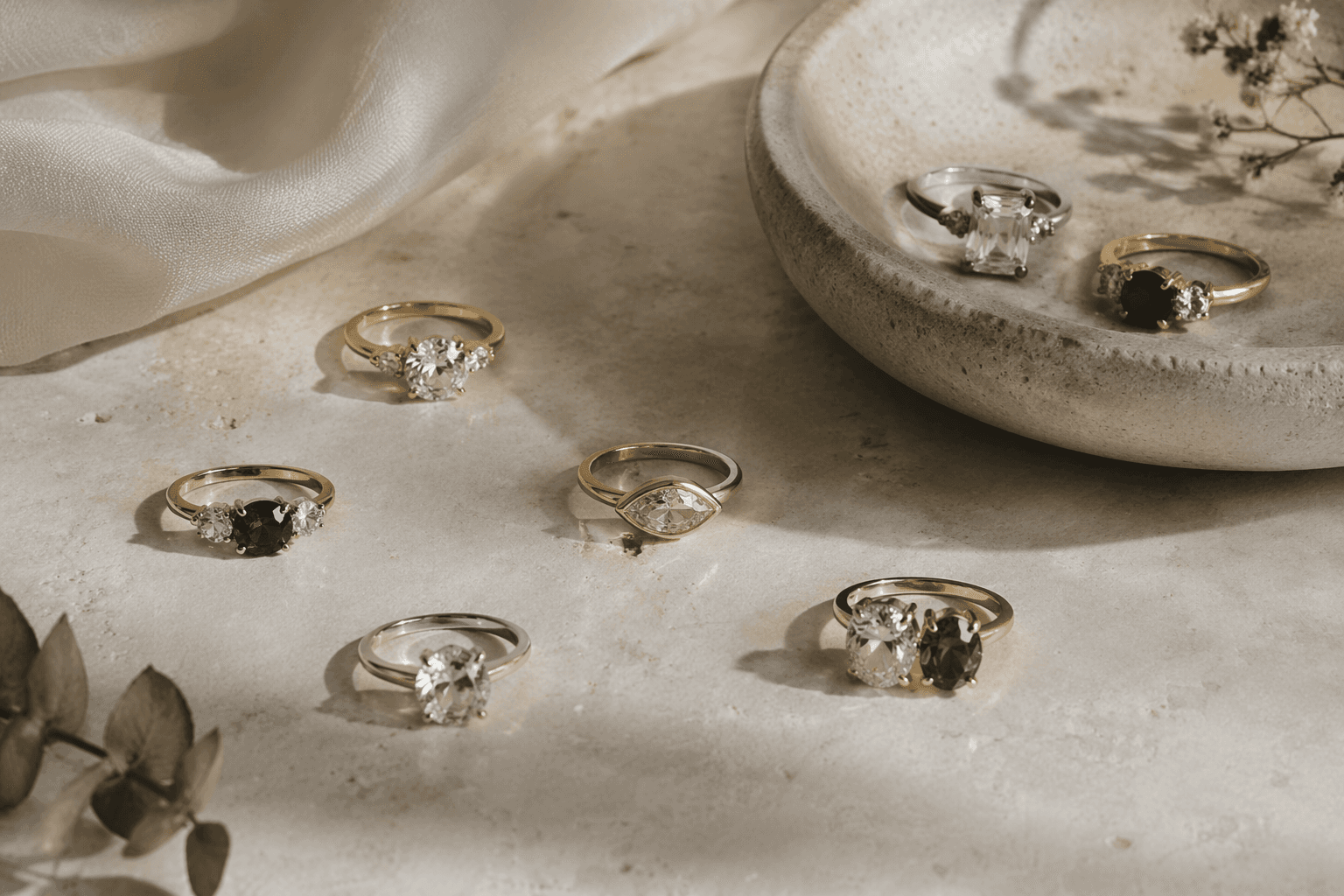
A ring can be fashionable and still make sense if you know what to look for: how it wears, how it can be resized, and whether someone else will still want it later. That is the real test now for alternative engagement rings, where east-west settings, toi et moi designs, chunky bands, and colored center stones are no longer fringe choices but part of a lasting bridal vocabulary.
The shift from novelty to permanent choice
JCK’s trade coverage makes one point clear: alternative engagement rings are cementing themselves as a category, not a passing fad. That matters because the strongest designs are no longer being sold as rebellion for its own sake. They are being chosen for how they fit the way couples actually live now, with more personalization, more mixed metals, and more nontraditional stacks than the single solitaire-plus-matching-band formula that dominated for so long.
Pinterest’s 2026 Wedding Trend Report helps explain the momentum. Couples are rejecting one-size-fits-all rituals in favor of celebrations that feel unmistakably personal, and that mood carries directly into ring shopping. The best alternative rings are not simply different looking. They communicate identity, which is why they have been able to move beyond a narrow social-media moment and into mainstream bridal cases.
Why east-west settings and toi et moi rings keep showing up
East-west settings and toi et moi rings have become the most visible symbols of the shift because both styles read as intentional, not interchangeable. An east-west setting turns an elongated stone sideways, giving even a familiar shape a fresher profile. A toi et moi ring, with two stones side by side, has built-in symbolism and a layout that feels distinctive enough to stand apart from the standard centered solitaire.
These styles also fit the current appetite for rings that look collected rather than prescribed. JCK says younger couples are highly visual, highly informed, and influenced by social media, so they arrive with references in hand and with a sharper sense of what feels overexposed. That tends to favor designs that photograph well, but also designs that have enough structure to endure after the algorithm moves on.
Chunky bands: strong style, stronger practical case
Chunky bands are proving especially durable because they offer more than visual weight. They can make a ring feel finished on their own, and they often wear better in day-to-day life than ultrafine shanks that bend or thin out over time. For buyers who want a ring that can stand alone or anchor a stack, the broader band gives the jeweler more metal to work with, which can help with long-term durability and future repair.
They also carry a vintage crossover appeal. A bolder band can read like a Deco or midcentury reference without being tied to a single imitation era, which makes it easier to wear over many years. In resale terms, that flexibility matters: the more the ring balances a clear point of view with recognizable workmanship, the less it depends on one short-lived trend cycle.
Colored center stones and the question of longevity
Color is expanding well beyond side accents. JCK says sapphires and other colored center stones are increasingly part of bridal customization as consumers look for something more personal. That gives a ring immediate distinction, but it also changes how the piece should be judged. A colored center stone can feel more individual than a diamond, yet its long-term appeal depends on the quality of the stone, the richness of the color, and whether the setting protects it well enough for daily wear.
This is where a buyer should be blunt about priorities. If the goal is a ring that will stay expressive for decades, a colored center stone works best when the cut is clean, the mounting is secure, and the stone is not so unusual that it becomes hard to service or match in the future. In other words, originality should be paired with straightforward craftsmanship.
Why vintage and antique-cut diamonds are winning over newness
The vintage-diamond surge has deeper roots than social media. The Gemological Institute of America says old mine cuts date to the early 18th century and were common in Georgian and Victorian jewelry. They were hand-cut stones with a small table, high crown, large culet, and soft squarish outline, originally designed to sparkle in candlelight. That history gives them a visual character modern precision cuts do not try to imitate.
JCK says antique diamonds have moved from a niche that once required explanation to one many consumers now recognize. Dealers such as New York’s Perpetuum Jewels describe the appeal as uniqueness and historical context rather than mass-market uniformity, and National Jeweler reported in February 2025 that old mine and old European cuts were gaining traction because buyers wanted rings that symbolize the couple and tell a story. Taylor Swift’s engagement ring added a powerful accelerant, triggering an overnight surge of interest in vintage and cushion-style diamonds and showing how celebrity can move a niche style into the center of the market.
Durability, resizing, and repair: where smart buying gets specific
For buyers weighing expressive designs, the practical questions matter more than the trend language. East-west settings can be elegant, but the orientation means the head and prongs must be well engineered, especially if the center stone is elongated. Toi et moi rings are visually compelling, yet their asymmetry can make future resizing or rebuilding more complicated if the shank, stone sizes, or setting proportions are unusual. Chunky bands usually offer the easiest path for long-term wear and repair because there is more metal to work with.
Vintage and antique-cut diamonds bring their own considerations. Old mine cuts have charm, but they can vary more from stone to stone because they were hand-cut, and that individuality can make matching or replacing one later more difficult. The upside is that this same singularity can make them more desirable on the secondary market, especially when the piece is accompanied by clear documentation and sits in a recognizable era or style family.
Resale liquidity favors recognizability, not just rarity
Future resale depends on more than whether a ring is “different.” The strongest alternative pieces usually have some market shorthand buyers understand immediately: old mine cut, old European cut, east-west, toi et moi, or a colored-stone center with a classic silhouette. JCK’s reporting suggests that antique diamonds are no longer obscure enough to require a long explanation, which helps liquidity, because a second buyer can recognize the appeal quickly.
That said, liquidity is better for styles with broad crossover appeal than for highly personal one-offs. A ring that combines a recognizable cut or design with clean workmanship will generally be easier to place again than one that is too bespoke to describe in a single line. The sweet spot is expressive but legible, distinctive but not so eccentric that the next buyer has to decode it from scratch.
The market backdrop favors staying power
The broader market reinforces the sense that this is not a fleeting spike. The Natural Diamond Council’s 2025 analysis, based on more than 4 million jewelry transactions across 2,500 specialty retailers, found the average price of a natural diamond engagement ring in the United States rose 9 percent to $7,346 in 2025, while average carat weight increased 5 percent to 1.16 carats. In that environment, buyers are already making more deliberate choices about size, shape, and style, and the pull toward rings with a story makes financial as well as emotional sense.
Pinterest also says its trends last nearly twice as long as trends elsewhere on the internet, which helps explain why the alternative-bridal aesthetic has legs. When a style is built around personalization, old-world cuts, and silhouettes that can be customized without looking costume-like, it tends to outlast the seasonal rush. The rings that endure are the ones that feel specific now and still make sense when the next wave of wedding inspiration arrives.
This article was produced by Prism’s automated news system from verified source data, official records, and press releases, then run through automated quality and moderation checks before publishing. The system is built and supervised by the people who set the standards it runs under. Read our full AI policy.
Know something we missed? Have a correction or additional information?
Submit a Tip