Phillips Hong Kong Jewels Sale Fetches HK$42 Million, Vintage Signed Pieces Lead
** A 9.22-carat Colombian emerald ring led Phillips' Hong Kong Jewels sale to HK$41.9M, with signed Cartier and JAR lots outpacing estimates. **CONTENT:** Pick up a Cartier panther brooch pulled from a Hong Kong auction, and you are holding more than jewelry: you are holding a small dossier of decisions made across a century, from the Paris atelier where a craftsman pavé-set each brilliant-cut diamond into a reclining feline body, to the onyx spots chosen to suggest movement, to the emerald cabochon eyes that give the piece its unnerving life. That brooch sold at Phillips' Hong Kong Jewels Auction on March 30 for HK$3.4 million (approximately US$428,076), comfortably within its HK$2 million to HK$4.5 million estimate. It is the kind of result that tells you something specific about what signed vintage jewelry is worth right now in Asian collector markets, and more usefully, what makes it worth that much in the first place. Phillips' Hong Kong Jewels sale, held at the auction house's Asia headquarters in the West Kowloon Cultural District during Hong Kong Art Month, closed with a total of HK$41.9 million (US$5.4 million) across 61 lots sold from 85 offered, representing a sell-through rate of roughly 72 percent by lot and 75 percent by value. About 70 percent of sold lots exceeded their pre-sale low estimates, a figure that reflects genuine competitive bidding rather than lots simply finding reluctant takers. Signed pieces from Cartier, Bulgari, Van Cleef & Arpels, and JAR led the charge, alongside strong performances for natural pearls, unheated colored gemstones, and period antique jewels. The sale's top lot was a step-cut, 9.22-carat Colombian emerald set within a surround of trapeze-cut diamonds. The ring carried a no-oil designation, meaning no clarity enhancement treatments were detected, which in the emerald world is the single most consequential quality marker on a gemological certificate. It sold for HK$5.4 million (US$691,522), within its pre-sale estimate of HK$4.8 million to HK$6.5 million. The Cartier panther brooch landed at HK$3.4 million. And a ring centering on a 4.05-carat fancy-light-pink, internally flawless diamond in a brilliant-cut surround brought in HK$2.2 million (US$279,894), beating its upper pre-sale estimate by roughly 10 percent. These three lots share a quality beyond their gemstones: each carried verifiable provenance, and two of the three carried a recognized house signature. Understanding precisely what that means, and how to verify it, separates a confident vintage buyer from one who overpays or, worse, gets fooled. **What "signed" actually means** In the auction catalog world, "signed" has a specific technical definition that is worth unpacking before you bid on anything. A maker's mark is the most fundamental form of attribution: it is a stamp, punch, or engraved cartouche applied directly to the metal, typically inside a ring shank, on the hinge or clasp of a bracelet, inside a brooch frame, or on the reverse of a pendant. For the major French houses, these marks often include a lozenge-shaped "maker's punch" registered with French authorities, alongside the house name spelled in full. Cartier pieces typically bear both "CARTIER" and a serial number that can be cross-referenced against the maison's own archives. Retailer signatures are distinct from maker's marks and sometimes cause confusion. A piece signed "Tiffany & Co." or "Van Cleef & Arpels" may have been made in-house, but in some eras these houses also retailed pieces made by independent workshops to their design specifications. The signature is still meaningful, but it signals retail attribution rather than necessarily single-point manufacture. For pieces by smaller or less-documented firms, like the French house Retzignac, whose signed twin-flower pearl and diamond brooch was among the period pieces offered at the March 30 sale, the signature itself becomes evidence of a particular design tradition and quality tier even where archive documentation is limited. Case stamps are a third category, used primarily in British and European pieces, where hallmarks struck by assay offices record the metal purity, city of assay, date letter, and sometimes the maker's initials. An Edwardian platinum and diamond brooch with a London hallmark and a date letter corresponding to, say, 1907 cannot have its date faked without re-hallmarking, which is detectable. These assay marks function as a built-in provenance certificate and are consistently underappreciated by buyers focused only on house signatures. **Documentation that actually matters** Gemological reports from independent laboratories are the bedrock of colored stone authentication. For the Colombian emeralds at the center of the Phillips sale's top lot, a report from GIA, Gübelin, or the Swiss Gemmological Institute (SSEF) confirming Colombian origin and the absence of clarity enhancement carries enormous weight. For rubies, origin reports from Gübelin or GRS (Gem Research Swisslab) specifying "Burma (Myanmar)" origin and confirming no heat treatment have become effectively mandatory for serious consignments. For signed house pieces, certificates of authenticity issued directly by the maison, noting the piece's serial number and internal records, are the gold standard. Van Cleef & Arpels, Cartier, and Bulgari all maintain archives and will, under certain conditions, authenticate pieces and issue confirmation letters. Original purchase receipts, sales invoices, or estate documentation linking a piece to a previous named owner add independent corroboration. At Phillips, the presence of such documentation consistently influences where within a pre-sale estimate range a piece ultimately lands. **Three pitfalls that fool buyers** The first is laser-engraved attribution added after original manufacture. Modern laser technology can engrave a plausible-looking house name into a metal surface at low cost. What distinguishes an original signature from a later addition: depth and wear consistency. On a Cartier piece made in 1930, the engraved cartouche will show the same wear patina as the surrounding metal, with edges softened by decades of polishing. A laser engraving added in the last ten years sits crisply on the surface and often shows no corresponding wear. Under a loupe at 10x magnification, the distinction is usually clear. The second pitfall is the unsigned period piece presented as the work of a named house. Art Deco diamond clip brooches set with old European- and old-mine-cut diamonds, like those that appeared in the March 30 sale, were produced across Paris, London, and New York in enormous quantities from the 1920s through the 1940s. The quality can be exceptional. But many buyers conflate aesthetic similarity with house attribution and pay accordingly. A superb unsigned Art Deco brooch from the same period as a Cartier example may be indistinguishable to the untrained eye but should carry a materially lower price. Paying Cartier premiums for an unsigned piece is one of the most common and most avoidable errors in this market. The third pitfall is polished or buffed-away signatures. Jewelry that has been heavily repolished, whether to remove surface scratches before consignment or simply through decades of wear, can lose maker's marks entirely. A ring shank that appears unusually thin, or a brooch reverse with a suspiciously smooth and featureless back, warrants close examination. Ask the auction house specialist directly whether the piece was examined under magnification for traces of removed marks. The answer tells you how thoroughly the lot was cataloged. **Why natural pearls and period antiques held their ground** Natural pearls remained a category of demonstrable strength at the March 30 sale. Unlike cultured pearls, which make up nearly all the pearl market today, natural pearls require no human-inserted nucleus and form entirely through the oyster's own nacre deposition over years. A Natural Pearl, Seed Pearl and Diamond Bandeau Tiara, set with five graduated natural pearls and framed by seed pearl borders, was among the antique lots that drew competitive interest. For buyers willing to invest in a gemological certificate confirming natural origin, typically from GIA or the SSEF, these pieces represent a category where supply is genuinely finite and shrinking. **Smart alternatives for buyers priced out of the headline names** The Cartier panther brooch at HK$3.4 million and the top emerald ring at HK$5.4 million sit well beyond most collectors' reach. But the underlying logic of what made those lots perform, documented quality and verifiable attribution, can guide purchases at a fraction of those prices. Unsigned Art Deco diamond brooches set with old European- or old-mine-cut stones are the clearest alternative. These stones were cut by hand to maximize brilliance under candlelight, with higher crowns, smaller tables, and larger culets than modern brilliant cuts. A well-constructed unsigned Art Deco piece in platinum with old-cut diamonds can be acquired for a fraction of a comparable Cartier-signed example, and the craft standard is often similar. What to examine: look for platinum construction (test with a magnet if uncertain; platinum is non-magnetic), original pin mechanisms with trombone or C-catch closures rather than modern rollover catches, and old European-cut stones that show a characteristic open culet when viewed face-down. For natural pearl pieces, the Retzignac-signed brooch at the March 30 sale points to a useful approach: smaller French houses whose signatures are documented and verifiable but whose names carry less auction-room cachet than Cartier or Van Cleef offer genuine signed provenance at more accessible price points. The key is confirming the signature against reference works and, for any piece centered on pearls, insisting on a current natural pearl certificate rather than relying on the auction catalog description alone. The Phillips March 30 results made one thing plain: in Hong Kong's collector market, the premium for verifiable, documented, signed quality is real and durable. The rest, as any specialist will tell you, is negotiating how much you pay for ambiguity. SUMMARY: A 9.22-carat Colombian emerald ring led Phillips' Hong Kong Jewels sale to HK$41.9M, with signed Cartier and JAR lots outpacing estimates.

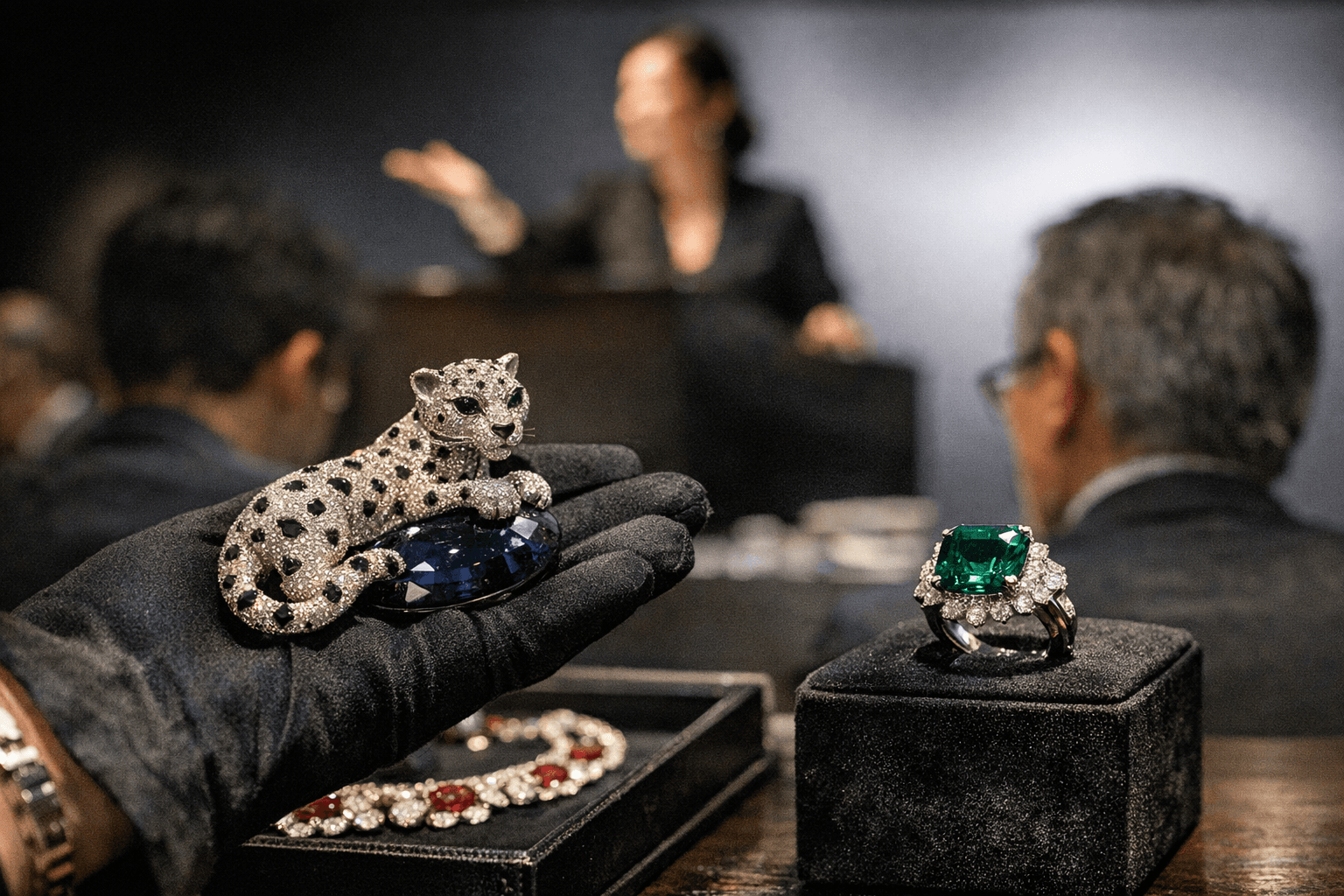
Pick up a Cartier panther brooch pulled from a Hong Kong auction, and you are holding more than jewelry: you are holding a small dossier of decisions made across a century, from the Paris atelier where a craftsman pavé-set each brilliant-cut diamond into a reclining feline body, to the onyx spots chosen to suggest movement, to the emerald cabochon eyes that give the piece its unnerving life. That brooch sold at Phillips' Hong Kong Jewels Auction on March 30 for HK$3.4 million (approximately US$428,076), comfortably within its HK$2 million to HK$4.5 million estimate. It is the kind of result that tells you something specific about what signed vintage jewelry is worth in Asian collector markets right now, and more usefully, what makes it worth that much in the first place.
Phillips' Hong Kong Jewels sale, held at the auction house's Asia headquarters in the West Kowloon Cultural District during Hong Kong Art Month, closed with a total of HK$41.9 million (US$5.4 million) across 61 lots sold from 85 offered, representing a sell-through rate of roughly 72 percent by lot and 75 percent by value. About 70 percent of sold lots exceeded their pre-sale low estimates, a figure that reflects genuine competitive bidding rather than lots simply finding reluctant takers. Signed pieces from Cartier, Bulgari, Van Cleef & Arpels, and JAR led the charge, alongside strong performances for natural pearls, unheated colored gemstones, and period antique jewels.
The sale's top lot was a step-cut, 9.22-carat Colombian emerald set within a surround of trapeze-cut diamonds. The ring carried a no-oil designation, meaning no clarity-enhancement treatments were detected, which in the emerald world is the single most consequential quality marker on a gemological certificate. It sold for HK$5.4 million (US$691,522), within its pre-sale estimate of HK$4.8 million to HK$6.5 million. The Cartier panther brooch landed at HK$3.4 million. And a ring centering on a 4.05-carat fancy-light-pink, internally flawless diamond in a brilliant-cut surround brought in HK$2.2 million (US$279,894), beating its upper pre-sale estimate by roughly 10 percent.
These three lots share a quality beyond their gemstones: each carried verifiable provenance, and two of the three carried a recognized house signature. Understanding precisely what that means, and how to verify it, separates a confident vintage buyer from one who overpays or, worse, gets fooled.
What "signed" actually means in auction catalog terms is worth unpacking before you bid on anything. A maker's mark is the most fundamental form of attribution: a stamp, punch, or engraved cartouche applied directly to the metal, typically inside a ring shank, on the hinge or clasp of a bracelet, inside a brooch frame, or on the reverse of a pendant. For the major French houses, these marks often include a lozenge-shaped maker's punch registered with French authorities, alongside the house name spelled in full. Cartier pieces typically bear both the house name and a serial number that can be cross-referenced against maison archives.
Retailer signatures are distinct from maker's marks and sometimes cause confusion. A piece signed "Van Cleef & Arpels" may have been produced in-house, but in certain eras these houses also retailed pieces made by independent workshops to their design specifications. The signature is still meaningful; it signals retail attribution rather than necessarily single-point manufacture. For pieces by smaller or less-documented firms, like the French house Retzignac, whose signed twin-flower pearl and diamond brooch appeared among the March 30 offerings, set with button-shaped natural pearl centers to single-cut diamond petals, the signature itself becomes evidence of a particular design tradition and quality tier even where archive documentation is limited.
Case stamps form a third category, used primarily in British and European pieces, where hallmarks struck by assay offices record metal purity, city of assay, a date letter, and sometimes the maker's initials. An Edwardian platinum and diamond brooch with a London hallmark and a date letter corresponding to 1907 cannot have its date faked without re-hallmarking, which is detectable under magnification. These assay marks function as a built-in provenance certificate and are consistently undervalued by buyers focused only on house signatures.
Gemological reports from independent laboratories are the bedrock of colored stone authentication. For the Colombian emeralds at the center of the March 30 top lot, a report from GIA, Gübelin, or the Swiss Gemmological Institute confirming Colombian origin and the absence of clarity enhancement carries enormous weight. For rubies, origin reports from Gübelin or GRS specifying Burma origin and confirming no heat treatment have become effectively mandatory for serious consignments. For signed house pieces, certificates of authenticity issued directly by the maison, noting the piece's serial number and internal records, are the gold standard. Cartier, Van Cleef & Arpels, and Bulgari all maintain archives and will, under certain conditions, authenticate pieces and issue confirmation letters.
Three pitfalls recur often enough that they have become almost predictable. The first is laser-engraved attribution added after original manufacture. Modern laser technology can engrave a plausible-looking house name into a metal surface at low cost, and the result can be convincing to the naked eye. What distinguishes an original signature from a later addition is wear consistency: on a Cartier piece made in the 1930s, the engraved cartouche will show the same patina as the surrounding metal, with edges softened by decades of polishing. A laser engraving added recently sits crisply on the surface with no corresponding wear. Under a loupe at 10x magnification, the distinction is almost always clear.
The second pitfall is the unsigned period piece presented as the work of a named house. Art Deco diamond clip brooches set with old European- and old-mine-cut diamonds, like those offered at the March 30 sale with their classic openwork and pierced construction circa 1930, were produced across Paris, London, and New York in large quantities during the 1920s and 1940s. The quality can be exceptional. But many buyers conflate aesthetic similarity with house attribution and pay accordingly. A superb unsigned Art Deco brooch from the same period as a Cartier example may be indistinguishable in construction but should carry a materially lower price. Paying Cartier premiums for an unsigned piece is one of the most common and most avoidable errors at auction.
The third pitfall is polished or buffed-away signatures. Jewelry that has been heavily repolished before consignment, or simply through decades of wear, can lose maker's marks entirely. A ring shank that appears unusually thin, or a brooch reverse with a suspiciously smooth and featureless back, warrants close examination. Ask the auction specialist directly whether the piece was examined under magnification for traces of removed marks. The answer tells you how thoroughly the lot was cataloged.
Natural pearls remained a category of demonstrable strength at the March 30 sale, and they illustrate a broader point about documentation. A Natural Pearl, Seed Pearl and Diamond Bandeau Tiara, set with five graduated natural pearls and highlighted by variously cut diamonds to seed pearl borders, was among the antique period pieces that drew competitive interest. Unlike cultured pearls, which make up nearly all the pearl market today, natural pearls require no human-inserted nucleus and form entirely through the oyster's own nacre deposition. For buyers willing to invest in a gemological certificate confirming natural origin, typically from GIA or the Swiss Gemmological Institute, these pieces represent a category where supply is genuinely finite and only ever shrinks.
For collectors priced out of HK$3.4 million Cartier panthers and HK$5.4 million emerald rings, the underlying logic of what made those lots perform can guide purchases at a fraction of those sums. The premium the market assigns to verifiable, documented, signed quality is real; the question is how to access comparable craft at lower cost.
Unsigned Art Deco diamond brooches in platinum, set with old European- or old-mine-cut stones, are the clearest alternative. These stones were cut by hand for brilliance under candlelight, with higher crowns, smaller tables, and larger culets than modern brilliant cuts. A well-constructed unsigned Art Deco piece can be acquired for considerably less than a comparable Cartier-signed example, and the craft standard is often equivalent. The markers to examine: platinum construction verifiable with a magnet (platinum is non-magnetic), original pin mechanisms with trombone or C-catch closures rather than rollover catches, and old European-cut stones that show a characteristic open culet when viewed face-down.
For pearl pieces, the Retzignac-signed brooch at the March 30 sale points to a useful strategy: smaller French houses whose signatures are documented and verifiable but whose names carry less auction-room cachet than Cartier or Van Cleef offer genuine signed provenance at more accessible price points. The key is confirming the signature against specialist reference works and, for any piece centered on pearls, insisting on a current natural pearl certificate rather than relying on catalog description alone.
The Phillips March 30 results confirmed what the Hong Kong market has been signaling for several seasons: verifiable signed quality is durably valued, and the categories most resistant to softening, natural pearls, no-oil colored stones, and historically attributed house pieces, are precisely those with the least ambiguity about what they are. That standard of clarity is worth applying to any vintage purchase, whatever the budget.
This article was produced by Prism’s automated news system from verified source data, official records, and press releases, then run through automated quality and moderation checks before publishing. The system is built and supervised by the people who set the standards it runs under. Read our full AI policy.
Did this article answer your question?