Raw Diamonds Gain Appeal as Lab-Grown Stones Disrupt Market
With lab-grown stones now dominating many engagement rings, raw diamonds are drawing shoppers who want visible natural character over factory-perfect sparkle.
Is this genuinely rustic, antique-adjacent character or just rough-looking modern design? In an inherited ring or an estate-sale tray, that question can turn a stone into a small archive, a clue to geology, taste, and whether a jewel is truly different from the polished look most shoppers know. The answer matters more now that lab-grown diamonds have taken such a large share of the market, including 61% of engagement-ring center stones last year.
What a raw diamond actually looks like
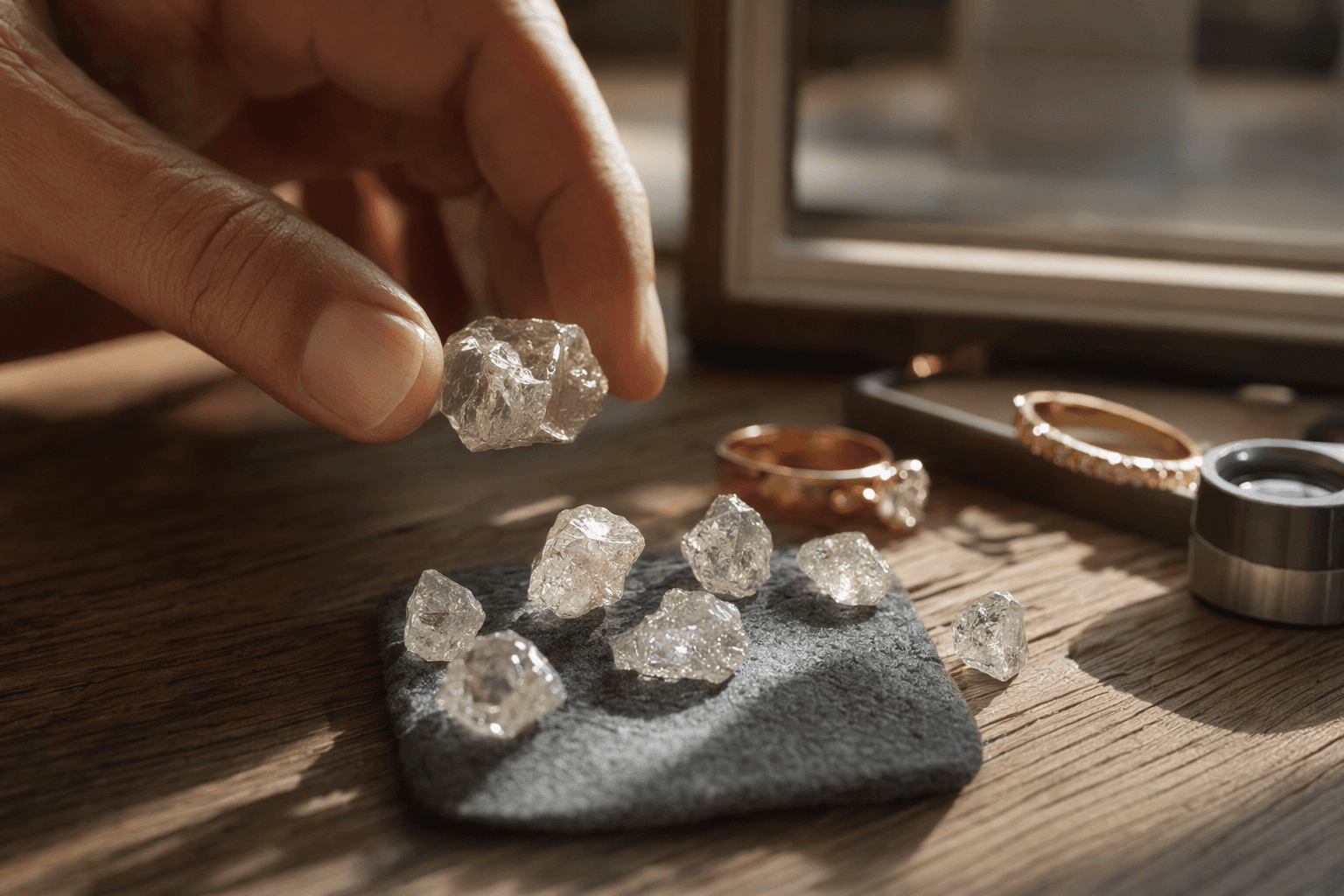
A raw diamond is a natural, uncut stone in its rough form, with irregular shapes, unpolished surfaces, and the kind of natural inclusions and color variation that polished diamonds are designed to hide. Instead of the crisp symmetry of a faceted gem, you see a mineral object that still looks as if it came straight from the earth. That is the appeal: it reads as visibly natural, and often more personal, than a standardized brilliant stone.
In the hand, rough diamonds tend to feel less like a finished sparkle and more like a specimen. Their edges can be uneven, their surfaces can appear frosted or matte, and their outlines rarely repeat from one stone to the next. For shoppers who want a jewel that does not look mass-produced, that asymmetry is the point.
How to tell rough apart from rose-cut, old mine-cut, and modern brilliant stones
Raw diamonds are easy to confuse with antique-looking cuts only if you are glancing quickly. A rose-cut, old mine-cut, or old European-cut diamond has all been shaped and polished by a cutter’s hand, even when the finished result looks soft, warm, or slightly irregular. A rough diamond has not been refined into a standard faceting pattern at all.
Rose-cuts usually look low and deliberate, with a faceted dome that catches light gently rather than explosively. Old mine-cuts and old European-cuts, which date back to the 18th and 19th centuries, often have a cushion-like feel and a hand-made charm that collectors love, but they still show the architecture of cutting: facets, polish, and intention. A modern brilliant is different again. It is engineered for maximum sparkle, with crisp symmetry and a highly uniform facet pattern.
The practical test is simple: if the stone looks intentionally shaped, it is cut. If it looks like a natural crystal with its own geometry still intact, you are looking at rough. That distinction is especially useful when you are comparing vintage jewelry, where an old cut can wear its age beautifully, but a rough diamond signals something more elemental.
Why the rough look is gaining ground now
Pam Danziger has framed raw, uncut diamonds as a countertrend to the lab-grown boom, and the market numbers explain why. Tenoris data show lab-grown diamond jewelry unit sales rose 14% in 2025, while loose diamond unit sales fell 10% and revenue dropped 4%. Another figure cited in industry coverage puts lab-grown diamonds at 14% of the U.S. jewelry market in 2024.
Price has changed the way people buy, too. Comparable lab-grown stones now sell for roughly 50% to 75% less than natural diamonds, which means many shoppers can trade up in size or quality while spending less. That is a powerful shift, but it also makes visible natural character more valuable as a form of distinction. If polished sparkle has become easier to buy, roughness starts to feel like proof.
The shift reaches into the most emotional corner of the jewelry market. The Knot data cited in Forbes says 61% of engagement-ring center stones were lab-grown in 2025, a number that says plenty about how quickly consumer taste has moved. Against that backdrop, a raw diamond reads as a deliberate rejection of sameness, a piece with texture, irregularity, and a traceable sense of origin.
How the industry is answering the demand for natural stones
De Beers has responded by leaning hard into natural diamond identity. The company launched its Desert diamonds consumer campaign on October 3, 2025, describing it as its first new consumer beacon in more than a decade and its largest category marketing investment in over ten years. That is not the language of a company shrugging off disruption. It is a signal that the natural-diamond business sees provenance and narrative as part of the fight.
Raw diamonds fit that conversation neatly because they are harder to mistake for lab-grown stones than a polished center stone. Their imperfections, color shifts, and organic outlines are not defects in this context. They are the evidence shoppers are seeking, especially when they want a jewel that looks like it could only have come from the earth in one particular form.
A designer built around the rough edge
Danish jewelry designer Maya Bjørnsten has been building Rough Diamonds Jewellery since 2007 around untouched stones and what she calls nature’s raw elegance. That long timeline matters. It shows that the appeal of rough diamonds is not just a market reaction to lab-grown competition, but a design language with staying power.
Her work captures why collectors respond to these stones: each one is one-of-a-kind, with a shape that cannot be repeated by a machine or disguised by a standardized setting. In the right mounting, a rough diamond does not look unfinished. It looks intentional, a reminder that individuality can be more compelling than polish.
What to look for when you shop
- Ask whether the stone is truly rough or simply designed to look rustic.
- Look for irregular crystal shapes, unpolished surfaces, and visible natural variation if you want a genuine raw diamond.
- Compare it carefully with rose-cuts and old mine-cuts, which are still polished stones, even when they feel antique and soft in the hand.
- Ask for independent documentation that identifies the stone as natural and explains any treatments, mounting changes, or enhancements.
- Pay attention to the setting. A thoughtful mount should protect uneven edges without flattening the stone’s character.
For vintage jewelry shoppers, that distinction is the real story. A raw diamond can offer the romance of the earth itself, while an antique cut offers the romance of the cutter’s hand. In a market crowded with precision-made sparkle, the rough stone offers something else: a small archive of geology you can wear.
This article was produced by Prism’s automated news system from verified source data, official records, and press releases, then run through automated quality and moderation checks before publishing. The system is built and supervised by the people who set the standards it runs under. Read our full AI policy.
Did this article answer your question?