Runner Loses Heirloom Engagement Ring at NYC Half, Jeweler Offers Free
A Weisbart family tie clasp converted into a floral heirloom ring vanished at mile 10 of the NYC Half Marathon before a Manhattan jeweler offered to rebuild it free of charge.
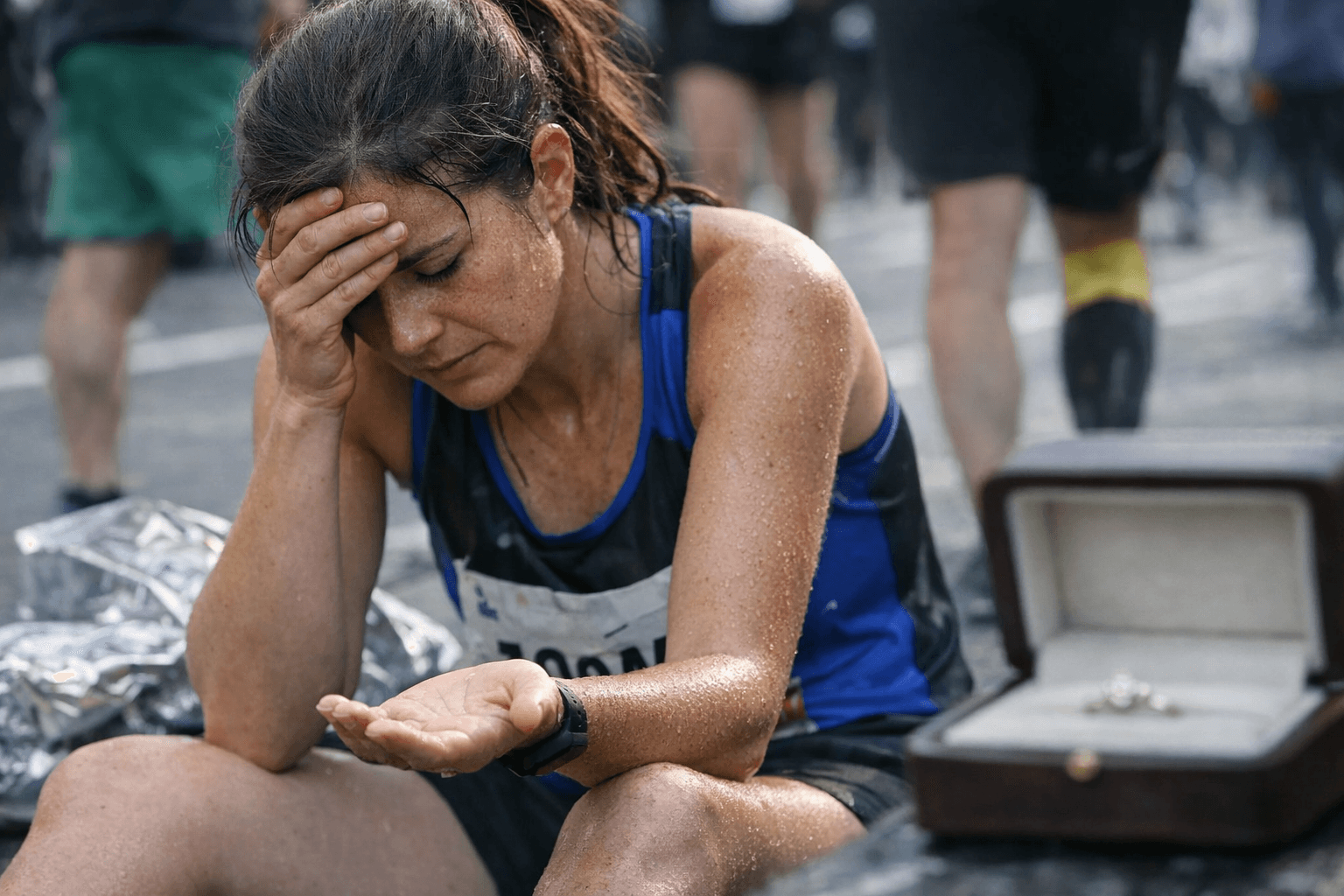
Pick up a ring that was once a tie clasp and you are holding a small archive. Every transformation it survived, every hand that shaped its metal into something new, every generation that wore it and passed it along, is folded into the setting. That is precisely what Isabel Lahn-Schroeder understood when her fiancé, Noah Weisbart, slipped a multi-stone floral ring onto her finger after a Halloween proposal. The ring had belonged to a Weisbart family member who had since died. Rather than let it disappear into an estate sale box, a female family member had it converted from a tie clasp into a ring, and it passed through the family's hands from that point forward. Now it was Lahn-Schroeder's, and on March 15, 2026, somewhere along Central Park South at mile 10 of the United Airlines NYC Half Marathon, it was gone.
Lahn-Schroeder, a social worker at Lenox Hill Hospital on Manhattan's Upper East Side, crossed the finish line in Central Park among more than 30,000 runners and felt the particular pride that belongs to a half marathon finish. Then she looked at her hand. The ring, with its cluster of stones set in the shape of a flower, was not there. She retraced the course on foot, reported to the race's lost-and-found, and walked into a local police precinct. None of it brought the ring back.
The story quickly moved beyond its own tragedy. When Lahn-Schroeder shared what happened publicly, Zak Nissanov of Big Apple Jewels, a Manhattan jeweler, stepped forward with an offer to build her a replica at no cost. "What we'd like to do is make you a replica of the exact same ring that you lost without any pay," Nissanov said. "We're happy that you came out to New York, ran the marathon and it's an opportunity for us to take part in your special day that will last with the family and with you forever." He added that the hope is the new ring will continue the Weisbart family tradition and create new memories going forward.
The generosity was genuine, but it also pointed to something any heirloom owner should sit with for a moment: a replica, however masterfully executed, is not the same object. A jeweler can replicate the form of a tie-clasp-turned-ring, the prong arrangement, the stone shapes, the silhouette of the flower cluster, but the provenance disappears with the original. The piece Nissanov creates will not carry the decades the first ring accumulated. That irreplaceability is exactly why understanding how heirloom jewelry is lost during physical activity, and how to prevent it, matters as much as any insurance policy.
The mechanics of a race-day ring loss are predictable once you understand them. During sustained aerobic exercise, the body diverts blood flow away from the extremities toward working muscles. Fingers cool and contract, and a ring that fit snugly at home on a warm morning can slide off a cooled, sweat-slicked finger without the wearer noticing a thing. This is especially true during the middle miles of a half marathon, when body temperature regulation is most dynamic. Cold-to-warm fluctuation compounds the risk. Mile 10 of the NYC Half runs along Central Park South, where runners emerge from the relative shelter of the park's tree canopy onto one of Manhattan's widest, most wind-exposed boulevards. The finger cools rapidly; the ring shifts. Then the runner turns a corner, the body warms, but the ring is already gone.
Glove removal is the most acute mechanical hazard. Many runners wear lightweight gloves for the first several miles and strip them off as body temperature rises. A snug glove can catch the underside of a ring shank and carry the piece off the finger in a single motion, landing it in a gutter or a storm drain. The runner feels the glove come off. The ring's departure registers as nothing at all.
The most effective protection before any race is also the simplest: leave the heirloom at home. A silicone ring, available for under $20, fits snugly, stretches rather than slipping, and serves as a practical stand-in for race day. If the original must come along, preparation is short but non-negotiable. Before any race, have a jeweler check prong integrity. Prongs on vintage and antique rings are often thinner than those on contemporary settings and can catch on fabric, gloves, or timing chip straps in ways a new mounting never would. A jeweler can also assess whether the ring's current size still matches the wearer's finger, which changes with temperature and season. A ring guard or sizing bar can temporarily tighten the shank without affecting the original metal.
Photograph the ring before leaving the house, under strong natural light and from multiple angles. Close-ups of the stone arrangement, any hallmarks on the interior of the shank, and the overall silhouette are essential. These photographs serve double duty: they establish the ring's appearance for a lost-and-found report and form the foundation of any insurance claim.
The first hour after a ring goes missing during a race is the most critical window. Stop, note GPS coordinates if possible, and search the pavement and gutter within a 10-foot radius of the last confirmed location. After the race, approach the event's official lost-and-found immediately. For the NYC Half, New York Road Runners maintains a lost-and-found process accessible through the NYRR website. Provide the photographs. Report the loss to the local police precinct covering the loss location: for Central Park South, that is the Midtown North Precinct. File a report even if recovery seems unlikely, because the report number is required for most insurance claims.
Within 24 hours, contact every independent jeweler and pawn shop within half a mile of the loss location. A multi-stone floral ring converted from a tie clasp is distinctive enough that any buyer or shop owner who sees it should recognize it from a photograph. Leave a printed card with the image, contact information, and a note about the ring's history. Post to neighborhood apps and community boards covering Central Park South, Hell's Kitchen, and the Upper West Side, the neighborhoods runners pass through in the NYC Half's final miles.
On the insurance timeline: most standalone jewelry policies require a claim within 30 to 60 days of discovering the loss. Standalone jewelry floaters, added to a homeowner's or renter's policy or purchased independently, typically cost between 1 and 2 percent of the insured value per year and cover accidental loss and mysterious disappearance, the policy term that applies when a piece simply cannot be accounted for. For a ring appraised at $5,000, that is roughly $50 to $100 annually for coverage most people never think about until the moment they need it. Heirloom pieces present a particular challenge here: no appraiser can place a replacement cost on a tie clasp that a grieving family member transformed into something wearable, then passed down through generations. Insurance can cover the metal and the stones; it cannot cover the story.
Noah Weisbart is an Ossining, New York native who proposed on Halloween. The ring he chose was not from a display case; it came from his family's history. Zak Nissanov's offer to recreate it reflects the best of what a neighborhood jeweler can do: not pretend the original can be replaced, but commit to building something that carries the story forward. The 2026 United Airlines NYC Half Marathon drew more than 30,000 runners across 13.1 miles, from Prospect Park in Brooklyn over the Brooklyn Bridge, up FDR Drive, through Times Square, and into Central Park near West 77th Street. New York Road Runners has organized the race since its inaugural edition in 2006. Somewhere along the most photographed stretch of that course, a floral ring slipped away.
The replica Nissanov builds will be worn. It will mean something to the Weisbart family's next chapter. But for anyone carrying an heirloom onto a race course, the lesson of mile 10 is one worth learning long before the starting gun fires.
This article was produced by Prism’s automated news system from verified source data, official records, and press releases, then run through automated quality and moderation checks before publishing. The system is built and supervised by the people who set the standards it runs under. Read our full AI policy.
Did this article answer your question?