Vintage and Signed Jewelry Dealers Drive U.S. Brick-and-Mortar Retail Expansion
Signed-jewelry dealers are making a bold physical bet: Yafa's 3,000-sq-ft Bal Harbour boutique and M.S. Rau's debut Aspen gallery signal a high-stakes retail shift.
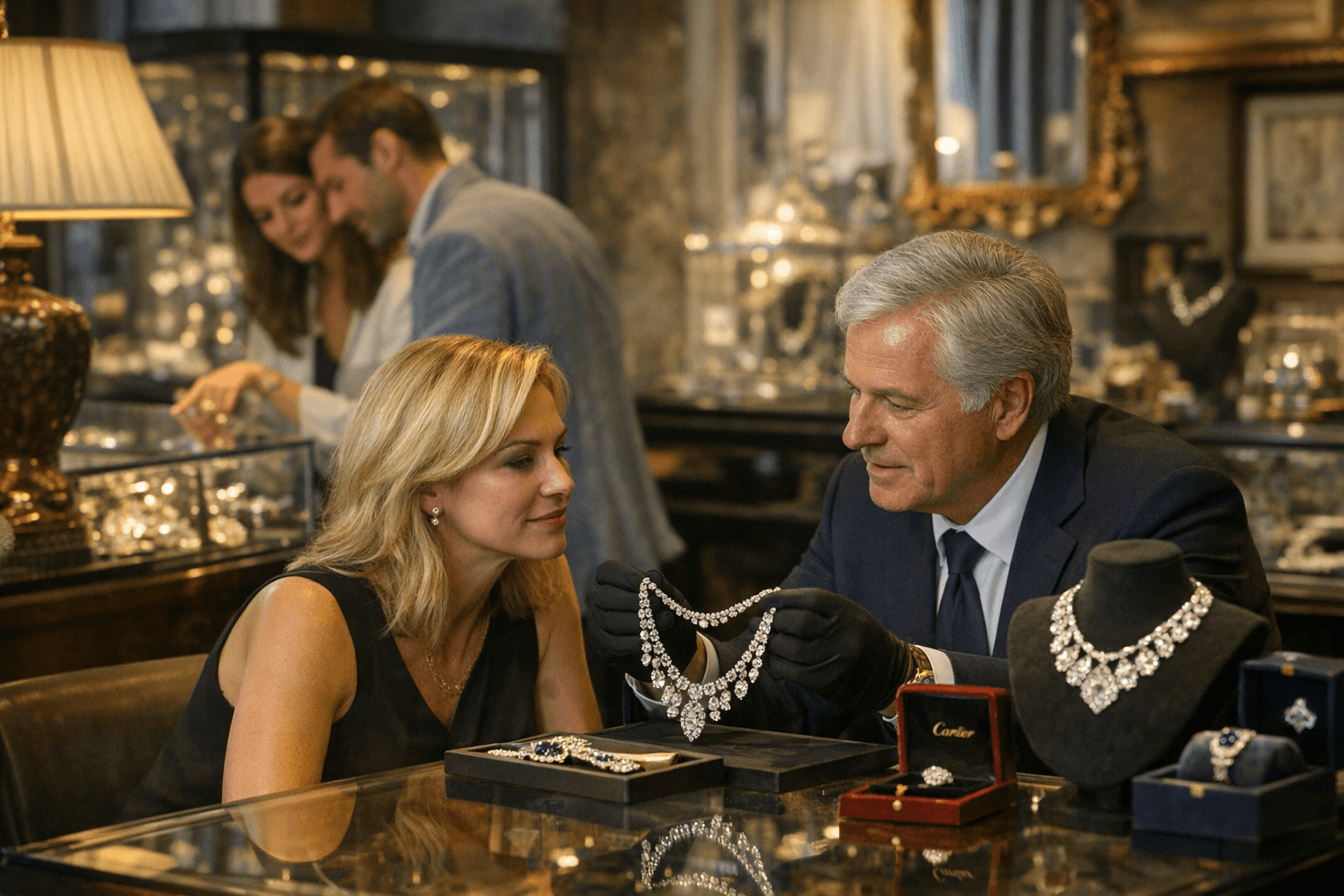
Pick up a mystery-set ruby brooch or a signed Van Cleef & Arpels clip from the 1960s, and you're holding a small archive: decades of craft decisions, a maker's signature pressed into gold, and a chain of custody that tells you something true about how luxury was understood in its time. For years, the dealers who specialized in exactly these objects operated at the edges of mainstream retail, through trade shows, private showrooms, and the back rooms of estate sales. That posture of discretion is changing, fast.
In the first quarter of 2026, two of the most respected names in signed and estate jewelry opened permanent, high-profile physical locations in some of the country's most competitive luxury markets. The moves are not nostalgic gestures toward a pre-digital past. They reflect a clear-eyed business strategy: in a category defined by provenance, expertise, and the irreplaceable act of holding a piece before you buy it, brick-and-mortar is not a liability. It is the product.
Why Physical Retail Is Gaining Ground Again
A Rapaport analysis published March 30, 2026 surveyed the recent wave of store openings, permanent pop-ups, and showroom launches reshaping U.S. jewelry retail, with vintage and antiques dealers among the most active participants. The momentum traces to three converging forces: investment in discovery-led environments where curation and expertise are central to the experience; rising demand from high-net-worth and destination shoppers who travel specifically to shop; and a strategic pivot away from purely transactional e-commerce toward long-term client relationships.
For signed and estate jewelry, these forces are especially potent. A collector weighing a significant piece, whether a 20-carat pink diamond, a Fabergé objet d'art, or a Cartier panther clip with documented provenance, is not making a cart checkout decision. They are entering a conversation that can take months and requires the kind of trust built only across a counter, in a room where the dealer can pull the piece from the case and explain exactly why it matters. The dealers now opening physical locations understand this, and they are designing spaces that make the conversation possible.
Yafa Signed Jewels: Three Generations at Bal Harbour
Yafa Signed Jewels opened its Bal Harbour boutique on March 13, 2026, on the second floor of Bal Harbour Shops at 9700 Collins Ave., Bal Harbour, Florida. At more than 3,000 square feet, it is the only retailer of signed vintage jewels in the shopping center.
Yafa Moradorf and her son Maurice founded Yafa Signed Jewels more than 40 years ago, starting out as a supplier of rare, signed jewels for high-end jewelry brands. Today, Maurice's son Tyler serves as principal of the family business. The firm's existing locations, a flagship in Palm Beach and a private showroom in New York, serve a clientele that prizes access over discovery. The Bal Harbour boutique is something different: a purpose-built destination.
The store was designed to feel more like a luxury hotel suite rather than a traditional store, inviting collectors into an atmosphere of "quiet sophistication," with a modern aesthetic and Art Deco accents as a nod to Miami's architecture. The inventory is calibrated to match. Exclusive to the Bal Harbour location are pieces including a 20-carat pink diamond, rare mystery-set jewels by Van Cleef & Arpels, and a significant deep green diamond. The broader collection specializes in vintage signed jewelry from the 20th and 21st centuries, with works by Van Cleef & Arpels, Cartier, and Harry Winston at its center.
The choice of Bal Harbour goes beyond real estate. Bal Harbour Shops draws an international clientele of serious collectors, many of them traveling from Latin America and Europe, exactly the demographic that has long sustained the signed jewelry market at its highest levels.
M.S. Rau: A 113-Year-Old Institution Expands for the First Time
The weight of M.S. Rau's Aspen commitment becomes clearer when you consider the history behind it. M.S. Rau, a leading art, antiques, and jewelry gallery, opened in Aspen in January 2026, marking the first time since it was founded in 1912 that the New Orleans-headquartered gallery opened a second location. The new gallery, encompassing two levels and more than 2,200 square feet, occupies the street and lower levels of the remarkable Victorian brick building at 307 S. Galena St. in the Aspen Block Building, a designated historic landmark. The grand opening celebration ran March 26 through 28, 2026.
M.S. Rau President Andrew Fields, a longtime Aspen resident, leads the team locally. Fields cited the gallery's long history in the area and the success of a pop-up in downtown Aspen the previous season as the basis for committing to a permanent second location. "Our Aspen gallery marks the beginning of an important chapter for M.S. Rau," Fields said at the opening. "With deep roots in New Orleans, it is especially meaningful to establish a permanent presence in Aspen." The Aspen Snowmass area has been his family's home for years, giving the expansion a personal dimension that aligns with the gallery's broader relationship-first philosophy.
The gallery offers iconic works by artistic visionaries like Renoir, Picasso, and Magritte alongside exquisite objet d'art and jewelry from Tiffany & Co., Van Cleef & Arpels, Fabergé, and Cartier. The cross-category curatorial approach is deliberate. Collectors drawn to Aspen by its art scene encounter the jewelry; collectors who come for the jewelry find themselves in conversation with works they hadn't expected to consider. The environment is as much about discovery as it is about transaction.
A Market That Rewards Deep Expertise
The global vintage ring market was valued at $3.5 billion in 2024 and is projected to grow to $6.2 billion by 2034, a compound annual growth rate of 5.7%. That growth is being driven in part by generational wealth transfer, as estate pieces enter the market when collections change hands, and in part by a collector base that has grown more sophisticated about provenance and period attribution over the past decade.
The shift is also cultural. Signed jewelry from the mid-20th century carries a specificity that appeals to a generation of buyers skeptical of new luxury's more generic vocabulary. A piece signed by a house and dated to a known designer's tenure at that house is a verifiable object. Its history can be researched, its value benchmarked, its story told. For buyers who want beauty with accountability, that traceability is the point.
What This Means When You Visit
Both locations are built to reward the collector who shows up with questions rather than a finalized purchase decision. A few things worth knowing before you go:
- Signed jewelry from the 1930s to 1980s represents the deepest and most liquid segment of the vintage market; pieces from this era by documented houses carry the strongest resale trajectories.
- Mystery-set stones, a technique patented by Van Cleef & Arpels in 1933, require extraordinary craftsmanship and represent some of the most technically demanding jewelry ever made. Encountering them in a physical setting, where their seamless stone surfaces can be seen under proper light, changes the way you understand the price.
- At a destination gallery like M.S. Rau, the cross-category inventory means condition context is everywhere. A signed piece of jewelry displayed alongside period fine art and decorative objects tells you more about the world that produced it than a product page ever could.
- Ask about provenance documentation. Reputable dealers in this segment can typically provide auction records, original receipts, or collector histories. The quality of that documentation is as telling as the piece itself.
The expansion of these galleries into Bal Harbour and Aspen reflects something the most experienced dealers in this category have always known: the story behind a piece of signed jewelry is not a marketing addendum. It is the primary value. Building spaces that can hold and transmit that story, in person, with full context and expert guidance available, is not a step backward from modern commerce. For the segment of the market where provenance is everything, it is the only defensible move forward.
This article was produced by Prism’s automated news system from verified source data, official records, and press releases, then run through automated quality and moderation checks before publishing. The system is built and supervised by the people who set the standards it runs under. Read our full AI policy.
Did this article answer your question?