Vintage jewelry clues hide in clasps, catches and hinges
Vintage jewelry often reveals its age at the clasp first, where C-catches, trombone clasps and hinges can confirm or challenge a seller’s date.
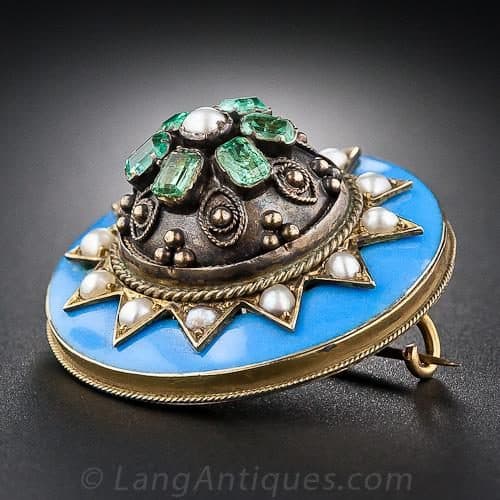
On a vintage brooch, the clasp, catch and hinge often reveal the date faster than the front. A front can be repaired, reset or copied later, but the hardware usually keeps its own chronology, and that makes the reverse side one of the fastest ways to test a seller’s date.
Why the back of the jewel matters
Brooches developed from the ancient fibula, the Greek and Roman fastening based on the safety-pin principle, so the mechanics were never secondary to the ornament. Jewelry has also long carried social meaning beyond decoration, worn as a sign of rank and as a talisman to avert evil and bring good luck. The Metropolitan Museum of Art has a 19th-century clasp or brooch set in silver-gilt with enamel, emeralds, garnets, pearls and opals.
C-catches: the Victorian fingerprint
The C pin catch — the term used by Antique Jewelry University — is a loop of wire shaped like a C, soldered to the reverse of a brooch or pin to stop the pinstem. It was the standard brooch-finding technology until about 1900, when articulated safety catches began to be patented, making it especially useful on Victorian and early Edwardian brooches.
A plain C-catch does not prove age by itself, but it can support a date when the rest of the construction fits: hand-finished metalwork, older-cut stones, and wear that sits naturally with decades of use. If a seller calls a brooch Art Deco but the reverse still wears a basic C-catch, the claim deserves scrutiny. The mismatch may point to an earlier body, a later repair, or a piece that has been assembled from different eras.
Trombone clasps: slim, secure and very specific
The trombone clasp, sometimes called a push-pull clasp, is the slender tubular mechanism that locks a brooch pin with a sliding sleeve. It is especially helpful when you are comparing late Victorian and early 20th-century brooches, because it marks a more developed level of security than the C-catch, with a tighter, more deliberate closure for lighter fabrics and more frequent wear.
Because trombone clasps remained in circulation for years, they should be read as a strong clue rather than a lone verdict. They can support a late 19th-century or early 20th-century date, but they should always be checked against the brooch’s proportions, stone cuts and overall finish.
Rollover safety catches: a later chapter
By the time rollover safety catches appear, you are generally in a later, more standardized era of brooch making. Their rotating lock is a cleaner, more mechanical solution than the C-catch, and it fits the shift toward mass-produced or machine-finished findings in the 20th century. If a piece is described as Victorian but closes with a rollover safety catch, the hardware may be telling you the brooch has been altered, repaired or re-housed.
A true antique brooch usually has a pin stem, hinge barrel and catch that all fit the same period.
Box clasps: elegant, but not a shortcut
Box clasps belong most naturally to necklaces and bracelets, where a tongue slides into a box-shaped housing, often with a safety latch. They can be beautifully made, with engraving, gemstones or enamel.
Still, box clasps are easy to misread because they have been used across many decades, including the Art Deco era and later. A box clasp can sit comfortably on a vintage bracelet, but it does not date a jewel on its own. The better test is whether the clasp matches the chain, the metal, the wear and the stone work around it.
Chenier and hinges: where repairs confess
Chenier is the hollow tubing used to make hinges and joints, and it turns up in lockets, watches, bracelets and safety catches. Seamed chenier and seamless chenier are distinct forms in Antique Jewelry University’s terminology, and that distinction can be revealing when you are trying to decide whether a piece is original or altered. A hinge with modern-looking tubing on an otherwise older jewel may signal repair, while a consistent hinge, catch and pin assembly often supports a more coherent history.
In 19th-century jewelry, mixed materials and complex construction were common.
What to check before you buy
- Start with the clasp, not the center stone.
- Compare the catch style to the seller’s claimed era.
- Look for consistency between the hinge, pin stem and metal finish.
- Treat later safety catches as possible signs of repair or replacement.
- Use the hardware alongside hallmarks, maker’s marks and wear patterns.
This article was produced by Prism’s automated news system from verified source data, official records, and press releases, then run through automated quality and moderation checks before publishing. The system is built and supervised by the people who set the standards it runs under. Read our full AI policy.
Did this article answer your question?