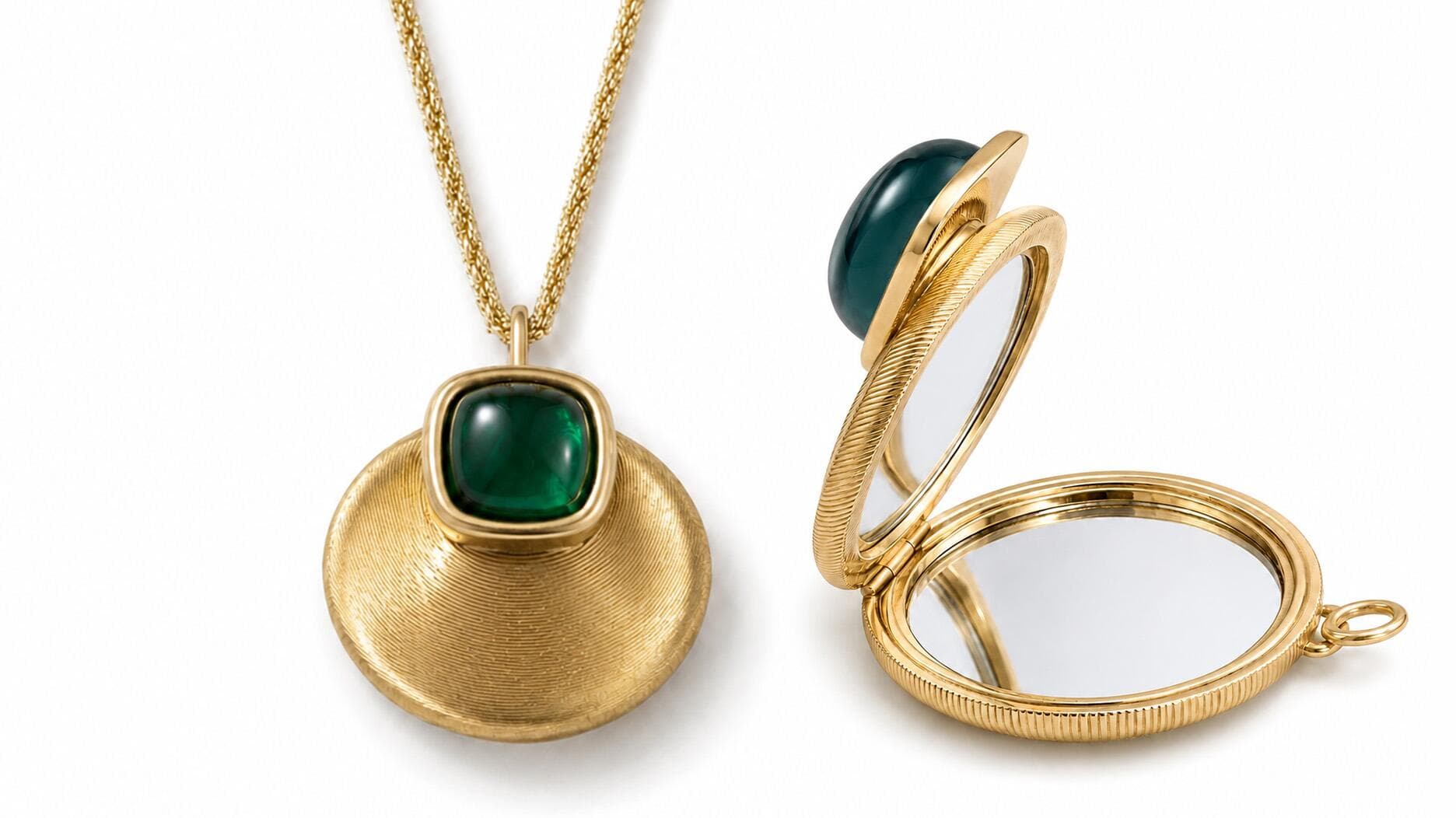
Vogue Editors Share Their Top Five Vintage Jewelry Picks for 2026
Pick up an inherited ring or an estate-sale brooch, and you're holding a small archive — and possibly a smart investment. Five vintage archetypes are getting full editorial endorsement from Vogue for 2026.
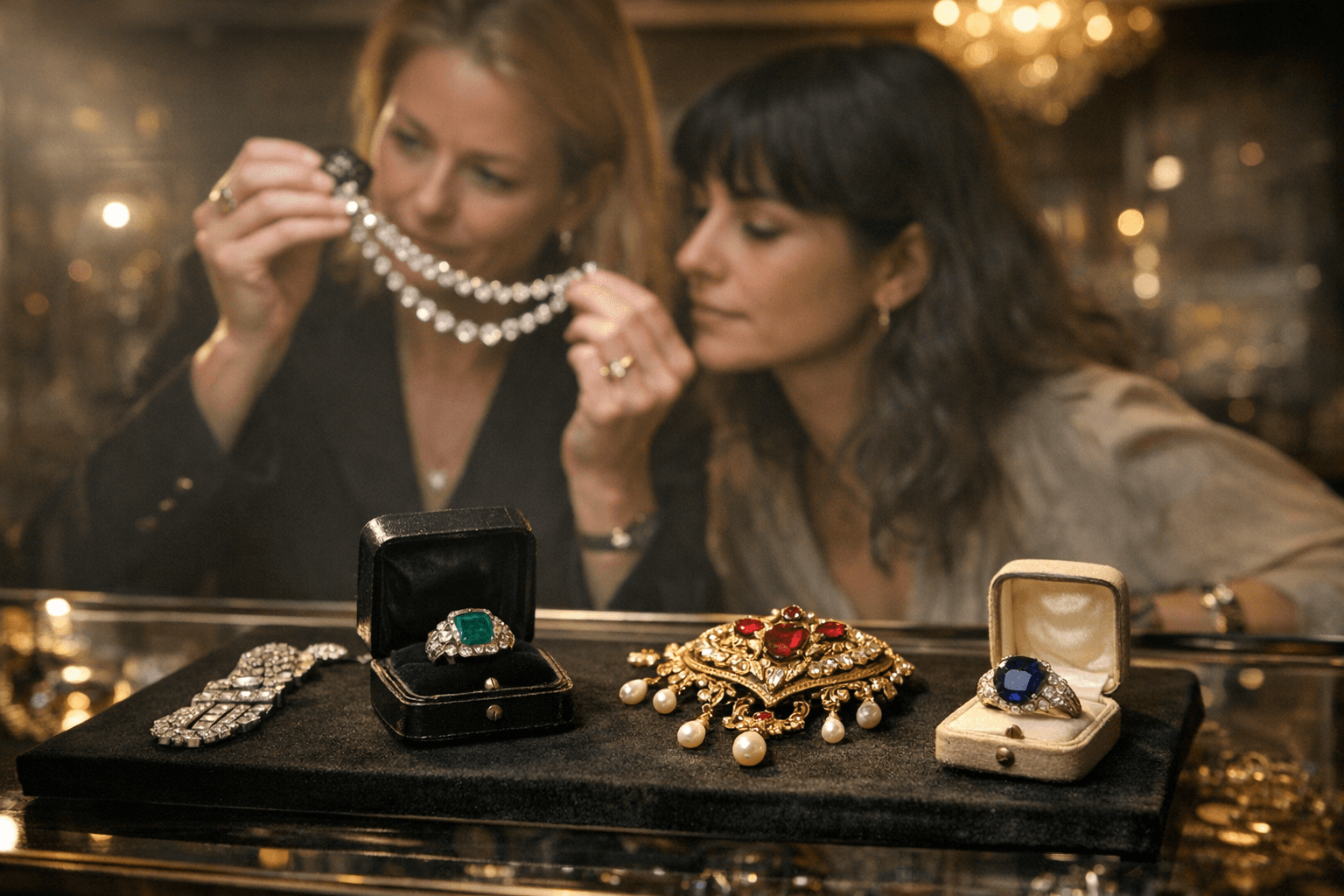
Pick up an inherited ring or a brooch pulled from an estate sale, and you're holding a small archive. The object in your hand carries a maker's mark, a period's aesthetic logic, and a transaction history that tells you something about what it was worth then, and what it could be worth now. Vogue's editors understand this. Their vintage jewelry picks for 2026, published in a late-March editorial, are less a shopping list than a forensic brief: five archetypes from Art Deco platinum geometries to signed mid-century costume pieces, each editorially resonant and, if you know what to look for, financially significant. Here's how to authenticate each one, what the fakes look like, where prices realistically land, and what to buy if the real thing is out of reach.
Before you shop any of them, know how to read a piece.
The checklist at the bottom of this article is designed to be screenshotted before you walk into any estate sale, auction preview, or vintage dealer. Every item on it is a tell, not a theory.
1. Art Deco Platinum-and-Diamond Pieces (c. 1920-1940)
The Art Deco period gave jewelry its most rigorous geometric vocabulary: stepped chevrons, calibré-cut colored stones set into rectilinear bezels, filigree milgrain edges worked in platinum with a fineness no modern casting replicates. The aesthetic emerged from Cubism, post-1922 Egyptomania, and the social freedoms that came with shorter hemlines, and it remains the single most-collected vintage jewelry period among fine dealers globally.
Authentication tells: Platinum from this era carries a hallmark, typically "PLAT," "950 PLAT," or "PT950." The milgrain work, the tiny beaded edges along collet settings, should be hand-rolled and slightly irregular under a loupe. Uniform, machine-perfect milgrain signals a reproduction or a much later piece. Calibré-cut stones (onyx, coral, lapis) in genuine Art Deco work are precisely fitted to their geometric outlines with no visible gap; fakes use rounded or poorly matched glass substitutes. Hand-engraving on the reverse of brooches and clips is another period marker.
Watch for: Replaced calibré-cut stones (expensive to source, frequently swapped with glass), repaired platinum solder joins visible as grainy, slightly discolored seams, and "enhanced" pieces where a later jeweler added stones or converted yellow-gold prongs to rhodium-plated white gold. Platinum holds its color over decades; white gold yellows at prong tips under wear.
Price bands: Unsigned platinum and diamond geometric brooches, $1,800-$6,000. Signed pieces by Cartier, Van Cleef & Arpels, or LaCloche command $8,000-$60,000 and above. Calibré-cut onyx and diamond bangles, unsigned, run $2,500-$9,000.
Budget substitute: Sterling silver and marcasite pieces from the same period, or 1970s reproduction Art Deco in silver. Marcasite is pyrite, not a diamond simulant, and a genuine marcasite brooch in silver costs $80-$300 with all the period geometry intact.
2. Antique Cushion-Cut Diamond Rings
Frank Everett, Sotheby's Director of Jewelry, has called 2026 "the year of the antique cushion-cut engagement ring," and the trigger is well-documented: Taylor Swift's 10-carat antique elongated cushion-cut diamond, designed by Kindred Lubeck, drove search volume for the shape to levels the vintage market hadn't seen. But the collector premium on these stones predates pop culture by centuries. Old-mine brilliant and antique cushion cuts were the dominant diamond shape from roughly the 1700s through the early 20th century. Their large culet (the flat facet at the base) creates the distinctive "open eye" visible when viewed face-down; their high crown and small table facet produce an intensely warm, candlelit scintillation that modern brilliant cuts simply don't replicate.
Authentication tells: Genuine antique cushion cuts show a visible culet under 10x magnification and an asymmetrical facet arrangement, since they were cut by hand on a wheel. The girdle is unpolished and bruted, appearing rough under a loupe. Modern "cushion cut" diamonds have a polished girdle, machine-precise symmetry, and no culet.
Watch for: Laser-drilled stones (small white channels entering inclusions), fracture-filled diamonds (iridescent internal flash under direct light), and replaced stones in antique settings. A stone sitting notably low in its collet often signals a swap. For any stone above half a carat, request an independent GIA grading report before purchase; without one, you are pricing a guess.
Price bands: Old-mine brilliant in a Victorian gold solitaire, 0.5-0.75ct, $1,500-$4,000. Antique cushion at 1ct in a platinum Art Deco mounting, $6,000-$18,000. Elongated cushions at 2ct and above in the Swift-adjacent range, $15,000-$60,000 and beyond.
Budget substitute: Old European cut diamonds (1890s-1920s, slightly more symmetrical than old-mine) in silver-topped gold settings run roughly 30% less for equivalent carat weight. Antique rose-cut diamonds, shallow and domed, are under-collected and offer genuine period character at $800-$3,000 in a simple ring.
3. Naturalistic Early 20th-Century Floral Jewelry
"Floral jewelry has always been a classic, but right now it's the naturalistic, early 20th-century pieces that are resonating most," says Adam Patrick, Managing Director at A La Vieille Russie, the New York specialist in antique and estate jewelry. The category spans Edwardian en tremblant brooches with platinum-set petals on wire springs, Belle Époque diamond garland necklaces with tightly modeled laurel and ivy, and Arts and Crafts enamel work where gold leaves hold their original plique-à-jour translucency after more than a century. These pieces were made at the peak of hand fabrication before casting replaced it, and that labor is priced into every genuine example.
Authentication tells: En tremblant work is identifiable by a tiny coiled wire or pivot at the attachment point. Edwardian platinum work is frequently "topped and tailed," meaning platinum on the face and gold on the reverse, since platinum was expensive to use throughout. Period enamel shows slight translucency and pooling at edges; reproduction enamel is uniformly thick.
Watch for: Re-enameled pieces (brush marks or pooling inconsistent with the period), missing tremblant springs, and replaced pearls. Natural pearls, standard in Edwardian jewelry, are now extraordinarily expensive. If a listing claims natural pearl without accompanying GIA or Gübelin documentation, assume cultured.
Price bands: Unsigned Edwardian garland diamond necklaces, $3,000-$12,000. Signed Cartier or Marcus & Co. floral pieces, $15,000-$120,000 and above. Arts and Crafts enamel brooches by known makers including Child & Child or Gaskin, $800-$5,000.
Budget substitute: 1950s-1960s unsigned rhodium-plated floral brooches with paste stones replicate the Edwardian aesthetic convincingly at $40-$250. Trifari "jelly belly" figural pieces from the same era carry their own collector following and sell for $100-$450.
4. Signed Mid-Century Costume Jewelry (c. 1940s-1970s)
Miriam Haskell, Trifari, Schiaparelli, Eisenberg, and Joseff of Hollywood are not substitutes for fine jewelry. They are, in several cases, worth more than unsigned 18-karat gold pieces of similar visual weight, because the signature is a provenance document. Haskell's Russian-glass beading, her seed-pearl clusters hand-wired onto Russian-gold-plated findings by a workshop of artisans, is not reproducible today. Trifari's crown mark and Alfred Philippe's platinum-inspired rhodium designs brought Paris couture aesthetics to mass production, and the result is some of the most precisely engineered costume jewelry ever made. Vogue's editors have always understood this category as wearable design history, not secondary market.
Authentication tells: Miriam Haskell pieces carry an oval cartouche stamped "Miriam Haskell." The earliest pieces from the 1940s through the early 1950s are unsigned, which does not diminish their value if the construction is identifiable. Trifari marks evolved: pre-1955 pieces show a crown over "Trifari" without a copyright symbol; post-1955 examples include one. Eisenberg pieces from the 1940s marked "Eisenberg Original" command a premium over later "Eisenberg Ice" production.
Watch for: Replaced glass stones (check for color inconsistency under natural light against adjacent stones), re-plated findings with gold tone that is too uniform or too bright, and broken seed-pearl wiring on Haskell pieces re-strung without period technique. Schiaparelli Rhodonite and shocking-pink glass reproductions circulate actively; authentic pieces have a specific glass depth with irregular light dispersion that reproductions flatten.
Price bands: Signed Trifari brooches, $45-$350. Miriam Haskell beaded necklaces, $150-$1,200. Schiaparelli aurora borealis pieces, $200-$900. Joseff of Hollywood film-worn pieces with documentation, $800-$8,000.
Budget substitute: Unsigned mid-century costume jewelry in the same tradition sells for 70-80% less than signed equivalents. Lisner, Kramer of New York, and Weiss produced excellent work without the collector premium; a Weiss aurora borealis bracelet runs $35-$120.
5. Vintage Brooches: The Signed Revival
Pinterest's trend data confirms what estate dealers have said for the past year: the brooch is back, decisively. JCK noted that brooches had been "going gangbusters for months," a resurgence that started on the runway and moved into the real habit of anchoring them to lapels, knitwear, and bags. The collector opportunity is real because brooch prices haven't fully caught up with the cultural moment. A Cartier mid-century clip brooch in yellow gold with rubies and diamonds that cleared $3,500 at auction four years ago now regularly reaches $6,000-$8,000; meanwhile, excellent unsigned examples in 14-karat gold with natural stones still trade in the $300-$900 range. That gap closes as awareness spreads.
Authentication tells: Pre-war brooches (1920s-1940s) used "C" catches or tube-and-roll mechanisms that were replaced by modern safety catches after the 1950s. An intact original catch is a dating tell. Cartier, Van Cleef & Arpels, and Bulgari brooches carry serial numbers on the reverse, verifiable against house archives. French pieces carry an eagle-head hallmark for 18-karat gold; British pieces show a full hallmark suite including assay office mark, year letter, and maker's initials.
Watch for: Converted pieces (a pendant retrofitted with a pin back, identifiable by asymmetric weight distribution and a visible solder seam on the reverse), missing pave stones (run a fingertip across the surface; any sharp prong tip with no stone beneath it signals loss), and replacement pin stems in white metal that don't match the original gold back color.
Price bands: Unsigned 14-karat gold floral brooches with cultured pearls or semi-precious stones, $200-$900. Signed Cartier or Van Cleef & Arpels gold brooches, $3,500-$25,000 and above. Retro-period (1940s-1950s) rose-gold brooches with synthetic rubies or sapphires, unsigned, $400-$1,800.
Budget substitute: Sterling silver brooches by American studio jewelers from the 1950s-1970s, particularly Southwestern silversmiths working in turquoise and silver, offer exceptional hand fabrication at $60-$400 and remain undervalued relative to their craft.
Hallmark + Condition Red Flags: Screenshot Before You Shop
HALLMARKS TO FIND: PLAT / PT950 / PT900 (platinum); 750 or 18K (18-karat gold); 585 or 14K (14-karat gold); eagle head (French 18K); lion passant (British gold or sterling); owl head (French import mark on foreign pieces). For signed costume: locate the cartouche with a loupe and confirm it is stamped into the metal, not applied as a label or painted on.
RED FLAGS THAT SHOULD STOP YOU: Solder seams in unexpected locations (repairs or conversions). Prong tips with no stone beneath them (missing stones). Gold tone that is too uniform and too bright on a supposedly 80-year-old piece (re-plating). White metal pin stems on yellow-gold brooches (replaced findings). Pearls that are perfectly round, perfectly matched, and uniformly white (modern cultured; natural pearls show surface texture). A hallmark stamp that looks too crisp and too centered (modern reproduction). Any stone showing iridescent internal flash under direct light (fracture-filling treatment).
The window for buying well in these five categories is narrowing. Rebag's most recent resale analysis credits global tariff uncertainty for pushing buyers toward hard assets, and estate jewelry, with no supply chain exposure and no mining cost, absorbs that pressure cleanly. Vogue's editors have always understood that a signed Haskell collar or an Edwardian tremblant brooch is not an accessory: it's a position. The question now is simply whether you take that position at today's prices or wait for tomorrow's.
This article was produced by Prism’s automated news system from verified source data, official records, and press releases, then run through automated quality and moderation checks before publishing. The system is built and supervised by the people who set the standards it runs under. Read our full AI policy.
Did this article answer your question?