What makes diamond jewelry a true family heirloom, provenance, care, and appraisal
A diamond ring becomes heirloom-ready when its story is documented as carefully as its setting, with provenance, appraisal, and care records intact.
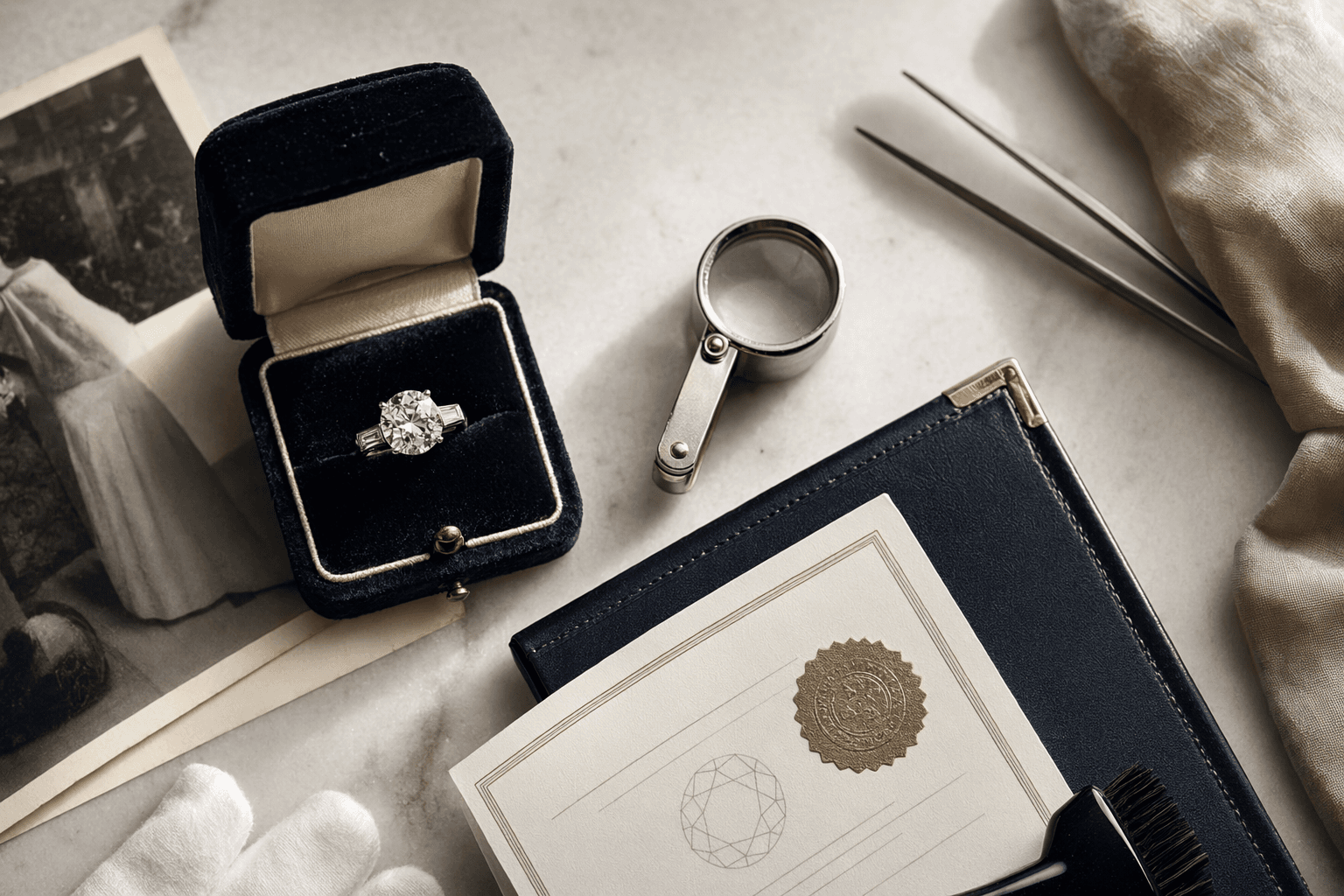
A diamond is already a miracle of time; your job is to make it legible
A true family heirloom is not simply old. It is identifiable, protected, and understood. That matters because a diamond can outlast the people who first wore it: some natural diamonds date to roughly 3.5 to 3.3 billion years ago, and most formed between 1 billion and 3.5 billion years ago deep in Earth’s mantle before volcanic activity brought them up to the surface. Their staying power is not poetry, but physics. GIA attributes diamond durability to hardness, toughness, and stability, which is why these stones are so well suited to being worn, then worn again, across generations.
That longevity, though, can be wasted if the piece arrives in the next generation as a mystery. A ring with no papers, a brooch with no maker’s mark documentation, a bracelet whose repair history vanished in a drawer, all of these become harder to insure, harder to value, and harder to trust. The family story may survive. The asset can suffer.
Provenance is the first line of inheritance
Provenance is more than sentiment and more than a name on an old envelope. Sotheby’s defines it as the chain of ownership, and that chain can influence authenticity, legitimacy, and value. In practical terms, provenance is what allows a descendant or insurer to understand not just that a jewel was loved, but where it came from, who owned it, and whether its identity can be supported.
For a diamond piece you intend to pass down, provenance should live in a single organized file, not scattered across a phone camera roll and a handful of remembered anecdotes. The strongest documentation includes:
- Original purchase receipts
- Prior appraisal reports
- Price history, if available
- Certificates and laboratory reports
- Citations or references connected to the jewel’s ownership
- Notes on unusual characteristics, such as an uncommon mount or an old-cut stone
- Records of any repairs, resets, or stone replacements
That file does more than preserve family meaning. It protects market desirability. A diamond with clear ownership history and supporting documents is easier to assess, easier to compare, and less likely to be treated as an orphaned object with an uncertain past.
Marks on the metal can tell you more than the family legend
Vintage jewelry often reveals itself through the smallest details. Hallmarks and maker’s marks can provide clues to metal content, origin, and sometimes date of creation. A tiny stamp inside a band, a clasp engraving, or a signature on the back of a brooch can shift a piece from “family ring” to something much more specific: a documented artifact with a maker, a place, and a period.
That is where careful observation becomes collecting. Look closely at the shank of a ring, the underside of a pendant, the clasp on a necklace, and the hinge or safety catch on a brooch. These are the places where identity often hides. Even when a mark is faint, partial information can still matter, because it can be matched against known maker’s marks and hallmarks to support attribution.
GIA jewelry reports can strengthen that identification work. Those reports can include metal testing, item weight, markings, a photo, and estimates of stone characteristics. In other words, they translate a sentimental object into a record that can be read, compared, and preserved. For a family asset, that shift from memory to record is everything.
Appraisal is not paperwork theater, it is financial clarity
A proper appraisal does not merely attach a price to a jewel. It establishes a baseline that insurers, executors, and future owners can use. Sotheby’s valuations department says its appraisals are recognized by agencies and international insurance brokers, including the IRS in the United States, which is a reminder that expert documentation can matter in estate planning, tax matters, and insurance claims.
That is especially important with inherited diamond jewelry, where families often assume the value is obvious because the piece is beloved. It rarely is. A setting may be original or later replaced, the center stone may be a different cut than it first appears, or the metal content may not be what a casual glance suggests. Appraisal puts those facts in writing, and written facts are what survive a loss, a divorce, an estate division, or a claim.
The best time to appraise a piece is before there is a problem. Waiting until after a theft, a flood, or a death means you are reconstructing a story from fragments. A current appraisal gives the next generation something better: a usable record with enough specificity to stand up when it counts.
Care is part of value, not an afterthought
A diamond’s famous hardness can create a false sense of invincibility. GIA’s care guidance makes clear that durability includes hardness, toughness, and stability, and each of those qualities matters differently. Hardness helps a diamond resist scratching. Toughness helps it resist breakage. Stability helps it withstand exposure to chemicals and everyday wear.
That means the goal is not to baby the jewel into hibernation, but to wear it intelligently. A diamond ring with a thin antique shank, a fragile old setting, or worn prongs can look deceptively sturdy while hiding vulnerability at the mounting. Regular inspection matters, because a stone is only as secure as the metal holding it.
Practical care should be documented alongside provenance and appraisal:
- Note the date of each professional cleaning
- Record any tightening, soldering, prong repair, or re-tip work
- Photograph the piece before and after servicing
- Keep copies of invoices from jewelers and setters
- Store pieces separately to prevent scratches and abrasion
These records may seem mundane, but they are part of the heirloom’s biography. A family that can trace both ownership and maintenance is preserving not just the jewel’s beauty, but its usefulness.
The heirloom is strongest when the paper trail is visible
A diamond piece becomes a true family heirloom when the object and its documentation travel together. Provenance explains where it came from. Appraisal explains what it is worth and for what purpose that value is being recognized. Care records explain how it has been protected over time. Without those three pillars, meaning can blur and insurable value can erode.
That is why the most heirloom-ready diamond is not necessarily the largest or flashiest. It is the one whose maker’s marks have been noticed, whose chain of ownership has been gathered, whose appraisal is current, and whose repairs have been recorded with the same care given to the stone itself. In the end, a family jewel is most secure when the next generation inherits not a guess, but a documented story they can actually use.
This article was produced by Prism’s automated news system from verified source data, official records, and press releases, then run through automated quality and moderation checks before publishing. The system is built and supervised by the people who set the standards it runs under. Read our full AI policy.
Did this article answer your question?