Antioch Christian Church stands as Allendale County’s oldest Disciples landmark
Antioch Christian Church is Allendale County’s oldest standing Disciples landmark, but its story is tied to Smyrna’s Kirkland roots and the family lines still preserved on both church grounds.
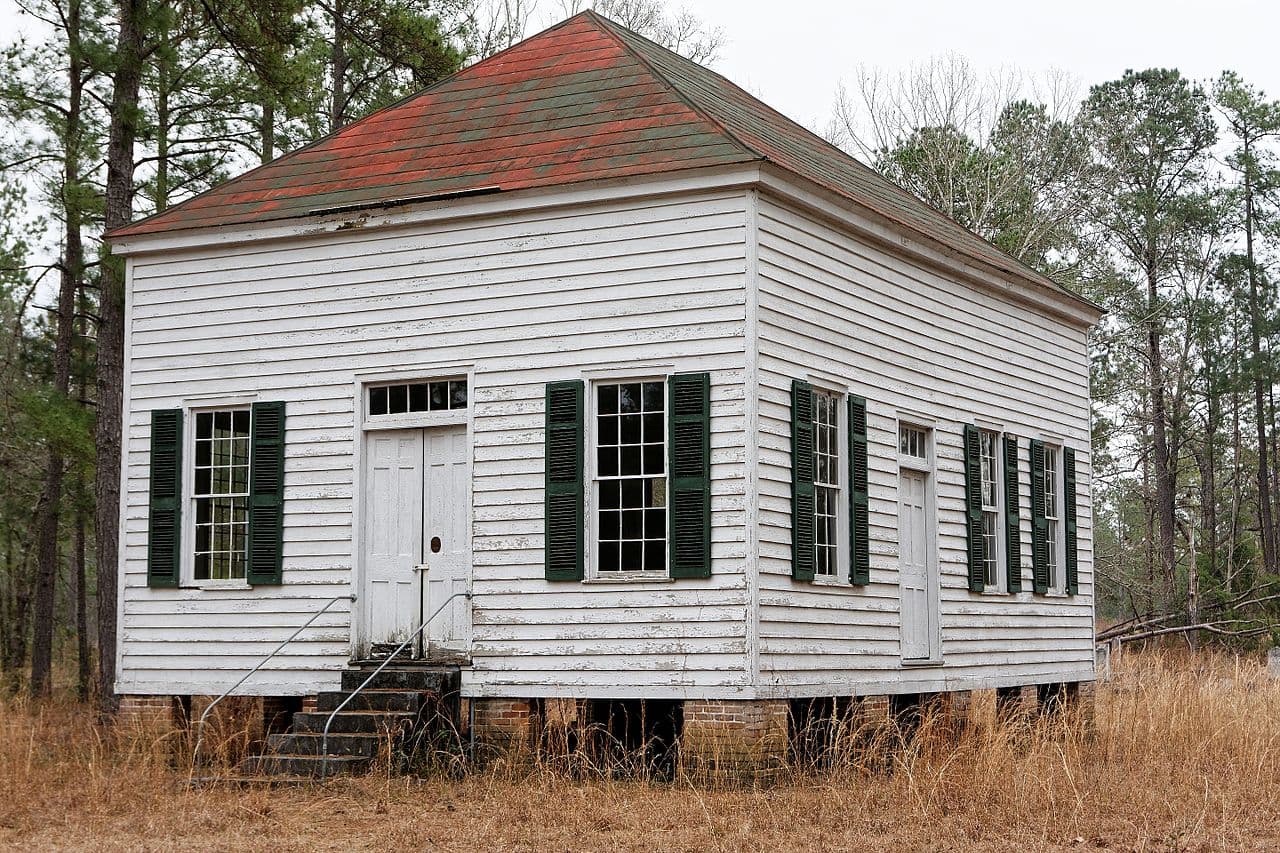
A church split in 1833 left Allendale County with one of its clearest heritage landmarks: Antioch Christian Church on Highway 3, also known as River Road. Built about 1835, the clapboard meeting house now stands as the oldest surviving structure of the Disciples faith in South Carolina, while the cemetery beside it still carries the names of many of the county’s oldest families.
Two churches, one county story
Antioch and Smyrna Baptist Church belong together in the same local conversation because they show different chapters of the same religious history. Smyrna began as Kirkland’s Chapel, founded in 1815, became Kirkland Church in 1827, and was renamed Smyrna in 1836. Antioch grew out of that world, after a doctrinal break turned a church dispute into a new congregation and, eventually, a new building.
That connection is what gives the story its local force. Antioch is not simply an old rural church preserved for its age. It is a physical record of how religious conviction, family ties, and community boundaries shifted in Allendale County during the early 1800s, then settled into two nearby meeting-house traditions that still help define the county’s historic landscape.
How Antioch took shape on River Road
The Antioch story begins with a specific break at Smyrna Baptist, then known as Kirkland Church on Bluff Road. In 1833, Dr. W. R. Erwin, his wife, and his sister-in-law were excommunicated over denominational differences and soon formed the second Christian congregation in South Carolina. Services were first held at Erwinton until the Antioch meeting house was completed and dedicated in 1835.
The historic marker record identifies the congregation as organized in 1833 by Dr. and Mrs. W. R. Erwin and Mrs. U. M. Robert. That same marker says Dr. J. D. Erwin, II served as minister for forty years, a long pastoral run that helped anchor the church through later generations. A roadside marker was erected in 1960 by the Antioch Association, adding another layer to the building’s public memory.
Antioch’s place in the wider denomination is equally specific. It was the second Disciples of Christ church founded in South Carolina, and South Carolina Disciples regard it as the oldest standing structure of that faith in the state. That makes the building important not only in Allendale County terms, but also in the history of early Disciples expansion across South Carolina.
What the building still looks like
Antioch’s architecture remains plain, sturdy, and deliberate. The church sits on low brick pier foundations, carries a hipped roof, and keeps the restrained meeting-house form that marked many early rural churches in the South. The South Carolina Historic Properties Record notes plaster walls and original hand-hewn pine pews that still remain intact inside.
That interior detail matters because it preserves the scale and feel of the original congregation. The South Carolina Disciples renovated the church in 1976, but the interior was not included in that work, leaving key historic fabric in place. The church was listed in the National Register of Historic Places on December 12, 1977, which formally recognized the building’s architectural and religious importance.
The site also carries an unexpected civic chapter. The National Register nomination notes that the present building was used as a courthouse in 1865. In a county where churches, roads, and family cemeteries often doubled as public landmarks, that brief use says as much about the building’s centrality as its worship history does.
Smyrna and Kirkland as the other side of the frame
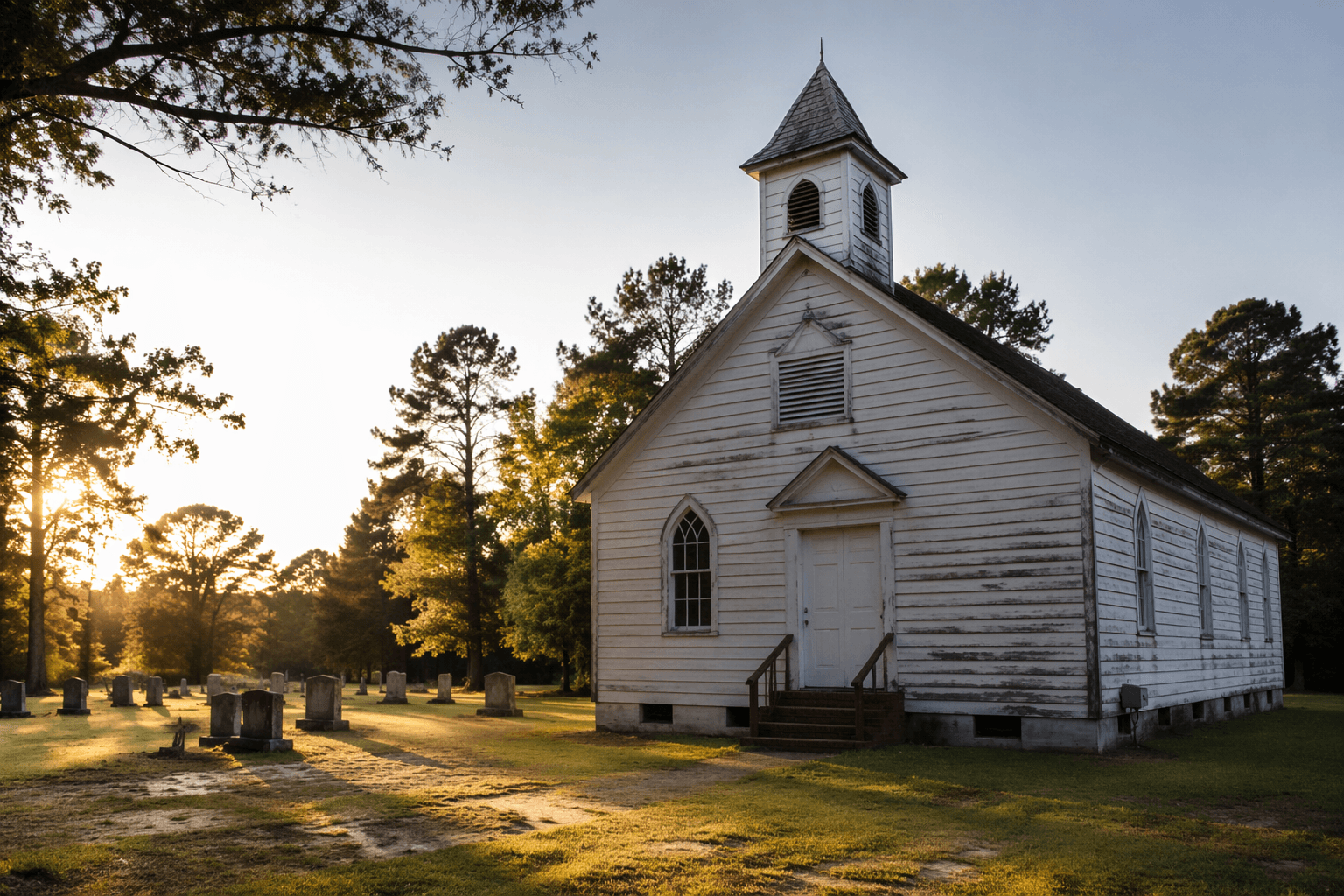
Smyrna Baptist Church gives the Antioch story its necessary mirror. Its National Register documentation says the exact construction date is unknown, but local tradition places it in 1827, the same year the church was organized. The structure is an antebellum frame meeting house set on a low brick foundation, with a central Palladian window and balanced nine-paneled entrance doors with transoms on the front facade.
Those architectural details matter because they show continuity as much as difference. Smyrna and Antioch both reflect the same restrained rural meeting-house tradition, yet each captures a different institutional outcome. Smyrna represents continuity from Kirkland’s Chapel through a renamed congregation; Antioch represents division, relocation, and rebirth through a new denomination.
Smyrna was listed in the National Register of Historic Places on May 28, 1976, a year before Antioch’s own listing. Archival records for Smyrna Baptist Church cover 1870 to 1927 and include covenant rules, meeting minutes, and membership lists, which gives the site a paper trail that complements its building history. Together, those records and the surviving structure show how church life extended far beyond Sunday services into the daily structure of family and community memory.
Why the cemeteries matter as much as the sanctuaries
The church grounds hold more than architecture. Antioch’s documentation says many of Allendale’s oldest families are buried in its cemetery, making the site a kinship map as well as a religious one. Smyrna’s cemetery carries a similar weight, with later property additions in 1849 and 1882 showing a congregation that continued to grow and adapt across generations.
That is why these churches remain relevant to descendants and to the wider county today. They preserve the names, dates, and lineages that otherwise could be scattered across private records or lost to time. In a place where family history often runs through the same roads, churches, and burial grounds, Antioch and Smyrna still hold the county’s memory in visible form.
What preservation protects now
Preserving Antioch means keeping several histories intact at once: the founding of a denomination, the split from Kirkland, the Erwin family line, and the survival of a rare meeting-house structure. Preserving Smyrna does the same for the older Kirkland lineage, the early congregation organized in 1827, and the record of worship that followed it into the late 19th and early 20th centuries.
For Allendale County, the value is not abstract. The two churches still show how doctrine shaped settlement, how architecture reflected belief, and how family names tied generations together across a small rural landscape. Antioch’s clapboards, Smyrna’s Palladian window, and the graves beside both buildings form one continuous local record, and that record is exactly why these places still matter.
This article was produced by Prism’s automated news system from verified source data, official records, and press releases, then run through automated quality and moderation checks before publishing. The system is built and supervised by the people who set the standards it runs under. Read our full AI policy.
Did this article answer your question?
%2Ffit-in%2F200x300%2Ffilters%3Afill(white)%2Fprod%2F550%2F508436%2FrI5B6acwe7Flxndz1000029711.jpg&w=1920&q=75)