Lawton Mounds stands as South Carolina’s best-preserved Savannah site
Lawton Mounds is not just old earthwork ground. Its two mounds, ditch, and rare defensive enclosure make it one of South Carolina’s most intact Savannah River sites.
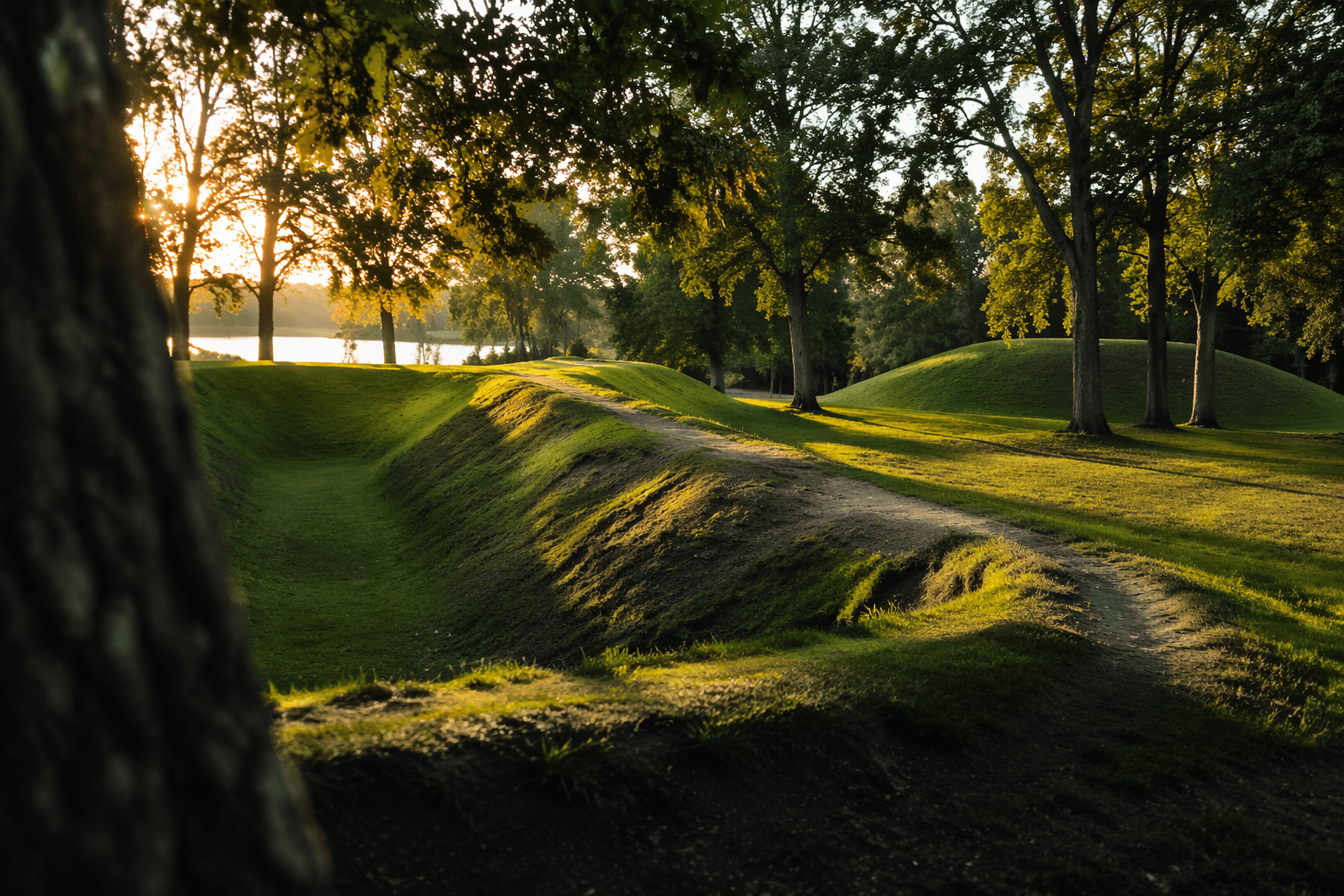
Lawton Mounds sits in a quiet corner of Allendale County, but its value reaches far beyond county lines. The site holds two low earthen mounds, a village area, and a ditch-and-parapet enclosure on a heavily forested terrace of the Savannah River, a combination that makes it one of the state’s most important prehistoric places. Its preservation is the point: in a county with only a small number of recognized historic properties, Lawton is a rare surviving record of how people lived, defended space, and organized community along the lower Savannah River.
The National Register of Historic Places listed Lawton Mounds on June 19, 1972, and identified it as address-restricted near Johnson’s Landing in Allendale County. That restricted status matters because the site is not a casual stop on the roadside. It is a protected archaeological landscape, and its significance lies in what has remained in place rather than what has been made into a public attraction.
What survives on the ground
The site’s physical layout is unusually clear. The South Carolina Department of Archives and History describes two flat-topped mounds set within a surrounding village area and enclosed by a ditch and parapet. The North Mound measures about 65 by 70 feet at the base and rises about five feet above the terrace. The South Mound sits roughly 100 feet away, measures about 70 by 85 feet at the base, and stands about 7.5 feet high. The enclosing ditch is 15 to 20 feet wide and about 3 feet deep.
That arrangement gives Lawton Mounds a shape that can still be read in the land. The site covers about three acres and sits on a low terrace of the Savannah River, separated from the modern channel by an old slough of cypress swamp. That setting helped preserve the remains, but it also explains why the site deserves care. River terraces and swamp edges can hold archaeological features remarkably well, while changing water patterns, erosion, and human disturbance can damage them just as efficiently.
What makes it rare in South Carolina
Lawton Mounds belongs to the Savannah II period, roughly AD 1200 to 1300, based on the pottery recovered there. The state historic property record says that period is especially important because it shows the spread of strong ceremonialism into the South Carolina-Georgia area. That places Lawton in a key moment of regional change, when mound-building communities were shaping settlement, ritual, and authority across the lower Savannah River valley.
The National Register entry goes further and states that no other known Savannah-period village site in South Carolina matches it, and no other mound site in the state is so well preserved. That is a strong claim, and it is exactly why Lawton matters to Allendale County. It is not simply one more mound in a landscape already full of them. It is a surviving benchmark for a specific period, a specific river system, and a specific kind of community form.
Archaeologists have treated the site as one of a small number of Middle Mississippian centers in the lower Savannah River valley. A University of Georgia publication describes the site as fitting the Mississippian architectural tradition of the valley, with a formal mound-and-plaza complex surrounded by a habitation area. It also notes that Lawton has two mounds, the most favorable terrace landform among the compared sites, the largest single construction-stage mound, and the only confirmed defensive ditch and palisade among those sites.
What the excavation added
The research work at Lawton did not stop at mapping. The Savannah River Archaeological Research Program began a long-term project at the site in 1999. That work produced evidence of a burned and collapsed palisade, which confirmed that the enclosure was real and not just a surface impression. Keith Stephenson, Adam King, and Christopher Thornock described that evidence in their 2010 study, and it sharpened the site’s importance as a defended settlement, not only a ceremonial one.
That defensive detail changes how the site is read. A ditch and palisade mean labor, planning, and collective action. They suggest people were organizing the landscape with a purpose, whether that purpose was protection, status, boundary-making, or all three at once. For Allendale County, that turns Lawton into a place where the pre-contact history of the Savannah River can be seen in earth, not just in textbooks.
How Lawton fits into the county’s bigger record
Lawton is not the only important archaeological site in Allendale County, and that is part of the county’s story. The county’s National Register inventory also includes the Allendale Chert Quarries Archaeological District and Red Bluff Flint Quarries, evidence that this stretch of the river corridor preserved not only settlement sites but also places tied to raw material extraction and broader prehistoric land use.
Allendale County has 14 National Register properties overall, but only a few are ancient earthworks. The South Carolina Encyclopedia says five South Carolina Indian mound sites are listed in the National Register of Historic Places: Adamson Mounds in Kershaw County, Blair Mound in Fairfield County, Lawton Mounds in Allendale County, McCollum Mound in Chester County, and Santee Mound in Clarendon County. It also notes that South Carolina has at least sixteen Woodland mounds and nineteen Mississippian mounds that are at least fifty percent intact, while another eleven known sites have been destroyed or are underwater.
That statewide context shows how limited the surviving record is. Lawton Mounds sits inside a small class of earthworks that still retain enough form to teach something useful about pre-contact life in the Southeast. In a state where so much has vanished, intactness is itself a form of historical evidence.
What residents can value now
The practical value of Lawton Mounds is that it still exists in a readable, protected form. It is near Johnson’s Landing, but it is not an ordinary public recreation site, and its address-restricted status is part of what keeps it intact. The best way to think about it is as a fragile archive in the ground, one that depends on careful stewardship rather than heavy visitation.
For residents, that means the site is worth understanding through official records, preservation listings, and the work of archaeologists rather than through casual access. It is also a reminder that Allendale County’s place in the Savannah River story is not peripheral. The county holds one of South Carolina’s best-preserved mound complexes, and the land still carries the outline of a community that lived there more than 700 years ago.
Lawton Mounds endures because it was built on a terrace that could hold its shape and because it has been treated as something more than open ground. That combination, rare in South Carolina, is what makes it one of the clearest surviving links between Allendale County and the prehistoric Savannah River world.
This article was produced by Prism’s automated news system from verified source data, official records, and press releases, then run through automated quality and moderation checks before publishing. The system is built and supervised by the people who set the standards it runs under. Read our full AI policy.
Did this article answer your question?
%2Ffit-in%2F200x300%2Ffilters%3Afill(white)%2Fprod%2F550%2F508436%2FrI5B6acwe7Flxndz1000029711.jpg&w=1920&q=75)