St. Johns emergency services cover 2,200 square miles in southern Apache County
St. Johns keeps ambulances on the road across 2,200 square miles with paid paramedics, EMTs and volunteers. If that volunteer base thins, southern Apache County’s safety net weakens.
St. Johns does not run emergency services like a small town with a small footprint. Its ambulance and fire coverage reaches across 2,200 square miles in southern Apache County, where a call from Vernon, Concho, Show Low Pines, Hunt or Witch Wells can mean a long run before a patient ever reaches a hospital.
A county-sized safety net
Apache County is Arizona’s largest county by land area, but its population remains thinly spread. The county was estimated at 65,998 residents on July 1, 2025, while St. Johns had 3,395 and nearby Springerville had 1,711. St. Johns is also the county seat, which helps explain why its emergency services function as a regional anchor rather than just a municipal department.
That geography shapes how emergency care works here. Arizona’s Department of Health Services now uses ambulance response-time standards that account for urban, suburban, rural and wilderness settings, with standards tied to population density and geographic and medical considerations. In a place like southern Apache County, distance is part of the emergency, not just the backdrop to it.
How the ambulance stays staffed around the clock
St. Johns EMS keeps an ambulance staffed 24 hours a day, 7 days a week with two full-time paramedics, two full-time EMTs and community volunteers. That mix is what allows the city to promise coverage across a broad rural area that stretches far beyond St. Johns itself.
The practical result matters for families facing a heart attack, stroke, ranch accident or crash on a long county road: the system is built to send help and keep it moving. Patients are typically transported to Summit Regional Medical Center in Show Low or White Mountain Regional Medical Center in Springerville, the two closest destination hospitals named in the city’s emergency services information.
The model is lean, but it is not casual. Keeping a 24/7 ambulance available across a sparsely populated region requires enough people to staff the truck, enough vehicles to cover multiple call types and enough coordination to move patients to the right hospital without losing time.
What the fire side adds to rural protection
The St. Johns Volunteer Fire Department has 30-plus volunteers trained at Northland Pioneer College, a school established in 1974 to serve a rural, sparsely populated part of northeastern Arizona. That training pipeline matters in Apache County, where a local responder pool must be built from the same dispersed communities the department protects.
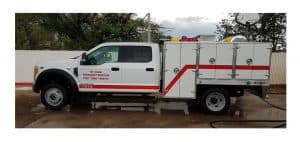
The department’s apparatus reflects that mission. Its fleet includes a 3,000-gallon pumper, a smaller 750-gallon firetruck, two rescue trucks, a tender and two wildland firetrucks. That mix gives the department the ability to handle structure fires, vehicle accidents, water supply problems and wildfire response in a county where the nearest backup may be miles away.
The city also sends a firetruck and crew anywhere needed in southern Apache County at no charge. That is a significant public-service choice in a region where help can be far from the scene and where one department often has to fill several roles at once.
Why wildfire work pays back at home
St. Johns’ wildland fire crew can travel throughout the Southwestern United States during difficult fire seasons. The work is not just about helping other communities get through heavy fire years; funds earned through those deployments are used to buy new equipment for the St. Johns Fire Department.
That creates a local loop: wildfire assignments help support the gear needed at home. In a department that covers a huge rural area, replacing equipment is not an abstract budget item. It determines whether the next call can be answered with a pumper, a rescue truck, a wildland unit or a crew that is ready to leave town and still leave enough people behind.
The arrangement also helps explain why this system is fragile. Wildland assignments can bring in money, but they also pull people and apparatus away during the same season when local fire risk is often highest. The department has to balance the chance to earn operating funds with the obligation to stay ready for house fires, wrecks and medical calls in southern Apache County.
Where the system becomes vulnerable
The strongest point in St. Johns’ emergency network is also its most exposed: volunteers. A 24/7 ambulance and a county-spanning fire response depend on community members willing to train, stay current and answer calls at all hours. If that volunteer pool shrinks, the city has less margin for simultaneous incidents, fewer hands for long-distance runs and less flexibility when wildfires, structure fires and medical emergencies stack up at the same time.
That strain would fall hardest on the paid EMS staff. Two full-time paramedics and two full-time EMTs can keep an ambulance moving, but they cannot substitute for the depth that a larger volunteer corps provides when several emergencies hit at once or when fire coverage has to be split between town and outlying communities.
For families in Vernon, Concho, Show Low Pines, Hunt and Witch Wells, the difference would not be theoretical. Fewer volunteers means a thinner local safety net, more pressure on the staff that remains and a greater chance that a response has to come from farther away or with less immediate backup.
Who runs it and how to reach help
The city’s emergency leadership is named and formal, not improvised. Lance Spivey is listed as Chief Fire Department and EMS, Gary Liston as Assistant Fire Chief and Jason Kirk as Assistant EMS Chief. The city’s emergency after-hours phone number is 928-337-4321.
That matters in a region where emergency service is as much about organization as it is about courage. St. Johns has built a system that depends on volunteers, full-time clinicians, local training, a broad apparatus fleet and wildland work that feeds equipment back into the department. In southern Apache County, that is what keeping coverage alive looks like.
This article was produced by Prism’s automated news system from verified source data, official records, and press releases, then run through automated quality and moderation checks before publishing. The system is built and supervised by the people who set the standards it runs under. Read our full AI policy.
Did this article answer your question?