Baltimore breaks ground on North Avenue revitalization in Coppin Heights
Baltimore leaders broke ground on a Coppin Heights revamp tied to more than $100 million in West Baltimore investment, with the first step targeting three vacant houses on North Avenue.
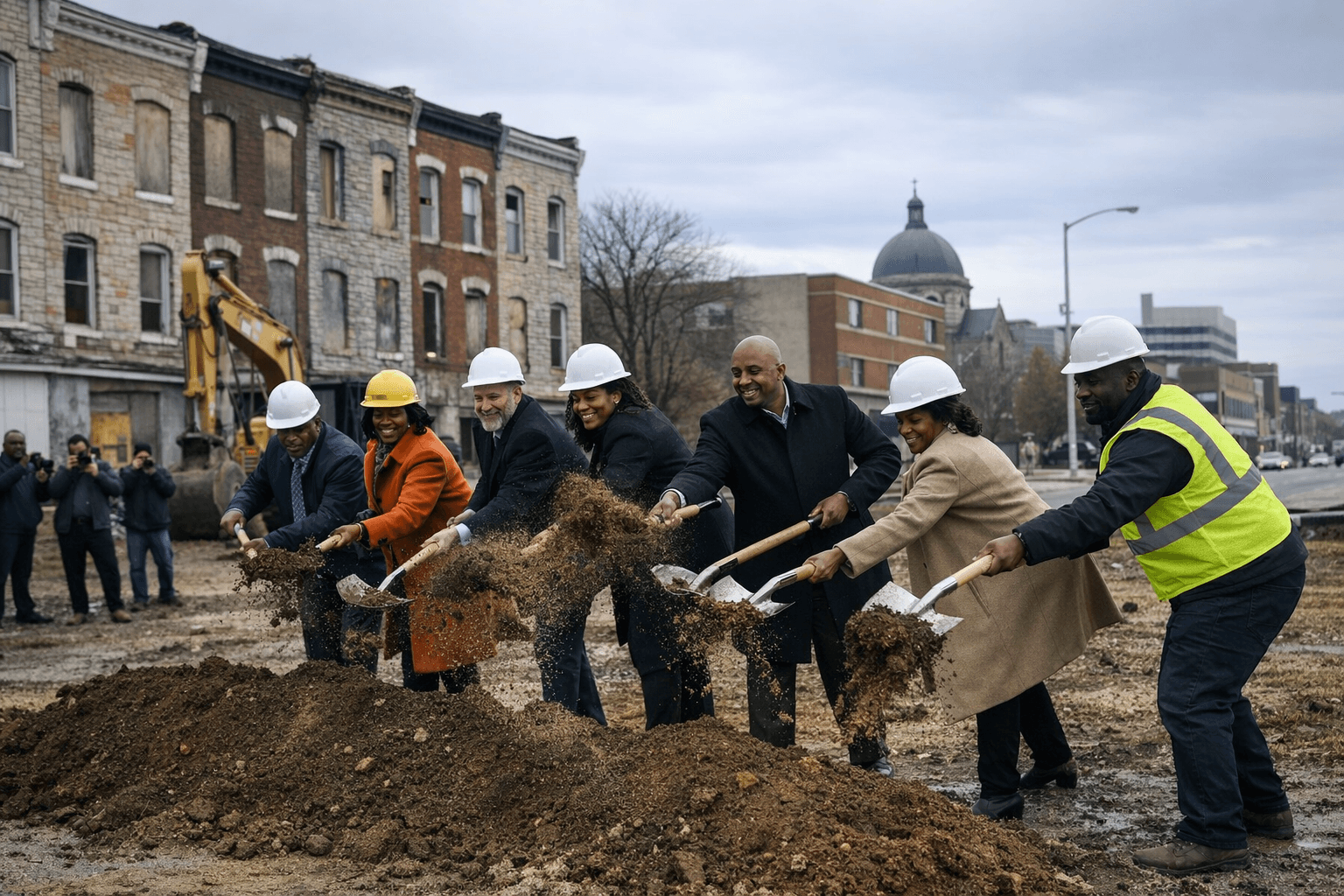
Baltimore leaders broke ground on a North Avenue revitalization plan in Coppin Heights that begins with three vacant houses but is meant to reach far beyond them. Council Member James Torrence said the city is investing more than $100 million within about a two-mile radius in District 7, a scale that signals the corridor is being treated as more than a string of isolated properties.
The immediate work is small but visible: gutting and renovating the first houses, then moving block by block through the 2700, 2800 and 2900 blocks of North Avenue over the next three years. City officials have framed the effort as a whole-block redevelopment strategy, one aimed at turning boarded-up properties into housing that can support both renters and future homeowners. For Coppin Heights, that shift matters because it suggests the city is trying to rebuild a market, not just stabilize decay.
Residents already have one nearby example to measure against. The Mill on North opened in April 2025 at 2636 West North Avenue, just steps from Coppin State University, with about 7,500 to 7,800 square feet, six or seven local food vendors, a bar and community space. It sits within the larger Walbrook Mill project, and for many on North Avenue it has become the clearest sign that commercial activity can return to a corridor long marked by vacant buildings and underused land.
The city’s planning department has long identified Coppin Heights and the North Avenue Gateway as development priorities, and its Sustainable Communities materials say Coppin Heights should be considered one of the city’s development priorities. Planning documents also say neighborhood plans are built with stakeholder feedback, placing this redevelopment inside a formal community-planning framework rather than a one-off real estate deal.

That matters because the stakes are not only architectural. Coppin Heights Community Development Corporation says it has worked since 1995 to improve affordable housing in Greater Coppin Heights and Rosemont, and it lists the West North Avenue corridor revitalization, The Mill on North and Walbrook Mill Apartments as active projects. The West North Avenue Development Authority describes itself as the economic development authority for West Baltimore, created to benefit Coppin State University and nearby residents.
The question now is whether the groundbreaking becomes a measurable turning point for West Baltimore. Neighbors will be watching for new construction to move on schedule, storefronts to stay occupied, and housing to remain within reach as the corridor changes. If the city can fill the blocks while keeping room for current residents, North Avenue could become a rare Baltimore example of revitalization that reaches the street, not just the podium.
This article was produced by Prism’s automated news system from verified source data, official records, and press releases, then run through automated quality and moderation checks before publishing. The system is built and supervised by the people who set the standards it runs under. Read our full AI policy.
Did this article answer your question?