Bamberg’s railroad origins shaped its downtown and civic growth
A 1855 water-depot stop on the South Carolina Rail Road still explains Bamberg’s street pattern, downtown, and why the county seat ended up here.
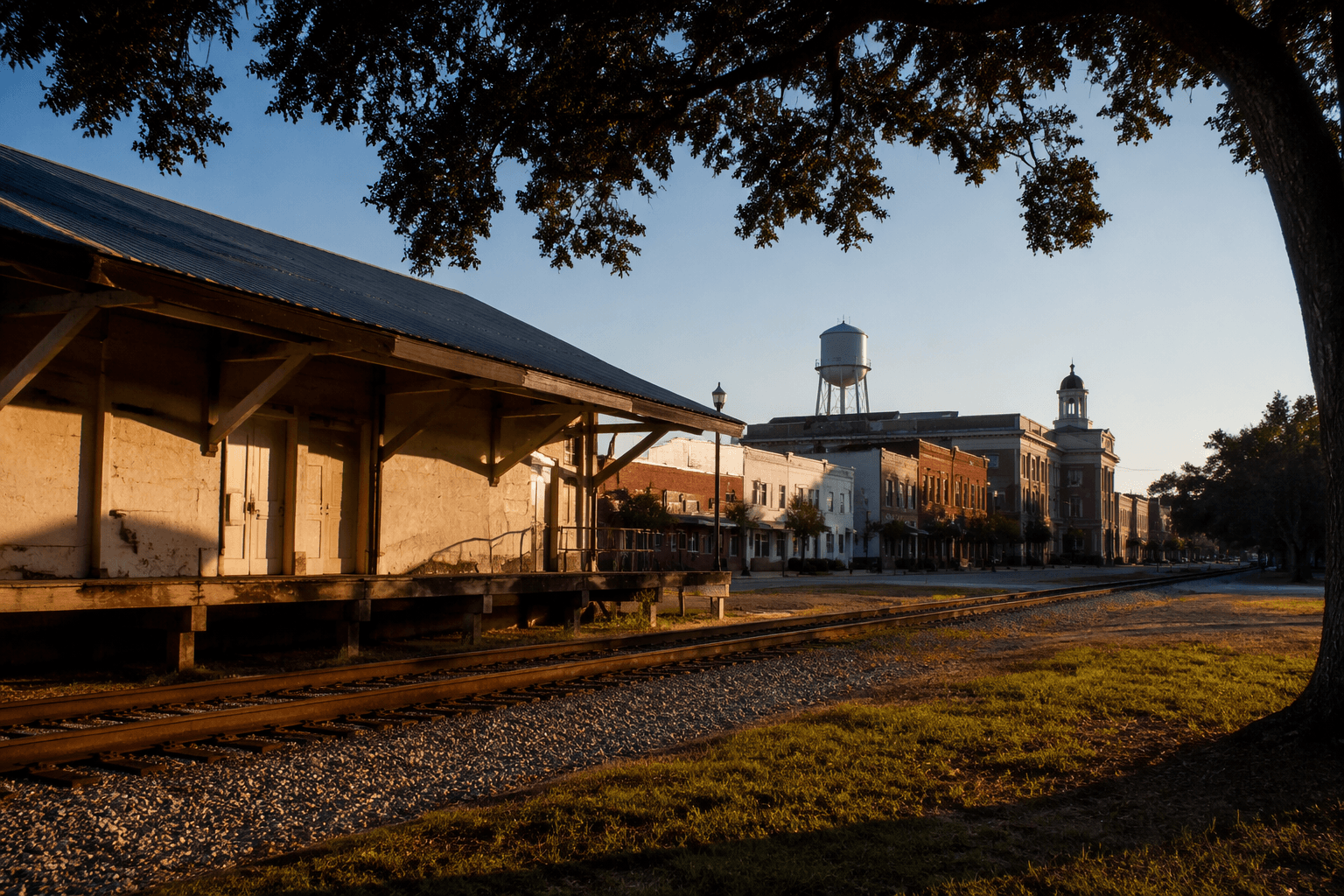
Bamberg began as a railroad stop with a practical purpose: water. In 1855, the town took shape at a water depot on the original South Carolina Rail Road tracks, and that single location choice still helps explain why the city sits where it does, how its streets run, and why its downtown became the center of county life.
Railroad stop, town center
The South Carolina Rail Road, chartered in 1827 and operating from 1843 to 1902, was part of the rail network that pushed settlement into South Carolina’s interior coastal plain. Bamberg’s origin fits that pattern closely. Steam locomotives needed water, and stops built around that need often turned into places where people settled, businesses clustered, and public institutions later followed.
That is the practical meaning of Bamberg’s founding story. The town was not laid out as a speculative subdivision or a later suburban outgrowth. It emerged at a place where rail access, water supply, and movement of goods all met, and that made it a natural node for commerce and civic life.
The South Carolina Encyclopedia places Bamberg within a much larger railroad era that lasted until after World War I. That broader context matters because Bamberg was one of several South Carolina towns, including Branchville, Fort Mill, and Ehrhardt, where rail infrastructure pulled activity into a defined downtown rather than letting it spread outward in random patterns.
What still reads as railroad town today
The clearest clue is the Bamberg Historic District, which lies along both sides of what was once the Southern Railway. A National Register nomination says the district includes 56 properties dating from about 1852 to about 1930, while other preservation descriptions place its buildings in the 1875 to 1930 range. Those dates show a town that kept growing after the first rail stop, but still on a footprint set by rail-era geography.
The district’s surviving fabric makes the origin story visible. Historic homes, commercial buildings, and public structures line the same basic corridor that once anchored train traffic, and the town’s old rail alignment still helps explain why downtown reads as a compact civic core rather than a scattered commercial strip.
A walk through the city’s own history materials reinforces that point. The visual timeline ties together the courthouse, historic homes, Civil War-era imagery, and the post office, showing how Bamberg’s built environment developed in layers rather than all at once. That sequence is important: transportation came first, then institutions, then the architecture that gave the town a lasting center.
The county seat grew out of the rail stop
Bamberg County was formed in 1897 from the southeastern section of Barnwell County, and both the county and its county seat were named for William Seaborn Bamberg and other members of the Bamberg family. That naming history connects the town’s identity to the family name now attached to the county, but the physical reason Bamberg became the seat is still the railroad.
Today, Bamberg remains the county’s hub for government, public services, and activities. The county administrative offices, county library, health department, Office on Aging Thomas N. Rhoad Center, County Historic Society, and County Economic Development Commission are all based there. Those institutions did not appear by accident in a rail stop town; they followed the same logic that once made the site useful for steam-era transportation.
The county courthouse, originally built in 1897, marks that shift from rail settlement to formal county center. The year the courthouse rose also matches the year Bamberg County was created, showing how quickly a transportation town could become an administrative one once the county’s boundary lines were drawn.
The post office and the next layer of civic growth
Bamberg’s civic story did not stop with the courthouse. The historic post office was built in 1937-38 with Treasury Department funds, a reminder that federal investment later reinforced the town’s role as a local service center. A New Deal mural titled *Cotton the World Over* is reportedly inside the building, adding another layer to the town’s public memory and linking Bamberg to the era when federal architecture often doubled as civic art.
That post office matters because it shows how the town’s center kept expanding after rail travel peaked. The railroad created the original gravity point, but institutions like the courthouse, post office, library, health department, and county offices deepened it into the county’s working center. Bamberg’s identity now rests on that sequence of transport first, government after.
The historic district also preserves names that connect the town to prominent local figures, including Francis Marion Bamberg and former S.C. Senator Jesse F. Carter. Those associations make the district more than an architectural collection. They show how rail access helped anchor the social and political life of the town as well as its streets and storefronts.
What the railroad origin explains now
If the railroad story fades, so does the logic behind Bamberg’s downtown. The town’s compact core, the placement of public buildings, and the historic district along the old Southern Railway corridor all make more sense when seen as the product of a 19th-century water stop that grew into a county seat. Without that memory, the city can look like any other small South Carolina town, when in fact its shape is a record of transportation history.
That history also helps explain why Bamberg is not an isolated case. Across South Carolina, rail towns often developed where lines, depots, and junctions created a permanent center of activity. Bamberg belongs to that statewide pattern, but its particular story is sharper because the founding date, the water-depot function, the later county-seat role, and the preserved historic district all line up so clearly.
The result is visible today in the same places residents use every day: the courthouse built in 1897, the post office built with New Deal funds, the county library, the health department, the Office on Aging center, and the historic district running along the old rail line. Bamberg’s railroad origin is not just a fact from the past. It is the reason the city has a downtown, the reason county functions gathered there, and the reason its identity still fits the map drawn around a water stop in 1855.
This article was produced by Prism’s automated news system from verified source data, official records, and press releases, then run through automated quality and moderation checks before publishing. The system is built and supervised by the people who set the standards it runs under. Read our full AI policy.
Did this article answer your question?