AccuWeather Puts March Kona Low Storm Damage at $2 Billion Statewide
AccuWeather's $2B Kona low estimate covers losses most homeowners' policies won't touch, and for Big Island farmers like Tom Greenwell, that gap defines recovery.
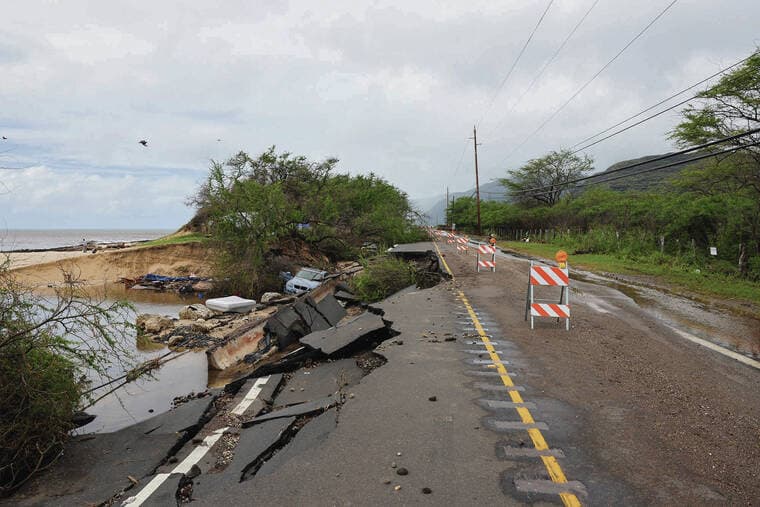
Tom Greenwell watched the first Kona low carve three trenches through his South Kona coffee farm on March 14, wiping out decades-old trees his family had cultivated for 176 years. AccuWeather's preliminary statewide damage estimate, released this week, puts the price tag for the back-to-back storms that produced that kind of destruction at roughly $2 billion across Hawaiʻi - a number that will shape how much federal aid flows to the Big Island and how long the rebuilding takes.
That $2 billion is a broader measure than the official figures that preceded it. Gov. Josh Green's office had pegged the first storm's damage at more than $400 million; after the second system struck already-saturated ground beginning March 19, that tally climbed above $1 billion. AccuWeather's analysis pushes higher because it counts both insured and uninsured losses alongside indirect economic costs: job and wage losses, crop destruction, supply chain disruption, tourism cancellations, flight delays, evacuation expenses, emergency management, and long-term health costs. Critically, AccuWeather noted that water damage is "especially costly to repair" and is often not covered by standard homeowners' policies - a reality that hits Big Island households hard, since residential flood coverage requires a separate federal flood insurance policy that many homeowners don't carry.
On the Big Island, the first storm closed Highways 11 and 130, two main arterial routes connecting Kona to Hilo and the lower Puna district. Mayor C. Kimo Alameda declared a county emergency on March 12 and activated the county disaster fund. Greenwell Farms tallied an estimated $10 million in combined damage and lost revenue from the March 14 storm alone, including the prospect of losing roughly half the season's coffee harvest. The Hawaiʻi County Civil Defense Agency visited the property on March 19 - the same day the second storm began its approach.
To calibrate what $2 billion actually means: AccuWeather estimated the 2023 Maui wildfires caused between $8 billion and $10 billion in total damage and economic loss, a figure it later revised to between $14 billion and $16 billion. The Kona low figure is a fraction of that, but the comparison illuminates something important about who bears the cost. Wildfire destruction generates visible, insurable losses that adjusters can count. Flood damage is harder to tally because so much of it falls outside standard coverage, pushing the financial burden directly onto homeowners, farmers, and county governments rather than the insurance industry. AccuWeather's total, which explicitly incorporates uninsured losses and indirect economic harm, captures that exposure in a way that official government tallies typically do not.

Gov. Green submitted a formal request for a major disaster declaration to the president on March 23, citing the Stafford Act and the compounding nature of the two storms. FEMA teams have arrived in affected counties to evaluate infrastructure and housing damage, the initial assessment step that determines eligibility for federal support. Green told the Honolulu Star-Advertiser that discussions with DHS and FEMA leadership had been "very productive," though no declaration has been approved.
For Big Island farmers and small businesses, some state relief is already open. The Hawaiʻi Department of Agriculture and Biosecurity is offering one-time emergency grants of $1,500 per qualifying applicant and emergency loans of up to $100,000 at a 3 percent interest rate for farmers and ranchers. County and state recovery teams are still collecting damage reports, and the data will support federal aid applications while guiding prioritization of hazardous road repairs.
AccuWeather's estimate is preliminary and will almost certainly rise as more claims are logged, consistent with how the company's Maui wildfire figures evolved over months. Whether the $2 billion total is sufficient to secure a presidential disaster declaration - and how quickly those dollars reach Kona coffee farms, damaged Big Island roads, and flooded households - will depend largely on how thoroughly affected residents and businesses document their losses now.
This article was produced by Prism’s automated news system from verified source data, official records, and press releases, then run through automated quality and moderation checks before publishing. The system is built and supervised by the people who set the standards it runs under. Read our full AI policy.
Did this article answer your question?