Hawaii County Grows 5% as Oahu, Maui Populations Decline
While Oahu and Maui lost residents, the Big Island grew 5% from 2020 to 2025, bucking a statewide trend of shrinking populations.
While the rest of Hawaii was losing people, the Big Island was gaining them.
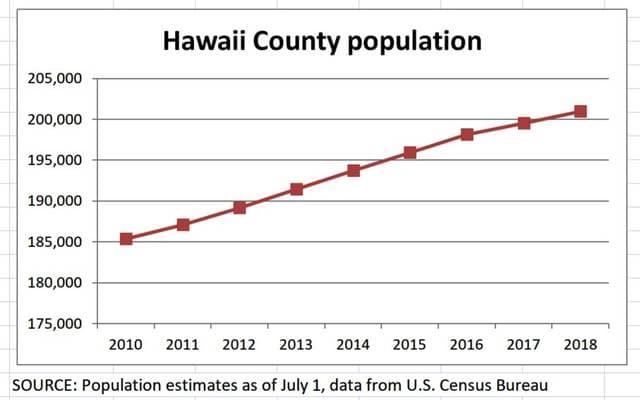
New U.S. Census Bureau Vintage 2025 population estimates reveal that Hawaii's statewide resident population came in smaller than previously projected. But Hawaiʻi County stood apart: the island's population, which stood at 200,629 in the 2020 census, continued a decades-long growth trajectory that the new data confirms at 5% between 2020 and 2025, a gain of roughly 10,000 residents.
The divergence from the neighbor islands is striking. Between July 1, 2020 and July 1, 2024, the state population declined at an average rate of 0.1% per year, with Honolulu County dropping at 0.3% per year and Maui County decreasing at 0.2% per year. Under the new Vintage 2025 estimates, those losses for Oahu and Maui deepened past the 2% mark over the full five-year period.
Statewide, the population fell to 1,432,820, a loss of 22,447 residents, or 1.5%, since the April 2020 census base. That adjustment is primarily attributed to significant downward revisions in international migration data, coupled with persistent domestic out-migration that continues to outpace the state's natural birth-to-death growth.
The University of Hawaii Economic Research Organization (UHERO) has reported that Hawaii's population losses have been concentrated on Oahu and Maui, with many residents moving to less expensive and more affordable locations. The Big Island, with its comparatively lower cost of entry, appears to be absorbing some of that intrastate movement. The median property value in Hawaiʻi County was $519,300 in 2024, well below Maui County, where the median home price has reached $1.3 million.

The growth does not come without pressure. In 2025, 24.2% of the population in Hawaiʻi County was living with severe housing problems, a figure that reflects how demand for housing has outpaced supply even as residents arrived. About 14.9% of the county's population lives below the poverty line, higher than the national average of 12.5%.
Hilo-based demographer Karl Eschbach has noted that Hawaiʻi Island, for the first time, is experiencing a natural decrease in population, meaning more residents die in a year than are born. That means the 5% net growth is being driven by in-migration rather than natural increase, a distinction with long-term implications for the county's workforce and tax base. Loss of working-age population is economically consequential: fewer working people can lead to a lower tax base, which is not replenished by retirees living on non-taxable income, meaning less revenue for social safety net programs that could be in higher demand because of an aging population.
Hawaiʻi County's 2026 population is estimated at 213,284, reflecting a 0.83% growth rate over the past year. Since 2010, the county has grown 15.06%. That longer arc of sustained growth, running counter to the statewide trend, positions the Big Island as the one place in Hawaii where the population story, for now, is still moving in one direction.
This article was produced by Prism’s automated news system from verified source data, official records, and press releases, then run through automated quality and moderation checks before publishing. The system is built and supervised by the people who set the standards it runs under. Read our full AI policy.
Did this article answer your question?