Hawaii Health Officials Urge Big Island Residents to Screen for Colon Cancer
Colon cancer kills 225 Hawaiians a year and is now the top cancer killer for adults under 50. Big Island residents can get screened close to home, even without insurance.
The drive from Pahoa to a specialist can consume most of a workday. From Ka'u, it can take longer. Add the cost of missed wages, the assumption that colon cancer is a disease of old age, and the discomfort of a test that feels optional when nothing hurts, and the logic of skipping screening starts to make a familiar kind of sense to Big Island residents. That logic, public health officials say, is quietly lethal.
Colon cancer kills approximately 225 people in Hawaii every year. Around 700 more are diagnosed annually, according to the University of Hawaii Cancer Center's Hawaii Tumor Registry. It is the third leading cause of cancer death for men in Hawaii and the fourth for women. And a recent American Cancer Society study found it has become the leading cause of cancer-related deaths among people younger than 50, a shift that upended the longstanding assumption that screenings could wait until middle age.
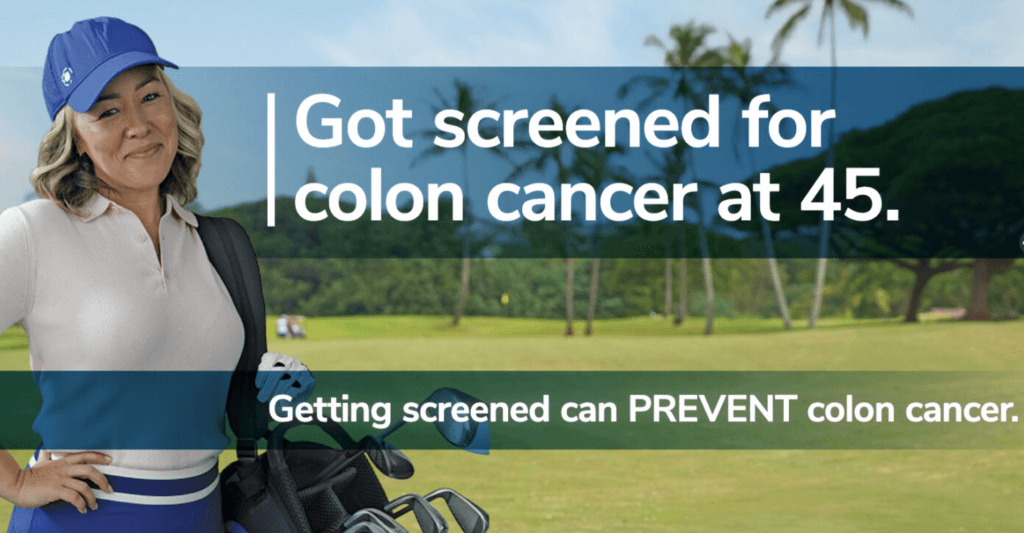
The Hawaii Department of Health launched its "Get Screened Hawaii" public service announcement campaign in March to confront those assumptions directly. The push runs through June 30 across TV, radio, print, digital, and mall advertisements statewide.
"Now is the time to catch up on cancer screenings," said Lola Irvin, administrator for the DOH Chronic Disease Prevention and Health Promotion Division. "Postponing screening visits may delay life-saving treatment."
The trend driving the campaign is especially stark among younger adults. Between 2013 and 2022, the incidence of colorectal cancers in both men and women under age 50 significantly increased at an average of 3.4 percent per year, and more individuals are being diagnosed at advanced stages. Declining rates now hold only for adults 50 and older. Dr. Timothy Swindoll, chief of gastroenterology at Hawaii Pacific Health, said the pattern has become unmistakable in clinical practice. "Most gastroenterologists have been noticing more colorectal cancer patients younger than 50," he said. "The most common symptom of colorectal cancer is no symptoms at all," Swindoll said.
Cost is the barrier most clearly documented in the data. People with coverage are more than twice as likely to be up to date with colorectal cancer screening as those without it. A bill before the Hawaii Legislature, House Bill 1969, would create a colorectal cancer public assistance program for residents who fall outside coverage.
For Big Island residents who cannot wait for a legislative fix, the most accessible first step is a FIT kit, a fecal immunochemical test done at home with no prep, no fasting, and no specialist needed. The test can be requested through a primary care provider and mailed back. A positive FIT result triggers a referral for colonoscopy.
Hawaii Island Community Health Center operates locations across the island, including Waikoloa, Kailua-Kona, Kealakehe, Kealakekua, Ka'u, Keaau, and Pahoa. As a Federally Qualified Health Center, it uses a Sliding Fee Discount scaled to income, and no patient is turned away for inability to pay. West-side residents can call (808) 326-5629; East-side residents can reach the center at (808) 333-3600. For colonoscopy services, Big Island Gastroenterology and Endoscopy Center, a Joint Commission-accredited facility, provides on-island colon cancer screening and endoscopy.
Residents without a primary care provider can dial 2-1-1 through Aloha United Way to be matched with local health services. The DOH campaign website, GetScreened.hawaii.gov, lists screening options, test types, and what to expect at each step.
AM I DUE? A QUICK CHECK
Screening is recommended for all adults ages 45 to 75 with no prior history of colorectal cancer or polyps. Start earlier if a parent or sibling had colorectal cancer or polyps, particularly before age 60. See a provider promptly, rather than waiting for a scheduled screening, if you notice persistent changes in bowel habits, blood in the stool, abdominal pain that does not resolve, or unexplained weight loss. Colon cancer caught at an early, localized stage is highly treatable; found at stage 4, options narrow sharply.
RESOURCES FOR BIG ISLAND RESIDENTS
Hawaii Island Community Health Center: Seven locations across the island in Waikoloa, Kailua-Kona, Kealakehe, Kealakekua, Ka'u, Keaau, and Pahoa. Sliding Fee Discount based on income; no one turned away for lack of insurance. West-side patients: (808) 326-5629. East-side patients: (808) 333-3600.
Big Island Gastroenterology and Endoscopy Center: Joint Commission-accredited facility providing colonoscopy and colon cancer screening on the island.
Get Screened Hawaii: GetScreened.hawaii.gov for screening options, test types, and local provider information.
No provider, no insurance: Call Aloha United Way 2-1-1 to be connected with local health resources and coverage enrollment assistance.
This article was produced by Prism’s automated news system from verified source data, official records, and press releases, then run through automated quality and moderation checks before publishing. The system is built and supervised by the people who set the standards it runs under. Read our full AI policy.
Did this article answer your question?