Hawai'i Island Farmers Turn Agritourism Into Vital Income Diversification Strategy
Hawai'i Eco Experiences founder Kea Keolanui was told in 2019 she was the state's first ag-only tour operator. Now she routes cruise ships directly to Hilo farms.

When Kea Keolanui launched Hawai'i Eco Experiences in 2019 to bring visitors onto OK Farms, her family's tropical fruit operation across from Rainbow Falls in Hilo, state regulators told her something she hadn't anticipated: she was the first tour operator in Hawai'i focused exclusively on agricultural experiences.
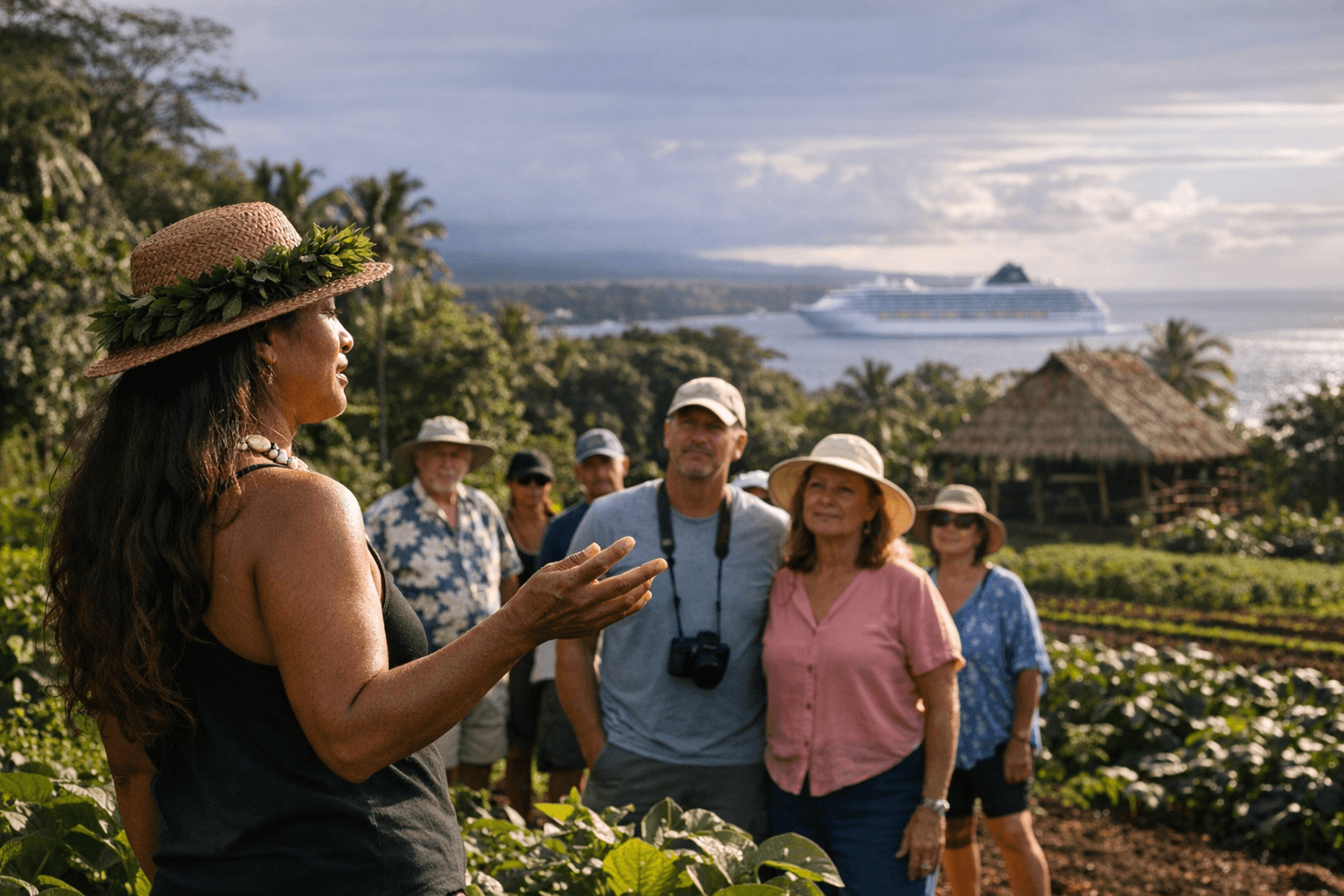
Seven years later, Keolanui holds contracts with cruise lines docking at Hilo Harbor and brings thousands of visitors annually to farms across East Hawai'i, converting what was once purely a production operation into a hospitality business that routes visitor dollars to growers in Puna and beyond. OK Farms, described as one of the largest tropical fruit producers in the United States, now doubles as a classroom where guests sample cinnamon leaves and clove buds and leave with a commercial relationship to local agriculture. Keolanui says the conversion is durable: visitors consistently return home and begin seeking out local food in their own communities, creating demand that outlasts the tour itself.
That kind of revenue diversification has become less a choice than a survival calculation for many Big Island farmers. Brandon Lee, the chef behind Lehua Restaurant at 'Imiloa Astronomy Center and Napua at Mauna Lani Resort, arrived at agritourism with resistance. Lee, who raises Berkshire pigs at his Kaunamano Farm on feed that includes roasted macadamia nuts, held the position that farmers should be able to sustain themselves through farming alone. Rising feed costs wore that position down. Agritourism became essential, not aspirational.
The economic argument is straightforward even when the execution is not. Traditional commodity farming in Hawai'i generates thin per-acre margins against fuel, feed and input costs that have continued climbing. Agritourism replaces volume with experience pricing and on-farm direct sales, shifting more revenue per interaction to the farmer. But capturing that margin consistently runs into a set of friction points that have slowed adoption across the island. Operators must navigate a regulatory framework spanning both sectors: county land use ordinances, state Department of Agriculture oversight, liability insurance, biosecurity protocols to protect crops from visitor-introduced pests, and in many cases, road access constraints and neighbor concerns about traffic on agricultural lanes.
Under Hawai'i Revised Statutes, agricultural tourism on working farms is a permitted use within the agricultural district, but county-level requirements add another layer of compliance. The rules exist for legitimate reasons, but they impose entry costs that fall hardest on smaller farms with fewer resources to absorb them, a dynamic documented in state agriculture data showing the top fifth of agritourism operators have historically captured the vast majority of sector revenue.
Janis Magin, editor-in-chief of Pacific Business News, has framed agritourism as a meaningful economic reframe for farming communities caught between rising input costs and a visitor economy historically concentrated in resort corridors. Spreading visitor spending from Kohala Coast hotels to Hilo-area farms and Puna smallholdings would distribute economic benefit while helping preserve agricultural land that faces constant development pressure.
The path to that outcome runs through policy as much as entrepreneurship. Training programs, coordinated liability frameworks, and clearer permitting guidance from Hawai'i County's planning department would lower the entry barrier for farms that lack the marketing infrastructure Keolanui has built. What operators like Keolanui and Lee have demonstrated is that the model works when executed with care. What remains unsettled is whether the regulatory scaffolding around agritourism will evolve quickly enough to let a second generation of farms follow.
This article was produced by Prism’s automated news system from verified source data, official records, and press releases, then run through automated quality and moderation checks before publishing. The system is built and supervised by the people who set the standards it runs under. Read our full AI policy.
Did this article answer your question?