HPD Adds 21 New Patrol Vehicles to Replace Units Dating to 2006
Patrol cars first deployed in 2006 are finally being retired as HPD rolls out 21 new blue-and-whites across all districts, from Hilo to Kaʻū, with no price tag yet made public.
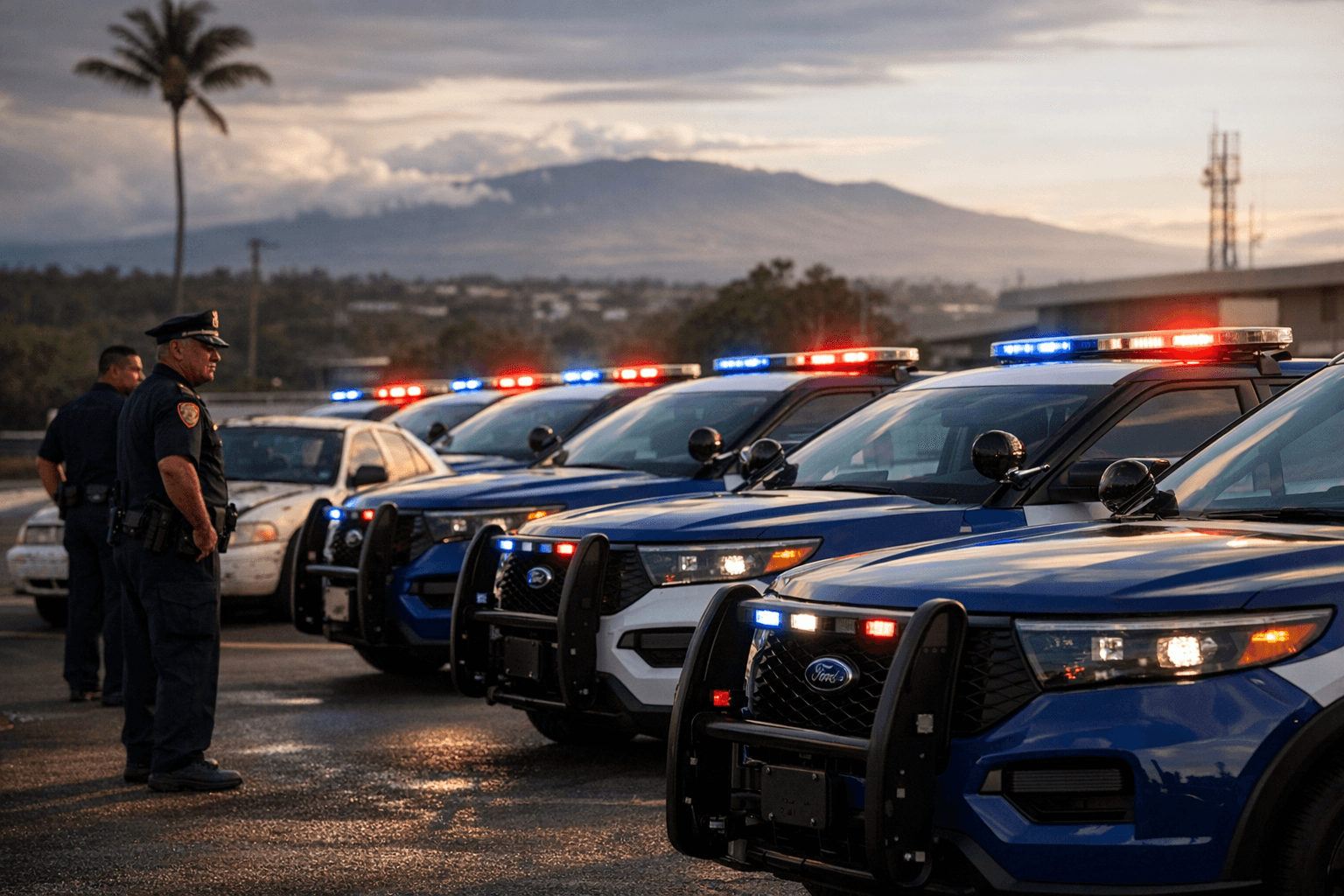
Some of the patrol cars Hawaiʻi Island officers drove through last year's islandwide warrant sweeps were already aging when the Obama administration took office. Nearly two decades is a long time for any vehicle; it is an extraordinary span for a unit absorbing the punishment of Hāmākua's rain-soaked gulches, Kaʻū's lava-track roads, and the daily grind of Hilo and Kona patrols.
The Hawaiʻi Police Department began rolling out 21 new "blue and white" vehicles in late March and early April, distributing 18 2025-model police-marked SUVs across the island's major districts and sending three 2024 full-size pickup trucks specifically to Hāmākua, North Kohala, and Kaʻū. The pickup assignments are not incidental: those three districts cover some of the county's most demanding terrain, from the cliff-backed coastline above Pololū Valley to the volcanic backcountry south of Nāʻālehu, and the ability to tow, haul, and navigate unpaved access tracks matters in ways a sedan cannot replicate.
"These new vehicles underscore our ongoing commitment to the community by equipping our officers with reliable, up-to-date equipment so they can continue to serve and protect the people of Hawaiʻi Island with greater efficiency and safety," Police Chief Reed Mahuna said in the department release.
What Mahuna's statement does not address, and what HPD has not yet disclosed publicly, are the figures that would let residents assess whether the county got value for money: the per-vehicle purchase price, the total contract value, the projected service life of the new units, and what the department spent maintaining the outgoing fleet in its final years. Agencies managing vehicle lifecycles typically plan replacements on roughly a 10-year cycle; the gap between routine upkeep on a new SUV and emergency repairs on a 2006-era unit running well past its design life can run into tens of thousands of dollars per vehicle annually. Those numbers should be public.
The performance question is equally unresolved. Hawaiʻi County covers roughly 4,028 square miles, and its patrol districts are not abstractions: a disabled cruiser in Kaʻū means a response delay measured in dozens of miles, not city blocks. HPD has not released data on fleet breakdown rates, average response times by district, or overtime tied to vehicle-related coverage gaps, and this purchase is precisely the moment to establish a measurable baseline. Without a commitment to report outcomes at one and three years post-deployment, the upgrade cannot be evaluated on any terms beyond the press release.
In Kaʻū, where the district stretches roughly 80 miles from Ka Lae to the Puna boundary, the new pickup means officers can reach remote ranch land and coastal access points that have historically required improvisation when a wheel went down far from backup. The same logic holds in North Kohala, where a mechanical failure on Kohala Mountain Road leaves a patrol unit well outside reasonable response range from any neighboring district.
The new vehicles will phase in gradually as the outgoing units are retired, so residents across the island will begin seeing the updated livery on roads over the coming weeks. Whether this purchase reduces breakdown rates, tightens response times in remote districts, and delivers a net maintenance savings over the old fleet are questions HPD is now positioned to answer, and obligated to track.
This article was produced by Prism’s automated news system from verified source data, official records, and press releases, then run through automated quality and moderation checks before publishing. The system is built and supervised by the people who set the standards it runs under. Read our full AI policy.
Did this article answer your question?