University of Hawaii seeks input on invasive fruit fly threat
Invasive fruit flies could cost Hawaii agriculture $300 million, and Big Island growers are being asked to help map where the pests are hitting hardest.
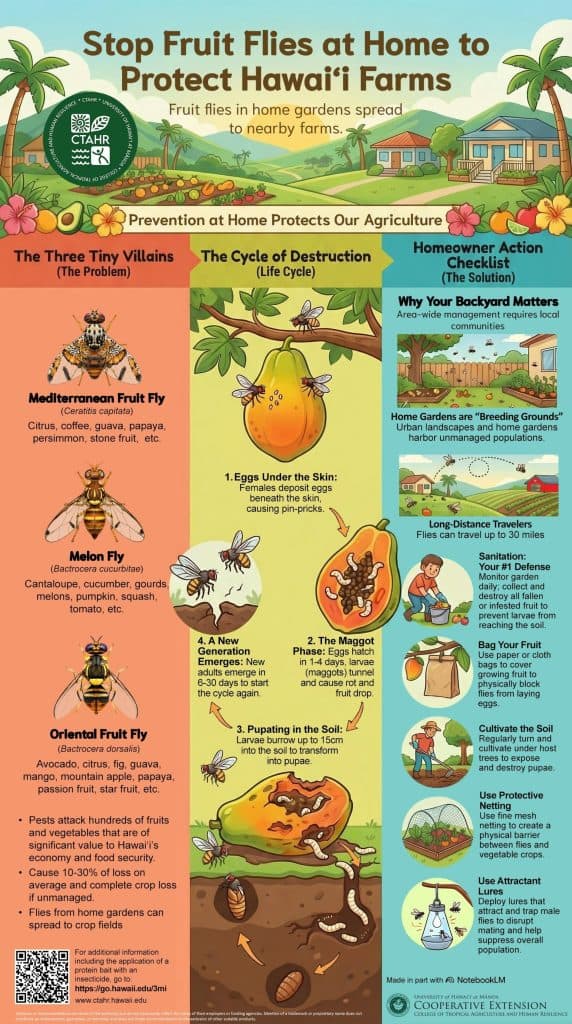
An invasive fruit fly problem that University of Hawaii researchers say could inflict about $300 million in damage on the state’s agriculture sector is now at the center of a statewide survey aimed at Big Island farmers, backyard growers and other residents.
The University of Hawaii at Mānoa College of Tropical Agriculture and Human Resilience opened the survey to anyone involved in growing or managing plants, from commercial farmers and landscapers to home gardeners. It runs through June 30 and is meant to sharpen fruit fly control efforts across Hawaii, where the pests damage more than 400 kinds of fruits and vegetables and threaten everything from orchard crops to backyard mango trees.
For Big Island readers, the stakes are not abstract. Fruit flies affect local food production in Hawaii County, where commercial growers and household gardeners often share the same pressure from invasive pests, rising input costs and dependence on imported food. Better data on where the flies are thriving could help researchers and state officials target sanitation, trapping, baiting and sterile-fly suppression in the places that need it most.
Researchers are not treating the survey as a stand-alone exercise. CTAHR has been working with growers and private-industry partners on Hawaii Island, Kauai, Maui and Oahu to monitor fly populations in real time and test trapping and baiting methods. The college is also looking toward future coordination with the Hawaii Department of Agriculture and Biosecurity, the USDA Agricultural Research Service and other stakeholders.

Pascal Aigbedion-Atalor, an assistant professor and Extension entomologist with CTAHR, has said the food-security effort depends on community voices and that researchers want hundreds of responses statewide so future outreach matches what producers actually need. That matters because officials still need a clearer picture of fruit fly pressure in local growing areas, especially as the state tries to decide where limited suppression work can do the most good.
The threat is longstanding. CTAHR says Hawaii has four established fruit fly species, melon, oriental, Mediterranean and solanaceous, and that they can occur from sea level to above 7,000 feet. Its extension publication says fruit flies have been serious pests in Hawaii since about 1895, while state testimony says the insects have no natural predators in the islands.
The economic and regulatory consequences extend beyond farm gates. The Hawaii Invasive Species Council says all four species would have to be eradicated before Hawaii could be declared fruit fly free and the federal quarantine lifted. A legislative committee report says the Department of Agriculture and Biosecurity contracted with CTAHR to restart the area-wide fruit fly suppression program using funding from Act 231, Session Laws of Hawaii 2024, underscoring that the survey is feeding into a broader state-backed push to protect local agriculture, backyard harvests and the price of produce.
This article was produced by Prism’s automated news system from verified source data, official records, and press releases, then run through automated quality and moderation checks before publishing. The system is built and supervised by the people who set the standards it runs under. Read our full AI policy.
Did this article answer your question?